Nuclear safety improvement a priority
Updated: 2012-02-22 09:50
By Liu Yiyu (China Daily)
|
|||||||||


New plan paves way for renewed expansion after Japanese disaster
BEIJING - China is seeking to improve safety at its nuclear power plants to pave the way for the industry's renewed expansion, as shown by recent statements and decisions by regulators.
|
 |
|
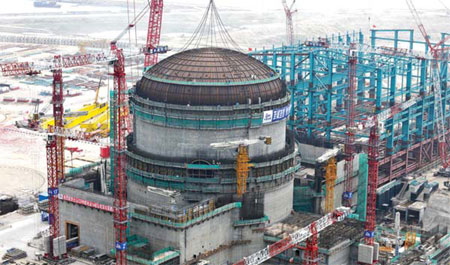
The construction site of the Taishan Nuclear Power Station in Guangdong province in October. China is seeking to improve safety at its nuclear power plants in the wake of Japan's Fukushima disaster. [Photo/China Daily] |
The National Energy Administration has embarked on a research and development plan for nuclear safety technology, following months of assessments and inspections in the wake of Japan's Fukushima disaster.
The administration said in a statement on its website that 13 R&D projects should be completed by 2013, covering such issues as operational safety and the capacity to deal with extreme disasters, including earthquakes and multiple hazards.
The move will greatly increase the safety of China's advanced second-generation technology, allowing it to meet the standards set for third-generation technology.
The statement came just days after an announcement that the NEA would expand its nuclear power division.
The agency established a separate nuclear power division on Feb 14, a sign of the importance that China attaches to the sector, experts said.
China has made great efforts to improve nuclear power safety since Japan's nuclear crisis last year.
China National Nuclear Corp, the nation's largest nuclear operator, said it was developing 25 plans to improve project safety. The first 11 plans were completed in 2011, the company said. Another 13 plans calling for waterproofing, emergency response procedures and other matters will be completed by 2013, it said.
China also strengthened its nuclear supervision system and doubled the staff in the Department of Nuclear Management in the Ministry of Environmental Protection.
Safety concerns arose again after a recent report that questioned the choice of location for the Pengze Nuclear Station in Jiangxi province, one of China's first inland nuclear projects, which is in the preliminary stages of construction.
"This is an indication of public resistance to nuclear power development," said Xiao Xinjian, industry expert at the Energy Research Institute, which is affiliated with the National Development and Reform Commission.
Following the nuclear leak in Japan after the March 11 earthquake and tsunami, the Chinese government suspended approvals for nuclear power stations. It also conducted rigorous safety checks at all nuclear projects, including those under construction. No new project was approved or started last year.
Earlier, an unidentified official with the National Nuclear Safety Administration, which is under the Ministry of Environmental Protection, told China Daily that regulators might be able to resume approving new nuclear projects during the first half of 2012.
The government might reduce the number of new reactors that can be approved each year from eight to six, industry insiders have said.
Before the Japanese quake, China had planned to increase its nuclear-generation capacity by about 10 gigawatts annually, building eight reactors each year.
Japan's former prime minister Naoto Kan acknowledged recently that the crippled Fukushima plant should not have been built so close to the ocean on a tsunami-prone coast.
The disaster disclosed even bigger man-made vulnerabilities in Japan's nuclear industry, from inadequate safety guidelines to crisis management, all of which he said need to be overhauled.
China had six new projects approved before the Japanese disaster, and construction on all of them was suspended over safety concerns. China has 11.3 gW of nuclear capacity and plans to increase that to 80 gW by 2020, exceeding an earlier target of 60 to 70 gW.
Related Stories
Japan says to review nuke power supply policy 2011-03-28 17:18
Japan: Nuclear policy must be reviewed from scratch 2011-05-11 10:31
Beijing: 'No first nuke strike' policy stays put 2011-01-07 12:58
Iran to maintain nuclear policy after replacing FM: spokesman 2010-12-14 15:55
- Overseas contract values rise
- Tianmao to push ahead with online sales of drugs
- Film agreement offers reel opportunities
- Online sales smart move for Jingdong, Mercedes
- Alibaba profit misses estimates
- Nuclear safety improvement a priority
- Xi forges stronger relationship
- China to raise health food standards