No coffee mourning over expensive drinks in Starbucks
Updated: 2012-02-09 09:07
By Gao Changxin and Wang Jingshu (China Daily)
|
|||||||||


|
A customer is absorbed in thought at Starbucks in Sanlitun, Beijing, on Tuesday. [Photo / China Daily] |
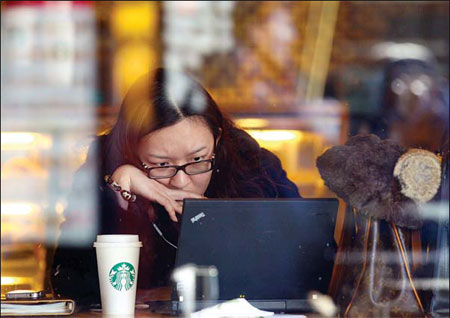
Su Nan stood inside a Starbucks on Shanghai's bustling Huaihai Road and complained about the US coffee chain's recent price hike. "It's already expensive. How am I going to live?"
But the 26-year-old still joined a long line for a latte.
The world's biggest coffee chain raised the price of some products on Jan 31, due to what it said were rising operating costs. That brought Su's 16-ounce (about half a liter) "grande" cup to 30 yuan ($4.75) from 28 yuan.
Starbucks was already an expensive choice for regular Chinese customers such as Su, who earns about 7,000 yuan a month. One cup of cappuccino a day for a year would cost her 10,950 yuan - about one-eighth of her income.
Still, Su is better off than many others. China's per capita GDP last year was $5,184. It was $48,147 in the US.
Despite a huge gap in personal income, Starbucks has priced its products almost the same in China as in the US, if not higher, since it entered the Chinese market in 1999.
It also raised prices recently in the US Northeast and Sunbelt, by an average of about 1 percent. In New York, a 12-ounce latte now sells for $2.85 and plain brewed coffee was $1.65. The price of a 16-ounce, "grande" cup of coffee is unchanged at $2.20 plus 20 cents in local tax.
But Chinese consumers, who traditionally drink tea and have little taste for coffee, seem not to mind paying a relatively higher price. They have become one of the engines of growth for Starbucks.
The company has become so popular in China that it opened its 500th store in October, in Beijing, and plans to triple the number by 2015. Globally, Starbucks had 17,003 stores in 58 countries as of Oct 2.
In China, it's expanding not just in the big and rich areas but also in so-called second-tier cities, where consumers have much less disposable income. In December, Starbucks announced it had entered five more Chinese cities, including Langfang in Hebei province, which can hardly be rated as second-tier. Annual per-capita GDP is just above $3,000.
Positioning move
Operating costs in China are much lower than in the US. So why do Starbucks and other American companies price their food and beverages higher in China? Two professors from Long Island University in New York offer explanations.
"From the marketing perspective, the price-setting reflects how the brand positions itself in the market," said T. Steven Chang, chair and professor of marketing and international business. "Therefore, cost is not the only factor considered by the company.
"Starbucks actually is selling their whole package, including the symbol of good taste and prestige, the Westernized atmosphere they created in each retail store, and high-quality coffee and food."
Thomas C. Webster, a professor of public administration and public economics, said, "Usually prices are set based on the conditions of the specific market. In the case of China, the market is probably not saturated with competitors, so if people want designer coffee - which many regard as a status symbol - they are willing to pay the higher price.
"If Starbucks starts making large profits," Webster said, "then you will see other competitors enter the market and that will drive the price down."
'Not just coffee'
|
One Starbucks patron describes herself as a "heavy coffee user" although she drinks just one 16-ounce cup a day. The price doesn't really matter to her or most Chinese customers.?[Photo / China Daily] |

"The Starbucks brand continues to resonate with the Chinese consumer," John Culver, president of Starbucks China and Asia Pacific, said in an article on Starbucks' website. The Chinese market has become so important that he rates it as "our second home market outside of the United States".
Zou Deqiang, a professor studying consumer behavior at Fudan University, believes Chinese consumers are willing to pay "unreasonable" prices for a nontraditional beverage because they are buying more than just coffee.
"In China, Starbucks is not just coffee anymore," he said. "It represents a Western lifestyle. Some people in China want to live like people live in the developed countries so, to some extent, drinking a cup of coffee that people in the US drink helps them fulfill that dream."
A lot of people can't really tell good coffee from bad, Zou said, but that doesn't keep them out of Starbucks. If they hold paper cups with the Starbucks logo, it gives them the illusion that they live better than those who don't drink Starbucks.
The foreign allure
|
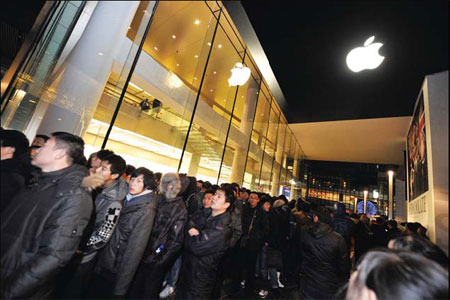
The iPhone 4S introduction in China last month filled the plaza outside Apple's store in Sanlitun, Beijing. Many buyers were working for scalpers, and Apple moved the smartphone's sale to the Web.?[Photo / China Daily] |
Zou's comment sheds some light on some Chinese consumers' obsession for foreign brands, most notably Apple's iPhone and iPad.
The craze was illustrated by the failed introduction of the Apple iPhone 4S in Beijing in January. Apple didn't open its flagship store and a frustrated crowd, which had waited all night, threw eggs at the store's gleaming glass walls. Many in the crowd were migrant workers hired by scalpers, who wanted to take advantage of demand that far exceeds supply. Apple shifted sales online to prevent scalping.
A student in Henan province went to the extreme. Local media reported in June that he sold his kidney for about 20,000 yuan and used the money to buy an iPad and an iPhone.
The starting price of an Apple iPhone 4S is 4,988 yuan ($790) in China and $649 in the US, where average personal income is about eight times higher. The price hasn't deterred Chinese consumers, even though they have easy access to domestic smartphones that cost about half but have similar functions and looks.
Why does 16-year-old Huang Junyi like iPhone in particular? "Because it's cool.
"Everybody wants an iPhone in our class. There is no reason for it," the Shanghai student said. "It will be big news if anybody in class gets an iPhone 4S, and you will be mocked if you use some copycat domestic smartphone."
'Badge of wealth'
Wang Haizhong, a professor studying brand strategy at Sun Yat-Sen University in Guangzhou, said the iPhone does have some advantages over other mobile phones but the advantages are not what Chinese consumers really want.
"It's mostly about vanity. Products like iPhone are seen as a badge of wealth and sophistication by young consumers in China. In fact, it's not just iPhone. Many Chinese consumers have a blind preference for brands in the US and other developed countries," he said.
Chinese consumers, he said, are highly brand-sensitive but price-insensitive, the opposite of consumers in developed countries. That explains why US consumers like cheap but high-quality Chinese products and Chinese consumers love US products.
Fudan University's Zou went deeper, saying that while consumers worldwide all tend to spend on vanity, the will is stronger in China, where "power distance" is longer.
Chinese people have a strong respect for power historically, he said, and it's hard for people to get power in society even if they are rich. So a lot of people turn to consuming to feel important and feel the dignity that is hard to obtain in daily life.
"For some consumers, no matter how their lives really are, they feel they are having a good time the moment they hold up a Starbucks coffee or show the latest version of iPhone to their friends," Zou said.
"In other words, they hope to go up a step in the social spectrum by consuming."
Free-market choice
Some scholars, including Qiu Baochang, head of the lawyers' group of the China Consumers' Association, feel that Chinese consumers should be educated to spend more rationally so no more students will want to sell their organs to buy anything. Campaigns, they believe, are urgently needed on campuses to help students understand the real value of money and what they really need.
But Zou disagreed. "There is no right or wrong about how people spend their money, as long as it's legal. In a free market, people have the right to buy what they like, no matter how irrational the choice is."
Write to gaochangxin@chinadaily.com.cn
Related Stories
Chinese consumers brace for Starbucks price hike 2012-02-01 15:58
Sun, sea, sand ... and Starbucks 2011-10-10 11:02
Starbucks raises coffee prices in China 2012-01-31 17:06
Starbucks to triple outlets in China by '15 2011-09-07 14:54
Price hikes brewing for Starbucks drinkers 2012-02-01 07:52
- No coffee mourning over expensive drinks in Starbucks
- Euro debt crisis 'creates opportunities'
- Maserati to recall 222 autos in mainland
- Beijing office rents not yet to rival NY
- China's auto exports hit record high in 2011
- China raises asoline and diesel prices
- China's stocks surge over 2% Wednesday
- Poly home sales slump 69% in Jan