UK retailers paying in yuan
Updated: 2012-01-13 09:08
By Cecily Liu and Zhang Chunyan (China Daily)
|
|||||||||


|
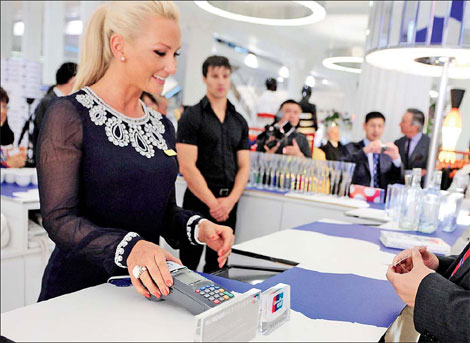
A shop assistant accepts a China UnionPay bank card at a Selfridges' store in London. Many British retailers choose to pay their Chinese suppliers in yuan. [Photo/Xinhua] |
Move can cut costs for buyers and protect suppliers from fluctuations
LONDON - A growing number of British retailers are paying their Chinese suppliers in yuan.
"Businesses have been talking about the possibility of paying in local currency since the yuan's peg was relaxed in June 2010," Sam Ford, head of Risk Solutions at Barclays Capital, told China Daily in an exclusive interview.
But it is only in recent weeks that the talk has turned into trades for Barclays' clients, Ford added.
According to Barclays Capital, the investment banking division of Barclays PLC, more British retailers are paying in yuan to achieve cost savings of up to 8 percent.
With the yuan having appreciated at least 7 percent against the dollar since June 2010, Chinese suppliers commonly embed a "buffer" into dollar-denominated contracts to guard against further yuan appreciation.
"There was a growing number of companies switching to yuan for trade settlements in the third quarter of 2011, showing that businesses are now more comfortable with this payment method," Michael Vrontamitis, regional head of product management of Northeast Asia at Standard Chartered Bank PLC, noted.
It makes more sense for businesses that have subsidiaries in China to carry out yuan-denominated cross-border trade transactions, particularly if they have two-way trade flows, so they can net off their transactions and significantly cut their foreign-exchange costs, Vrontamitis added.
This is especially so for the garment industry, which typically signs contracts six to eight months ahead of product delivery, during which time exchange rates can change dramatically.
With currency risks eliminated for Chinese suppliers, they would be more willing to give UK customers better deals.
Even marginal profit gains achieved in this way could prove life-saving for some UK clothing retailers. The industry experienced its largest year-on-year fall in sales last autumn since August 2009, according to a British Retail Consortium report.
"Many clothing and footwear retailers have to introduce discounts to clear stocks because mild weather this winter means people are not buying large and expensive items like coats and boots. At the same time, low confidence and falling disposable incomes are putting people off non-essential spending," said Richard Dodd of the consortium.
Another factor cutting UK businesses' profit margins is the rising cost of imports from China, reflecting inflation in the nation.
Paying suppliers in yuan would give British retailers a wider base of Chinese suppliers, and they could pick the most cost-effective ones.
During British Prime Minister David Cameron's visit to China in 2010, the two countries agreed to increase bilateral trade by 2015 to $100 billion.
Yuan settlements "allow businesses to trade with companies in China that have concerns about accepting exchange risk, or finding that in order to mitigate that risk, they could not offer a competitive price", said Ford.
Fashion retailer H&M is considering yuan payments. The company buys one-third of its products from China, its most important source.
Nils Vinge, head of investor relations at the Sweden-based retailer H&M Hennes & Mauritz AB, said: "At present, H&M pays all its Asian suppliers in US dollars. The deregulation of the yuan creates opportunities for us to pay our Chinese suppliers directly in their local currency. We are now investigating this opportunity."
Related Stories
British official to talk trade in China 2005-02-21 09:08
Royal wedding, warm weather boost UK retail sales 2011-05-19 16:57
British "stiff upper lip" a thing of the past 2010-03-26 08:52
- UK retailers paying in yuan
- 'Hot travel period' for New Year
- PBOC to further interest rates marketization
- Revenues of China's customs duties top 1.6t yuan
- West area tops illegal land deals
- Inflation drop may see shift in policy
- China to retrieve more natural gas
- CSR allowed to raise $1.4b on stock market