Organic food gaining popularity
Updated: 2011-12-12 10:11
By Tang Zhihao (China Daily)
|
|||||||||||


SHANGHAI - The organic food business is experiencing rapid growth in China as a consequence of increasing concern over food safety. However, people have expressed fears over how genuine the goods are.
|
 |
|
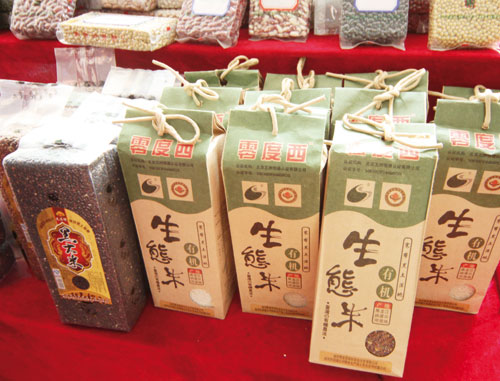
Organic rice and other organic cereals on sale at a shopping mall in Beijing. An increasing number of Chinese customers now understand the intrinsic value of organic food. Although it is good to have more choice, it is hard to identify whether food is truly organic, according to some Chinese food experts.[Photo/China Daily] |
"The Chinese are paying more attention to food quality and safety, especially after several scandals and problems were exposed. Customers who can understand the intrinsic value of organic food and want to enjoy a better life will shop in our stores," said Yang Ming, assistant general manager of Lohao City.
Lohao is one of a number of organic food growers and retailers with stores and outlets across China. It said its sales revenue increased by about 30 percent over last year and the growth rate is expected to be maintained for the next few years. It will open a directly managed store in Shanghai before March 2012.
Compared with ordinary food, organic selections are more expensive, often costing more than three times more. For instance, a cabbage weighing 1.3 kilograms is sold for 35 yuan at Yimutian organic farm in the Chongming district of Shanghai. The price of an ordinary cabbage is about 5 yuan in an ordinary Shanghai market.
Nevertheless, people who can afford organic are migrating to it in increasing numbers. Yang said more than 80 percent of customers will revisit Lohao City to buy organic food. Some residents in Shanghai are renting land on organic farms to grow vegetables and fruit for family members, according to media reports.
Eyeing the tremendous business opportunities in the market, companies have rushed into the organic food sector in search of bigger profits. Media reports suggest that some 345 companies obtained certification from the China Organic Food Certification Center (COFCC) in 2010, an increase of about 18 percent on 2009.
Cities such as Beijing and Shanghai, where people are said to have a better educational background and more disposable income, have been targeted by organic food suppliers. Currently, it is easy for householders to find food labeled organic in stores, supermarkets and online shops in big cities.
Although it is good to have more choice, it is hard to identify whether food is truly organic. The Wal-Mart organic pork scandal in Chongqing, in Southwest China's Sichuan province, knocked people's confidence over organic food sold in the country.
"We do not know what happened with Wal-Mart, but I will definitely think carefully before buying organic food in China. I do not want to pay a higher price for nothing," said Wang Rui, a Shanghai resident. "We can find many foods labeled as organic in the market but we really cannot tell whether they are truly organic. Sometimes they taste the same."
According to Chinese media reports, organic food labels and certificates are easily available.
"There is no anti-counterfeiting technique used in producing organic food labels and rules for using organic food labels are not strictly applied, which makes consumers lack confidence when buying organic food," said Liang Mingxuan, an analyst with CIC Industry Research Center.
Experts said retailers and suppliers should strengthen self-discipline so as to build credibility among competitors.
To establish trust, retailers said they have spared no effort in protecting customers' rights to maintain their patronage.
"We apply very strict rules in selecting organic food suppliers. They should provide several certifications including certificates issued by an authorized certification center and name the place of origin. We will visit the farm to inspect the complete process from growing to delivery to ensure they are qualified organic food suppliers," said a department manager surnamed Li from the operations department of online organic food retailer Yihaodian.
A report from COFCC said sales revenue generated from the organic food sector amounted to about 10.5 billion yuan in 2007 and market demand will continue to rise as disposable incomes of Chinese householders continue to increase.
Related Stories
Organic food, a way out 2011-10-19 11:47
Pesticides bring a silent spring 2011-10-19 07:54
Beijing farmers market 2011-09-28 11:11
Organic food a growing biz for the health-aware 2011-06-27 10:51
Discovering a taste for upmarket food 2011-06-13 13:22
- European gloom causes credit squeeze
- Reforms to target income tax system
- Surveys reveal sharp global slowdown
- Luxury brands eye record numbers
- Fiscal revenues rise 10.6% in Nov
- Dongfeng to triple own-brand vehicle sales
- Organic food gaining popularity
- A wealthier China shapes global luxury landscape