Loss of legitimacy








The failure of Western rules in the face of the rise of the Global South is driving a profound restructuring of the global order
The global order is undergoing an irreversible restructuring. The post-Cold War framework, long underwritten by Western powers and their "rules-based" system, faces a deepening crisis of legitimacy. This transformation is driven by the rise of the Global South — a diverse constellation of nations asserting economic weight, political autonomy and alternative visions for governance. The watershed moment came in late 2024, when the United Nations General Assembly overwhelmingly passed a resolution demanding a ceasefire in Gaza despite the United States' opposition, exposing the growing divergence between Western priorities and the collective will of the Global South.
There are three internal contradictions hollowing out the Western-led order: a debilitating credibility deficit, a fatal paradox between interdependence and attempted dominance, and an anachronistic ideological framework misaligned with a multipolar reality.
The foundational pillar of any rules-based order is credibility. For the Western alliance, this is rapidly eroding under a systemic "say-do" gap. Grandiose declarations at G7 and NATO summits repeatedly dissolve into fragmented, uncoordinated national policies, revealing strategic incoherence that Global South partners view with skepticism.
Climate governance exemplifies this failure. For over a decade, developed nations have pledged $100 billion annually in climate finance for developing countries — a target consistently missed. By 2020, only $83.3 billion had been mobilized, with much of it arriving as loans rather than grants, deepening the debt burden of climate-vulnerable nations. While the 2024 United Nations Climate Change Conference established a new target of $300 billion annually by 2035, this remains a fraction of the estimated $1.3 trillion needed. This persistent failure has become a symbol of solidarity divorced from fiscal reality, eroding the trust necessary for collective action.
Even in AI governance, where the West could demonstrate cohesive leadership, fragmentation prevails. The G7's 2023 Hiroshima AI Process produced voluntary guidelines, but now, a fractured regulatory landscape has emerged. The European Union implemented its stringent AI Act, while the US and the United Kingdom pursued flexible, industry-led approaches, and Japan emphasized innovation-friendly models. This divergence reflects fundamentally different philosophies on risk and innovation, undermining claims to global leadership and creating a vacuum that Global South actors are filling.
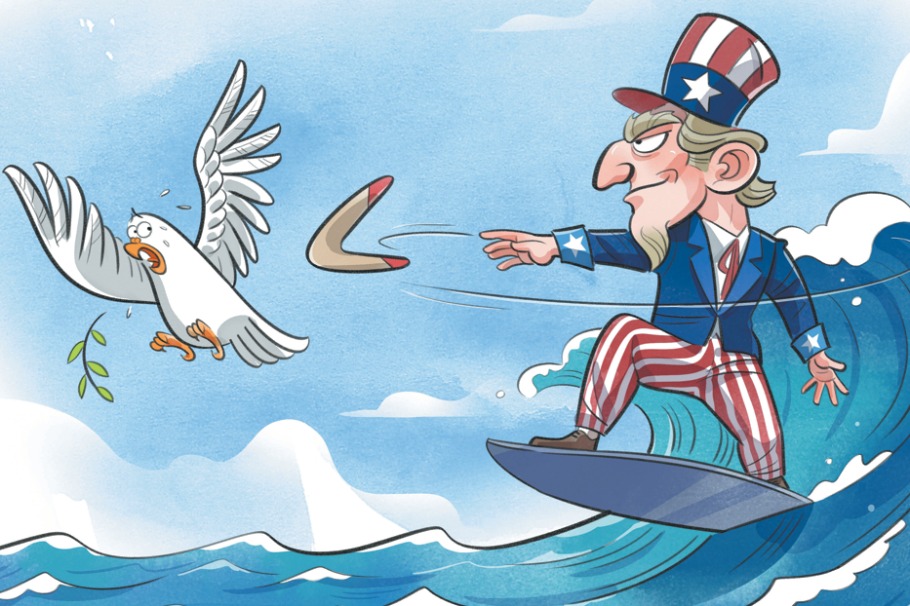
The Western order faces a deeper structural contradiction: economies increasingly reliant on the Global South simultaneously attempt to dominate global rule-making. Unable to decouple without triggering systemic disruption, Western powers have intensified efforts to weaponize international rules to constrain rising powers, producing an unsustainable imbalance.
In 2023, China alone represented 10.4 percent of G7 trade. The broader Global South serves as vital markets and indispensable sources of critical minerals, energy and manufacturing capacity. Rather than severing ties, the West's strategy has shifted to control. In global trade, this manifests in their World Trade Organization reform proposals centered on "market-oriented conditions", which are designed to challenge state-led development models that are common across the Global South. In response, nations such as those in Africa advocate preserving "policy space for industrial development", reflecting a direct clash over commerce rules.
This weaponization is most pronounced in finance. The International Monetary Fund and the World Bank governance structures grant veto power to the US and its allies, marginalizing Global South voices and attaching stringent policy conditionalities to loans. This dynamic catalyzed alternative institutions such as the BRICS New Development Bank, which funds sustainable infrastructure without politically charged conditions — representing a direct structural challenge to the Western financial hegemony.
In technology, the US and its allies have implemented sweeping export controls on advanced semiconductors, combined with "friend-shoring" strategies to confine Global South nations to lower-value supply chain roles. This form of technological containment is prompting counter-mobilization, with affected nations accelerating efforts toward self-reliance and indigenous innovation.
The ultimate weaponization tool — economic sanctions, such as those against Russia — has backfired spectacularly. Freezing Russia's central bank assets sent shockwaves through the system, accelerating global de-dollarization discussions. This has fueled interest in bilateral trade using local currencies, alternative payment systems and greater roles for non-Western financial hubs, hastening the emergence of a decentralized, multipolar financial landscape.
The most fatal flaw in the Western approach is ideological: a rigid and false "democracy versus authoritarianism" framework that misreads Global South priorities, which are shaped not by ideological alignments but by pragmatic pursuit of development, strategic autonomy and post-colonial insistence on sovereign equality.
The West's narrative assumes nations will naturally align within this ideological contest. This consistently fails because it overlooks historical sensitivities and offers no solutions to pressing challenges: poverty alleviation, debt relief, climate adaptation and technology access. Expecting democratic nations such as India, Brazil and South Africa to automatically join Western coalitions has proved to be a strategic miscalculation. These countries prize strategic autonomy and refuse to be conscripted into bloc politics which they view as neocolonial imposition.
Most Global South countries operate with pragmatic, polycentric multilateralism. Their primary goal is development and their primary principle is sovereign equality. Their foreign policy seeks to maximize benefits through diversified partnerships, not choosing sides. This stance is institutionalized in the expanded BRICS and Shanghai Cooperation Organization forums.
This ideological dissonance creates constant clashes. Western countries prioritize security alliances and liberal-democratic values, while the Global South emphasizes climate finance, technology transfer and institutional reform. In AI governance, Western discussions focus on "risk-based" frameworks to prevent misuse, while Global South priorities center on bridging the digital divide and ensuring equitable access. The result is parallel governance tracks, from the African Union's AI strategy to BRICS collaborative frameworks — a direct response to exclusionary Western framing.
The Western-led order is deteriorating from within, hollowed out by its contradictions: unmet commitments, structural tension between interdependence and control, and ideological rigidity misaligned with the multipolar reality. Its authority is waning.
In its place, the Global South presents an alternative vision: multipolarity, developmentalism and inclusive multilateralism. The expanded BRICS grouping and institutions such as the New Development Bank offering condition-free financing are tangible building blocks of parallel architecture gaining traction. Yet the Global South is not monolithic, and faces its own coordination challenges.
The immediate future will feature "competitive coexistence" — a fragmented governance landscape with competing norms and institutions vying for influence. The central question is whether the West will adapt by relinquishing its hegemonic posture and embracing genuine equality, or cling to diminishing primacy, risking systemic instability. The rise of the Global South is irreversible. The path toward a more equitably reordered world or a dangerously disordered one depends on whether the established powers can transcend their zero-sum thinking and forge a fairer, more representative and sustainable global order. The old rules can no longer rely on the luxury of time.

The author is a professor at the Institute of West-Asian and African Studies at the Chinese Academy of Social Sciences. The author contributed this article to China Watch, a think tank powered by China Daily.
The views do not necessarily reflect those of China Daily.
Contact the editor at editor@chinawatch.cn.