



From overseas expansion to higher-quality integration
Experts say future growth will depend on enabling 'Made in China' to evolve into 'Brands from China' that find niche in local economies, societies worldwide







Chinese companies are shifting from a traditional overseas expansion model built on exporting products and chasing scale, toward one defined by deep localization, digital integration and service differentiation, moving beyond merely "going out" to truly "going in", said analysts and business leaders.
The strategic evolution coincides with a steady rise in China's outbound direct investment. According to the Ministry of Commerce, in the first 11 months of 2025, China's total outbound direct investment rose 6.9 percent year-on-year to $158.21 billion. Non-financial outbound direct investment reached $132.09 billion, spanning 153 countries and regions.
Beyond the headline figures, they say the profound change lies not in where Chinese firms invest, but in how they operate abroad.
Roland Berger, a global consulting firm, describes this transition as a move toward "high-quality globalization". In its latest flagship annual report, the consultancy noted that the era of relying primarily on capacity exports and cost advantages is giving way to a phase that demands stronger operational depth, governance capability and local integration.
For consumer-facing sectors, experience accumulated in China's highly competitive domestic market is increasingly becoming an advantage overseas — particularly in digital execution and user engagement.
Trip.com Group, China's largest online travel agency, has made service differentiation a core pillar when it expands internationally. The company operates 24-hour, human-staffed customer service globally, covering 35 languages with more than 20,000 agents — a scale rarely seen in the global travel industry.
"When that level of service goes overseas and local customers experience it, user stickiness is naturally higher," said Qin Jing, vice-president at Trip.com Group, at a forum hosted by China News Service in December. She added that China-based companies now have a clear advantage in service execution, which has become "basic infrastructure" at home, but remains uneven globally.
Success often hinges on granular localization. In Japan, Qin said, travelers frequently filter hotels based on whether they offer smart toilets — a feature used by about 90 percent of Japanese users searching on the platform.
"When other platforms didn't build these differentiated labels and products, we did," Qin said, adding that the company's overseas business has posted triple-digit annual growth rates in recent years as a result.
Beyond service, Chinese brands are leveraging digital technology to embed themselves into the daily lives of overseas consumers.
Ashley Wu, senior director of business development of The Trade Desk in China, a global advertising technology firm, said the challenge is no longer simply gaining exposure, but embedding brands into overseas consumers' daily media environments.
"The key change we see in Chinese brands is not just 'going out', but 'going in' — truly entering overseas consumers' everyday language and cultural context," Wu said. That requires coordination between data, technology and content, rather than reliance on single platforms, she added.
She cited the strategy of Govee, a Chinese smart home brand, which used programmatic advertising across connected TV and other digital formats in the United States. By controlling exposure frequency and targeting younger demographics, Govee saw purchase intent increase 3.5 percent, with conversion rates significantly outperforming social media advertising alone.
Despite such successes, challenges in brand recognition persist. Beijing Ultrapower Software, a major mobile game developer, derives more than 90 percent of its mobile game revenue from overseas markets including the United States, Japan and South Korea. Yet, Zhang Kaiyan, the company's secretary of the board and chief brand officer, admits there is a gap between product popularity and brand awareness.
"Our competitiveness still lies mainly in product strength, not brand recognition," Zhang said."A US player may not know who made the game, or even which country it comes from — they stay simply because the product is good."
Zhang noted that Chinese developers often expand as individual players rather than as part of an integrated industry ecosystem, limiting their collective branding power.
For industrial and cultural enterprises, localization is increasingly defined by risk control and cultural management.
Zhang Wei, CEO of CNAUTO, an automotive industry platform under Beijing United Information Technology, said overseas expansion in traditional sectors such as automotive equipment and chemicals requires tight control over logistics and compliance before marketing or sales can scale.
"In our industry, safety and risk control come first. Otherwise, everything is just on paper, and all the risk sits with you," Zhang said. He advocated for digital, flexible supply chains and vertically specialized warehouses to ensure compliance, particularly in markets with complex regulatory environments.
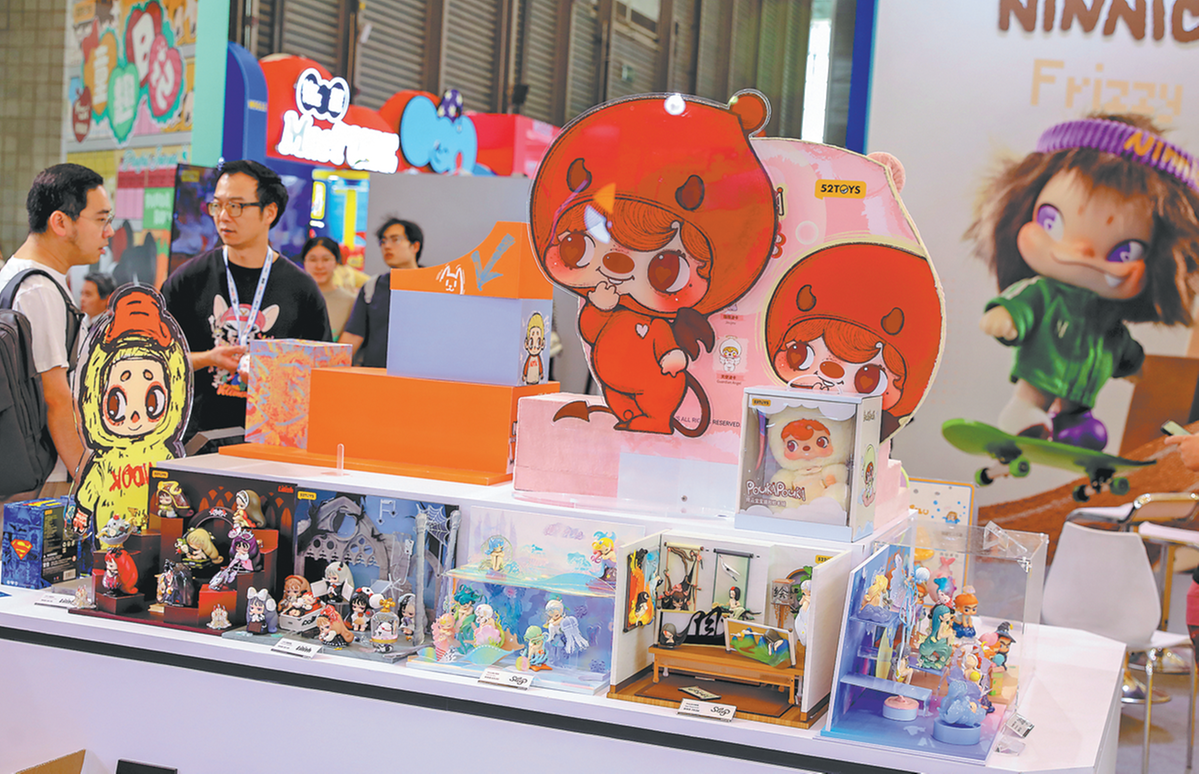
Cultural integration is also emerging as a decisive factor for consumer and creative industries. Jin Xun, vice-president of the International Division at 52TOYS, a Beijing-based pop-culture toy company, said the key is an inclusive corporate culture.
"Cultural conflicts are often less about religion or language than about work habits and communication styles," said Jin, whose company now operates in more than 30 countries. "A lot of things aren't managed into existence — they are built together through respect."
As Chinese companies deepen their global presence, compliance pressures are also becoming more complex, said Zhou Mi, a senior researcher at the Chinese Academy of International Trade and Economic Cooperation.
"On the one hand, companies must comply with long-established international norms, such as respecting local cultures, protecting the environment and fulfilling corporate social responsibility,"Zhou said. "On the other hand, they are facing new and rapidly evolving requirements, including green trade barriers, cross-border data rules, foreign investment reviews and country-specific restrictions."
Chinese companies, he said, must not only understand existing global rules and adjust their behavior accordingly, but also develop the capacity to respond effectively to new regulatory demands — a challenge that is becoming increasingly significant.
Looking ahead, Zhou said Chinese companies should not be subjected to differential treatment simply because of their country of origin, but as long-term contributors to global development.
"Chinese companies have a cultural DNA of working hard, creating value, using resources efficiently and continuously innovating," he said. "That should not be a reason for special treatment, but a basis for deeper cooperation."
Roland Berger said 2026 represents a critical juncture rather than a starting or ending point for Chinese companies' global expansion. Entire industries, it said, are shifting from large-scale overseas expansion toward higher-quality global integration.
Executives and analysts agreed that future growth will depend on combining product strength with brand resilience, enabling "Made in China" to evolve into "Brands from China" that are genuinely embedded in local economies and societies worldwide.





Today's Top News
- Xi stresses sci-tech self-reliance in building modern socialist country
- Takaichi's election 'victory' calls for vigilance: China Daily editorial
- Jimmy Lai verdict shows Hong Kong's rule of law tolerates no foreign meddling
- Xi visits IT innovation park in Beijing
- Jimmy Lai sentenced to 20 years in prison
- Jimmy Lai sentenced to 20 years in prison







