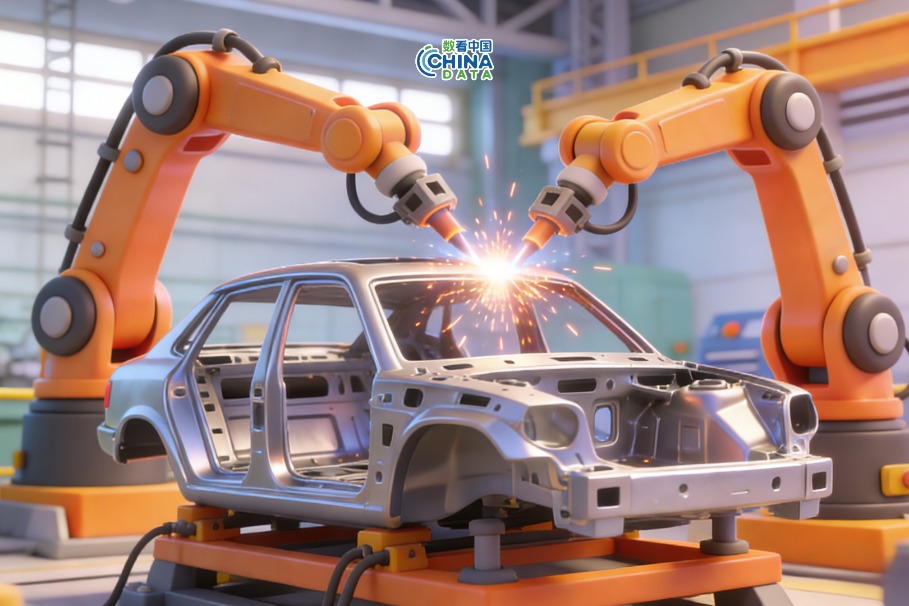
Automotive industry in China holds No 1 spot
National equipment renewals and consumer goods trade-ins help unlock potential demand








China's automobile industry set records in both production and sales in 2025, maintaining its top position globally for the 17th consecutive year, according to the China Association of Automobile Manufacturers.
New energy vehicles and exports were the standout drivers, while analysts expect growth to moderate in 2026 as policy support is fine-tuned and external uncertainties persist.
Automobile production reached 34.53 million units in 2025 and sales totaled 34.4 million units, up 10.4 percent and 9.4 percent year-on-year respectively, data released by the CAAM on Wednesday showed. Additionally, annual output has remained above 30 million units for three years.
The stronger-than-expected performance was attributed to policy support and faster product upgrades. Chen Shihua, deputy secretary-general of the CAAM, said the national program promoting large-scale equipment renewals and consumer good trade-ins helped unlock replacement demand, while automakers accelerated new model launches.
NEVs remained the main growth engine. Their production rose to 16.63 million units in 2025 and sales reached 16.49 million units, up 29 percent and 28 percent year-on-year respectively, CAAM data showed. NEVs accounted for 47.9 percent of total vehicle sales for the year, up 7 percentage points from a year earlier.
In the domestic market, NEVs strengthened their position, making up 50.8 percent of vehicle sales in 2025. The share was 54 percent for passenger cars and 26.5 percent for commercial vehicles, reflecting faster electrification in logistics, buses and other fleet uses.
Monthly figures showed a softer year-end after a strong annual run. In December, total vehicle production was 3.3 million units and sales were 3.27 million units, down 2.1 percent and 6.2 percent year-on-year respectively.
In December, NEV production reached 1.72 million units and sales totaled 1.71 million units, up 12.3 percent and 7.2 percent year-on-year. Battery electric vehicles remained the largest segment, with 1.11 million units sold in December, while plug-in hybrids recorded 599,000 sales. In the domestic market, NEVs accounted for 56 percent of December sales.
Exports provided another key source of growth. China exported 7.09 million vehicles in 2025, up 21.1 percent year-on-year, and exports in December rose to 753,000 units. NEV exports doubled to 2.62 million units in 2025, while exports of conventional fuel vehicles stood at 4.48 million units, down 2 percent.
Moreover, exports saw faster growth in plug-in hybrids, alongside solid gains in battery EVs. Battery EV exports reached 1.65 million units in 2025, up 66.7 percent year-on-year. Plug-in hybrid exports surged to 969,000 units, up 2.3 times. In December, NEV exports were 300,000 units, including 173,000 battery EVs and 127,000 plug-in hybrids, both posting triple-digit growth.
Leading automakers expanded their overseas presence. CAAM data show Chery Automobile exported 1.34 million vehicles in 2025, the highest among Chinese automakers, followed by BYD with 1.05 million. Analysts said more companies are investing in overseas sales networks, after-sales service and localized operations as competition and compliance requirements rise in key markets.
Passenger vehicle production reached 30.27 million units in 2025 and sales totaled 30.1 million units, up 10.2 percent and 9.2 percent year-on-year. Commercial vehicle sales rose 10.9 percent to 4.3 million units, while production reached 4.26 million units.
In addition, Chinese brands continued to gain market share in the passenger car segment. Sales of Chinese-brand passenger vehicles reached 20.94 million units in 2025, up 16.5 percent year-on-year, and their market share climbed to 69.5 percent, CAAM data showed. Conventional fuel vehicles remained under pressure in the domestic market, with their sales falling 4 percent year-on-year to 13.43 million units.
Foreign brands saw weaker deliveries in 2025 as competition intensified and the market shifted faster toward electrified models.
Honda China said its 2025 sales totaled 645,345 vehicles, down 24.28 percent year-on-year; its December sales fell to 66,765 units, down more than 40 percent. FAW-Volkswagen reported 1,587,065 vehicle deliveries in 2025, including imported vehicles, down 4.34 percent from 2024.
Looking ahead, the CAAM expects the market to remain broadly stable in 2026, but to grow at a slower pace. Total vehicle sales are forecast at 34.75 million units, up 1 percent year-on-year. NEV sales are projected to rise to 19 million units, up 15.2 percent, while exports are expected to reach 7.4 million units, up 4.3 percent.
The CAAM said continued policy support and efforts to improve industry governance are expected to help keep the sector on an even keel, but it cautioned that growth may cool as the boost from stimulus measures fades and underlying demand remains subdued.
Other factors include external uncertainties that could weigh on exports and adjustments to preferential purchase-tax treatment for NEVs through a half-rate levy and tighter technical requirements.
It added that stricter oversight of near new used-vehicle exports could add to short-term inventory pressure.
Cui Dongshu, secretary-general of the China Passenger Car Association, said the 2026 trade-in program started earlier than before. It is anticipated to help stabilize consumption expectations, even as subsidies are scaled back in tiers, and support a solid start for January sales.
Analysts also said the direction is clear; electrification is now the core driver of China's auto market and exports are playing a bigger role in sustaining scale and supporting longer-term growth.
wangyuchen@chinadaily.com.cn