Experts: Regulations on AI smartphones needed to protect consumers







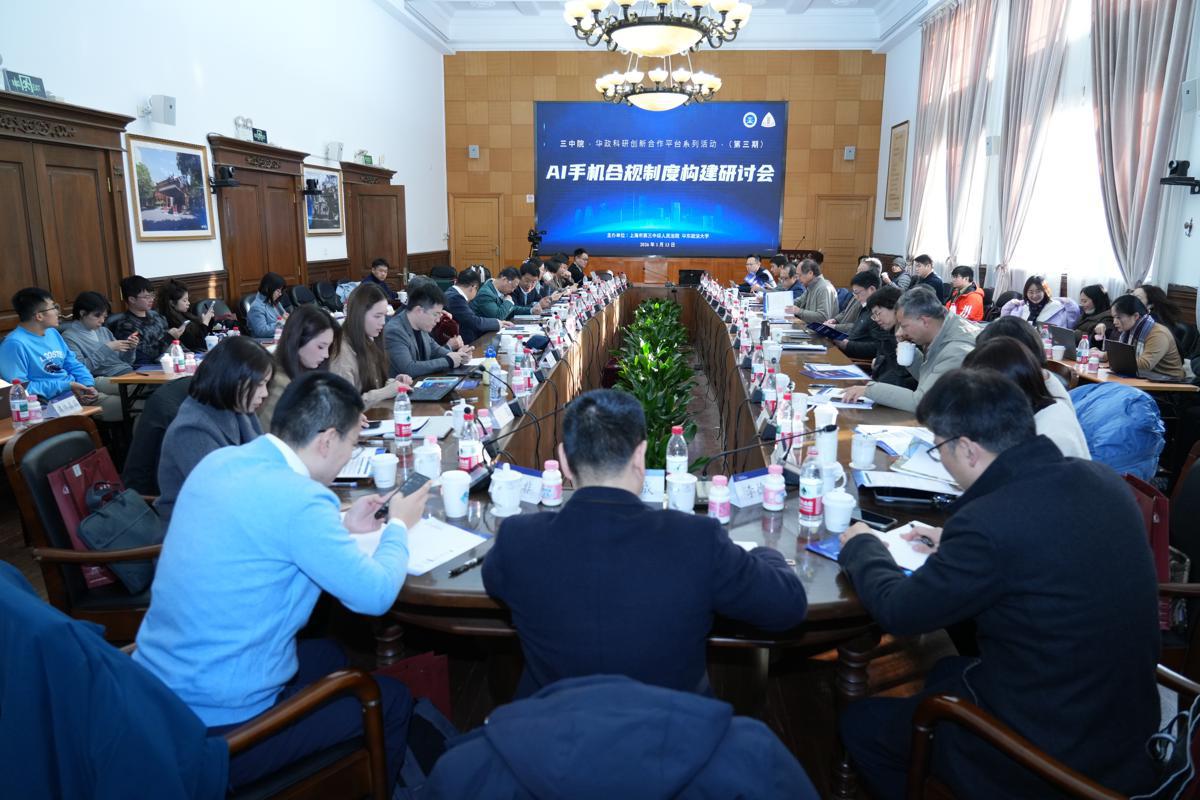
The establishment of a compliance framework for artificial intelligent smartphones in the AI era is urgently needed, industry experts said.
They made the remarks at a conference held in the East China University of Political Science and Law on Tuesday.
Li Mingde, a scholar at the Chinese Academy of Social Sciences and director of the Academic Committee of the Intellectual Property Law Society of the China Law Society, said that balancing the encouragement of technological innovation with the prevention of unfair market competition has become a crucial issue for current legal systems, compliance frameworks, and liability structures.
Han Qiang, deputy Party secretary of East China University of Political Science and Law, noted that these issues extend beyond mere technical concerns, evolving into comprehensive topics that intertwine technological logic, legal systems, and ethical norms. This underscores the urgency of establishing a compliance framework for AI smartphones.
Shan Xiaoguang, a professor at Tongji University, acknowledged that AI smartphone topics are cutting-edge and complex, presenting both challenges and research value.
Gao Fuping, dean and professor at the Internet Law Institute at East China University of Political Science and Law, noted that the continuous sensing, cross-device data reading, and intelligent inference mechanisms underpinning AI smartphones are profoundly challenging the personal information protection regime built on the principle of "informed consent". Traditional compliance frameworks centered on purpose limitation and data minimization face adaptation challenges when confronted with AI's high-frequency, multi-layered, and reuse-oriented data processing patterns.
In response to the issues identified during AI smartphone development, experts appealed to construct a compliance framework.
Key proposed measures include: defining clear compliance boundaries to ensure AI agent permissions are controllable and traceable; ensuring informed consent is substantively implemented, truly guaranteeing users' ability to "refuse, revoke, and delete"; maintaining complete logs of AI agent processes to record key operations; and promoting collaborative governance involving judicial, administrative regulatory, and industry self-regulatory bodies to form a dynamic adjustment mechanism.
Given the inherent lag and potential knowledge limitations in administrative and judicial oversight, the seminar also explored the possibility of establishing an independent supervisory body.
Chen Jinchuan, an arbitrator at the World Intellectual Property Organization, suggested that regulatory legislation should not be finalized prematurely, allowing room for market competition to adjust.
Guo He, a professor at the Law School of Renmin University of China, proposed that ensuring users' substantive informed consent regarding AI functions is central to compliance. Vague notifications should be avoided, and users should be empowered to make autonomous choices at critical junctures.
"In addressing the issues," Liu Junhua, vice-president of the Shanghai Intellectual Property Court, said during his closing remarks, "we must comprehensively examine the potential impacts of this new wave of technological revolution while responding calmly, identifying the real problems, and determining the appropriate timing and methods for legal intervention."






- Experts: Regulations on AI smartphones needed to protect consumers
- Cold wave expected to sweep across China
- Xi calls for advancing building of China-Canada new strategic partnership
- China, Canada should be partners, Xi tells Carney
- Xi receives credentials of new ambassadors to China
- South Korean visitor praises Ningxia's spicy street food