Space schedule opens with two launches







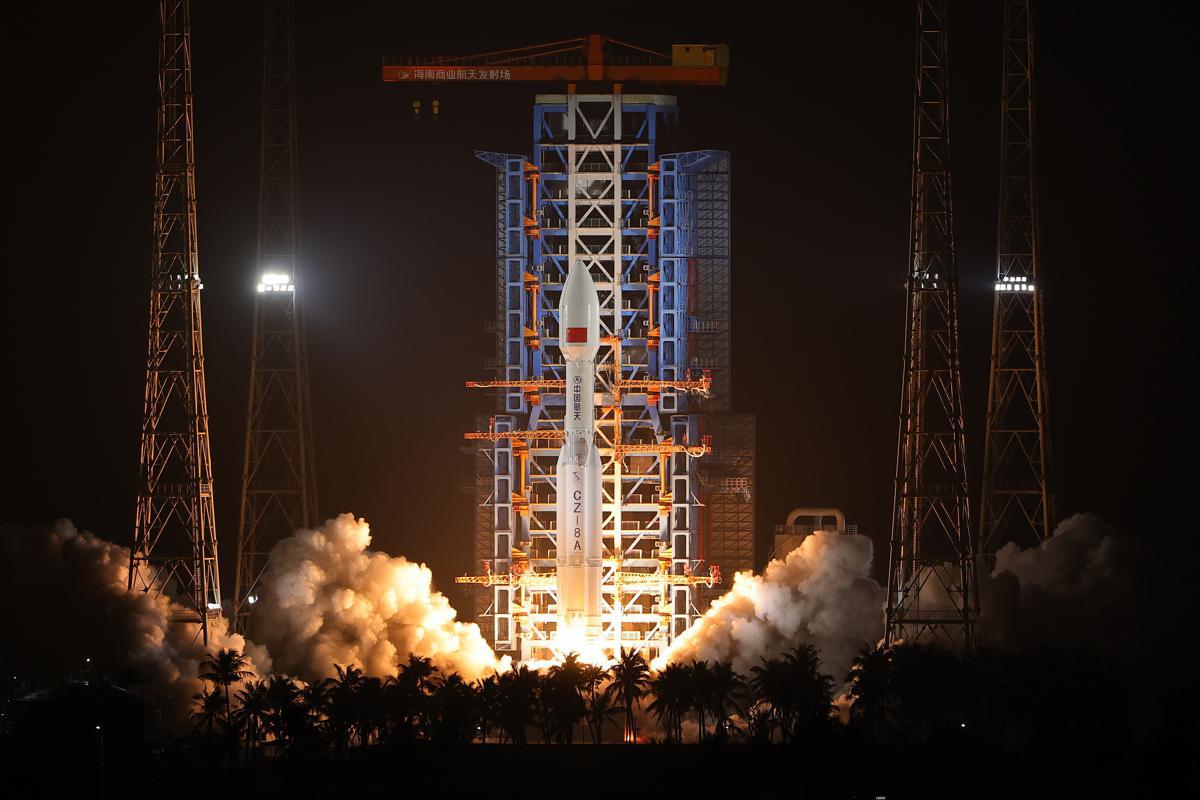
China launched two carrier rockets on Tuesday, signaling the start of the country's annual space mission schedule, which will feature a robotic lunar landing and two manned spaceflights.
At 10:16 pm, a Long March 6A rocket blasted off from the Taiyuan Satellite Launch Center in Shanxi province, and it soon placed the Yaogan 50A remote-sensing satellite into a preset orbit.
The satellite, built by the Shanghai Academy of Spaceflight Technology, is tasked with obtaining data to support land resource surveys, agricultural yield forecasts, and disaster prevention and mitigation.
Data obtained by the Yaogan family, the major series of remote-sensing spacecraft in China, has been widely used by governments, public service sectors and businesses.
The Long March 6A, which was also developed by the Shanghai academy, is a medium-lift launch vehicle. It comprises a 50-meter liquid-propelled core booster and four solid-fuel side boosters. The rocket has a liftoff weight of 530 metric tons and is tasked with transporting satellites to multiple types of orbits, including sun-synchronous, low-Earth and intermediate circular ones.
The launch marked China's first space mission in 2026 and the 624th flight of the Long March rocket fleet.
At 11:25 pm, a Long March 8A carrier rocket lifted off from the Hainan International Commercial Aerospace Launch Center, a coastal spaceport in Hainan province, deploying the 18th group of low-orbit satellites for China's State-owned satellite internet network.
These satellites were designed and developed by the China Academy of Space Technology. With their deployment, the State-run mega internet satellite network now has more than 140 satellites operating in low orbits.
The Long March 8A model, developed by the China Academy of Launch Vehicle Technology, is 50.5 meters tall, and it has a core booster and two side boosters. The carrier rocket has a liftoff weight of 371 tons and a liftoff thrust of about 480 tons.
It is mainly tasked with placing satellites in sun-synchronous orbits, and is capable of transporting payloads weighing up to 7 tons to a typical sun-synchronous orbit at an altitude of 700 kilometers.
This was the seventh time a Long March 8A rocket deployed low-orbit internet satellites.
Last year, China conducted 93 space missions, setting a new national record for orbital launches in a single year.
Observers said that 2026 will also be a busy year for China's space industry, with several launches scheduled before the end of January.
The Chang'e 7, a key mission in the fourth phase of the country's lunar exploration project, is scheduled for launch this year.
According to the China National Space Administration, the robotic probe is designed to land on the moon's south pole, and it will survey the surface environment, search for ice and volatile components in lunar soil, and carry out high-precision detection and analysis of lunar terrain, its composition and structure.
Program planners said the Chang'e 7 spacecraft will consist of an orbiter, a lander, a rover and a small flying probe capable of reaching lunar pits to search for ice.
This year, two manned missions — the Shenzhou XXIII and the Shenzhou XXIV — are also expected to take place to make crew shifts aboard the Tiangong space station.
One of the three Shenzhou XXIII crew members will stay a whole year aboard the space station, attempting the longest orbital journey by any Chinese astronaut.
Industry insiders said it is highly likely that a Pakistani astronaut will participate in a flight to Tiangong this year, and will become the first foreign national aboard the Chinese space station.





- Space schedule opens with two launches
- Winter cherry blossoms create unexpected spectacles
- Chongqing park becomes stage for captivating natural phenomenon
- Chongqing's cat theme park draws visitors, aids rescues
- Winter fishing season brings fresh catches at Hunan's Liuye Lake
- Former Guizhou official gets 11-year sentence for bribery