Lai's arms spending sending Taiwan to edge
Public funds paid to US weapon makers better spent on social services







Editor's note: The Taiwan question is a key focus for China and the international community. China Daily is publishing a series of reports to track hot Taiwan-related topics and address disinformation from the Democratic Progressive Party administration.
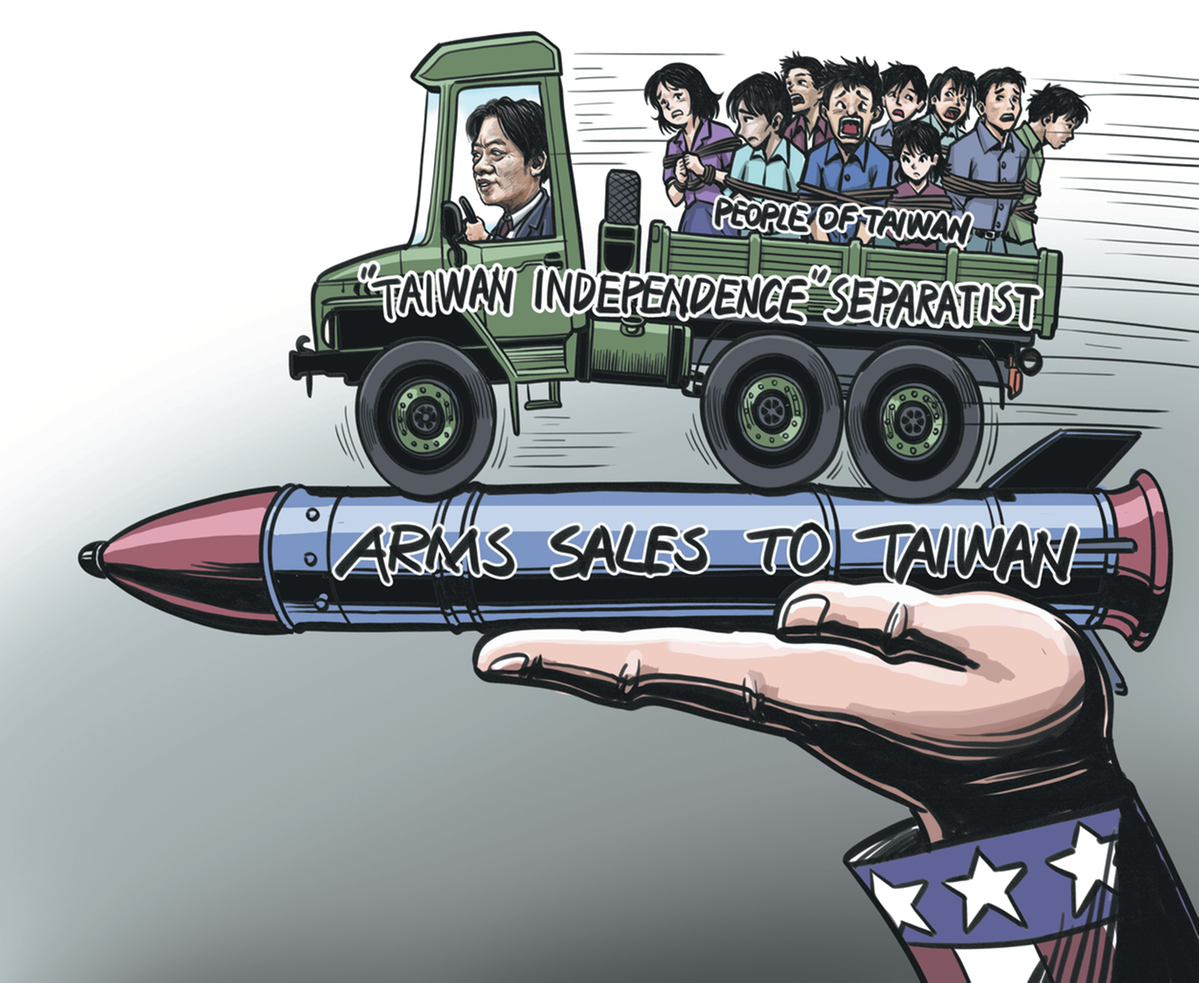
The sharp increase in "defense" spending proposed by Taiwan's leader Lai Ching-te is reshaping the island's economy and society, and pushing cross-Strait relations into a vicious cycle, according to analysts.
From raising the annual "defense" budget to more than 3 percent of GDP and proposing a special $40 billion "defense" fund, to purchasing an $11.1 billion arms package from the United States, the Lai authorities have steadily expanded spending in so-called defense capabilities.
While these measures may appear, so far, as mere figures on paper, experts said their real impact on Taiwan could be far-reaching, spanning a distorted public spending structure, intensified political confrontation and growing social anxiety, some of which are already emerging.
According to Taiwan's general budget draft released in August last year, a record NT$949.5 billion ($30 billion) was allocated to "defense" this year, accounting for about 31 percent of total government spending.
With a year-on-year increase of NT$302.5 billion, "defense" expenditure is expected to reach 3.32 percent of the island's GDP. Under the so-called NATO model adopted by the Lai authorities, the growth rate of military spending has outpaced overall economic growth.
In addition, Lai proposed a special "defense" budget of $40 billion to be distributed over eight years in an article published in The Washington Post. The fund, Lai said, is designated for US arms purchases and the development of the so-called T-Dome air defense system.
While the general budget remains pending, the special fund has been blocked multiple times by Taiwan's legislature since it was approved by the executive branch in November, with the most recent setback on Tuesday.
Experts said that Lai's long-touted "determination" to strengthen "defense" capabilities, when translated into concrete financial commitments through a NATO-level budget and supplementary spending, could reduce fiscal flexibility and produce spillover effects across society.
Zhu Guilan, an assistant professor at Tsinghua University's Institute of Taiwan Studies, said that keeping military spending at around 3 percent of GDP already consumes a sizable share of public resources, inevitably crowding out expenditures in other areas such as social welfare and education.
Media analyses showed that financial allocations on the island for education, science and culture, as well as economic development, are expected to decline this year.
Such a high level of military spending could generate sustained fiscal pressure, particularly when demand for public funds would surge during emergencies such as economic downturns or natural disasters, Zhu said.
She added that with pension obligations and personnel costs already highly rigid, multi-year arms procurement programs would further erode the government's policy flexibility.
Based on current GDP levels, Lai's stated goal of raising "defense" spending to more than 5 percent of GDP by 2030 would require an additional NT$400 billion annually. The total amount is nearly equivalent to the combined budgets for social welfare and education.
Chang Li-chi, a Taiwan scholar at Huaqiao University in Xiamen, Fujian province, said, "The Democratic Progressive Party authorities' move to increase 'defense' spending is sacrificing the majority's interests for their own sake."
Real intention
Cheng Li-wun, chairwoman of the Chinese Kuomintang, pointed out that the DPP has raised "defense" spending beyond the mandated debt ceiling, criticizing Lai for failing to report the move to the public and the legislature, and for bypassing professional deliberation.
Although Lai made the decision without consulting opposition parties or the public, it is fully consistent with his repeated pledge to demonstrate Taiwan's "defense commitment", experts noted.
Several senior officials in the US have said that Taiwan should increase its "defense" spending to 10 percent of its GDP.
On Dec 17, the US Defense Security Cooperation Agency announced eight arms sale packages to Taiwan worth $11.1 billion, including rocket artillery systems, anti-tank missiles, self-propelled howitzers and a tactical mission network. The deal, the largest-ever arms sale between the US and Taiwan since 1979, following another arms sale in November, drew strong condemnation from the Chinese mainland.
Under Donald Trump's second term, Washington has approved a total of $11.48 billion in arms sales to the island.
However, statistics showed that as of October last year, $21.5 billion worth of previously approved US arms sales to Taiwan had yet to be delivered. Media reports indicated that delivery of the newly approved weapons could take years due to US production constraints.
Fu Zhengnan, a researcher at the People's Liberation Army's Academy of Military Science, said that the High Mobility Artillery Rocket System, included in the arms sale package to Taiwan, is constrained by the island's geography and remains vulnerable to attacks.
"Beyond enhancing so-called combat capabilities, more importantly, these purchases are meant to signal to the US administration and Congress that Taiwan is 'sharing the security burden' and is a 'reliable partner'," Zhu said.
Scholar Chang described the purchase as paying "protection fees" to Washington, saying that the DPP is dragging the Taiwan people "onto the war chariot".
Spread across the island's population of 23 million, last year's arms purchases from the US amounted to roughly $500 per person.
The opportunity cost of "defense" spending should not be overlooked, Zhu said, pointing out that every additional dollar allocated to the military meant a corresponding reduction in funds available for employment-intensive sectors with stronger long-term growth potential, such as education, elderly care, scientific research and energy transition.
While Lai has been hyping up "security threats" to justify these moves, KMT chairwoman Cheng said that it is the DPP's misguided cross-Strait policies that lie at the root of Taiwan's escalating military risks.
She emphasized that lasting peace across the Taiwan Strait can only be maintained by adhering to the one-China principle and the 1992 Consensus.
Chen Binhua, spokesman for the State Council Taiwan Affairs Office, condemned the DPP for selling out Taiwan and pandering to the US without limits. "The Lai authorities are sacrificing economic development and public welfare through separatist activities," he said.
The mainland has repeatedly warned that the DPP's provocative "independence" moves, including colluding with foreign forces and militarizing the island, are undermining cross-Strait relations and the stability in the Taiwan Strait. Lai has been labeled a "peace disruptor", "crisis creator" and "war instigator".
Emerging split society
Although 2026 has already begun, Taiwan's general budget for the year has yet to be reviewed due to ongoing disputes between the DPP and opposition parties, which hold a majority in the legislature.
The KMT and the Taiwan People's Party have argued that the DPP has failed to compile budgets to increase military pay and pensions for retired police officers and firefighters that were approved by the opposition last year.
The KMT has criticized the Lai authorities for prioritizing payments to arms dealers over the welfare of service members, questioning how such an approach could be called strengthening "defense".
The reallocation of funds to accommodate rising "defense" spending has widened political rifts and deepened divisions in public priorities and perceptions, said Zhu from the Institute of Taiwan Studies.
The budget impasse has also prevented the government from disbursing public funds, a situation observers said could harm both the economy and public welfare.
Zhu added that high military spending, coupled with constant threat-oriented rhetoric, can fuel anxiety and anti-war sentiment on the island, which may undermine consumer confidence and private investment.
"The DPP's misguided policies are taking a toll on Taiwan's economy and discouraging investment," Taiwan scholar Chang said.
Zhu added, "The public tends to associate the buildup of weapons with a more dangerous environment, which fosters security anxiety instead of a sense of safety."
Alongside increased military spending, the DPP authorities have also organized drills and issued a so-called civil defense handbook on the island, urging residents to prepare for potential conflicts.
Recent polls have shown that over 50 percent of Taiwan people believe a war could break out within five years, while over 60 percent say they do not want themselves or family members to participate in combat.
"When security threats are repeatedly emphasized, conflict can shift from a remote possibility to a constant presence looming over society," Zhu said. "As society becomes accustomed to operating under persistent tension and anxiety, social trust and public rationality may be quietly eroded."
According to statistics from the budget center of Taiwan's legislature, between 2021 and 2024, more than 52,000 volunteer soldiers were recruited, but 12,884 left before completing the minimum service requirement.
Despite a record-high "defense" budget, the total number of volunteer officers and soldiers in Taiwan is projected to fall to 153,965 this year, which is 6,784 fewer than last year and 12,770 fewer than in 2024.
Spokesman Chen said more people in Taiwan have come to realize that the Lai authorities' stubborn separatist stance will only bring instability and conflict to the island, and that tolerating or supporting it would put themselves and their families at risk of becoming "cannon fodder".
lishangyi@chinadaily.com.cn