Enduring logic of openness drives ties with Ireland







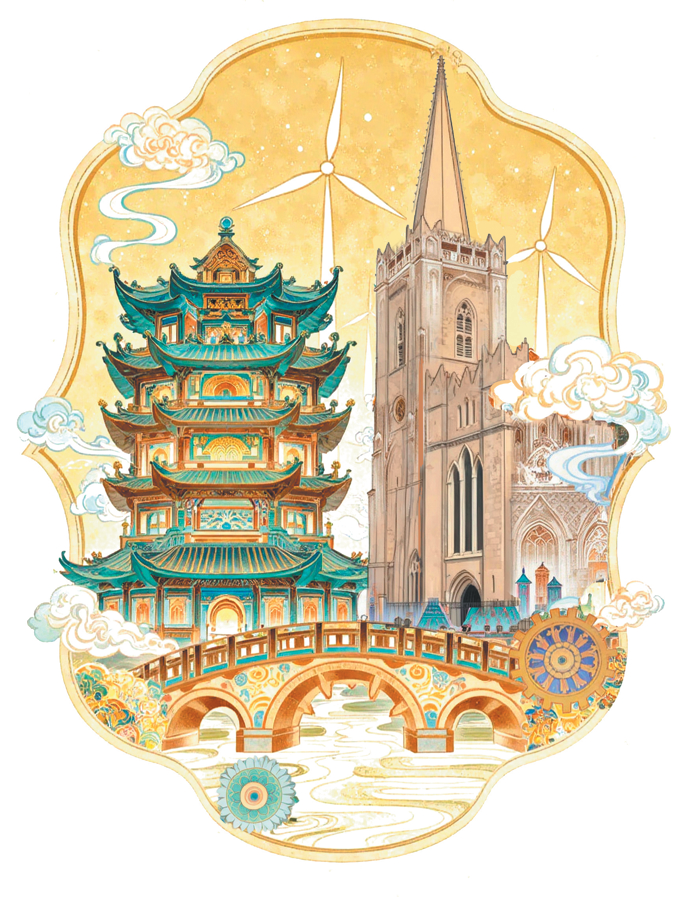
Irish Taoiseach, or Prime Minister, Micheál Martin's call for "open trade" during talks with Chinese President Xi Jinping on Jan 5 comes at a pivotal moment for China-Europe economic relations. Against a backdrop of global economic fragmentation, supply chain reconfiguration and ongoing trade frictions between China and the European Union, Ireland's renewed engagement with China carries significance that goes beyond bilateral diplomacy.
It highlights the enduring logic of openness, the depth of China-Ireland economic complementarity and Ireland's potential to stabilize China-EU economic ties. China offers Ireland scale: access to vast markets, advanced manufacturing ecosystems and capital that can amplify Irish innovation beyond Europe. Ireland offers China trust: a stable EU gateway with strong rule of law, regulatory credibility and deep expertise in tech, pharma and finance. China gains insight into European standards and consumer norms through Ireland's globalized economy. Ireland gains diversification, reducing reliance on the US while staying innovation-led. It's a complementary relationship where scale meets credibility, and ambition meets precision.
China is Ireland's largest trading partner in Asia and its fifth-largest globally. According to Irish government data and Eurostat, bilateral trade in goods and services has expanded steadily over the past decade, despite pandemic disruptions and geopolitical uncertainty. Ireland's exports to China are characterized by high value-added sectors: pharmaceuticals, medical devices, computer services, financial services and agri-food products. These exports align closely with China's evolving consumption structure and its transition toward higher-quality growth.
China exports machinery, electronics, consumer goods and intermediate inputs to Ireland, supporting the country's manufacturing base and its role as a European hub for multinational value chains. This two-way trade structure reflects not competition, but complementarity, a valuable feature in today's global economy.
Total China-Ireland trade reached $23.42 billion in 2024, yet the trade relationship remains structurally underutilized, with cooperation concentrated in a few sectors and significant untapped potential in services, the green economy and two-way investment. With both economies highly complementary and committed to open trade, deeper and more diversified cooperation could unlock new growth drivers. As Martin noted during his meeting with Xi, Ireland is willing to deepen cooperation with China in key sectors, including trade, investment, science and technology, biomedicine, renewable energy, artificial intelligence and education.
China's market scale remains unmatched. With a population of over 1.4 billion and a middle-income group of more than 400 million people, demand for health care, premium food products, education services and green technologies continues to expand. Irish companies, particularly small and medium-sized enterprises with strong innovation capabilities, stand to benefit from this enormous demand.
The pharmaceutical and medical technology sectors illustrate this potential clearly. Ireland is one of the world's largest exporters of pharmaceuticals, hosting major global producers and a dense ecosystem of research and manufacturing. China is accelerating health care reform, expanding insurance coverage and encouraging innovation in biopharmaceuticals. Cooperation in clinical research, contract manufacturing and regulatory alignment could unlock significant value for both sides. Over the past two decades, China's health care spending has also expanded rapidly, underlining sustained market potential.
Investment flows are another pillar of bilateral ties. Chinese investment in Ireland has increased steadily, particularly in information technology, financial services and renewable energy. Ireland's open investment regime, transparent regulation and access to the EU single market make it an attractive destination for Chinese firms seeking long-term European presence. At the same time, Irish firms can leverage China's advanced manufacturing clusters, logistics infrastructure and digital platforms to scale production and reach Asian markets.
For Chinese companies, Ireland offers three strategic advantages. First, it provides stable and predictable access to the EU market of more than 440 million consumers. Second, Ireland's position as a global hub for multinational headquarters, particularly in technology and life sciences, creates opportunities for partnerships, mergers and acquisitions and participation in global value chains. Third, Ireland's strong education system and research institutions support collaboration in innovation-intensive sectors.
Green economy cooperation deserves particular attention. Ireland has set ambitious targets for renewable energy and carbon reduction, while China leads globally in renewable energy equipment manufacturing, electric vehicles and battery technology. Joint projects in offshore wind, smart grids and energy storage could combine Chinese scale and cost advantages with Ireland's regulatory experience and integration into EU energy markets. According to the International Energy Agency, clean energy investment will be a key driver of global growth over the next decade, making this an area of shared strategic interest.
For Irish companies, China is a market of depth rather than short-term volatility. The agri-food sector is a case in point. Although trade frictions, including recent tariff discussions on EU dairy products, have created uncertainty, China's long-term demand for safe, high-quality food imports continues to grow, driven by urbanization and rising incomes. Ireland's reputation for food safety, traceability and sustainability aligns closely with consumer preferences in China. Education and talent exchange also represent long-term investments. Ireland's universities and higher education institutions have built extensive partnerships with Chinese counterparts, supporting joint research, student mobility and innovation collaboration.
As Ireland prepares to assume the rotating presidency of the EU Council in the second half of this year, its emphasis on open trade and multilateralism acquires broader significance. Ireland is one of the EU's most trade-dependent economies, with total trade exceeding the GDP by a wide margin. Its policy instinct is therefore aligned with stability, dialogue and rule-based cooperation rather than decoupling.
China's message during Martin's visit that deeper China-Ireland ties can add momentum to China-EU relations should be understood in this context. Ireland will not substitute for EU-level engagement, but it can play a constructive role by advocating pragmatic dialogue, resisting zero-sum thinking and highlighting the costs of fragmentation to European competitiveness.
According to the International Monetary Fund, increased trade barriers could reduce the global GDP by several percentage points over the medium term. For export-oriented economies such as Ireland, and for manufacturing and innovation-driven economies such as China, the economic logic of cooperation remains compelling.
The China-Ireland relationship demonstrates that openness is not an abstract principle but a practical strategy grounded in mutual benefit. At a time when global economic governance faces strain, such partnerships send an important signal: openness, dialogue and cooperation remain viable and necessary.
The author is a Bangladeshi independent researcher, freelance columnist, and strategic and security affairs analyst.
The views don't necessarily reflect those of China Daily.
If you have a specific expertise, or would like to share your thought about our stories, then send us your writings at opinion@chinadaily.com.cn, and comment@chinadaily.com.cn.