Fare enough: profits help fuel robotaxis
Revenue streams and cost controls contribute to spread of autonomous public transport sector across China and some foreign countries







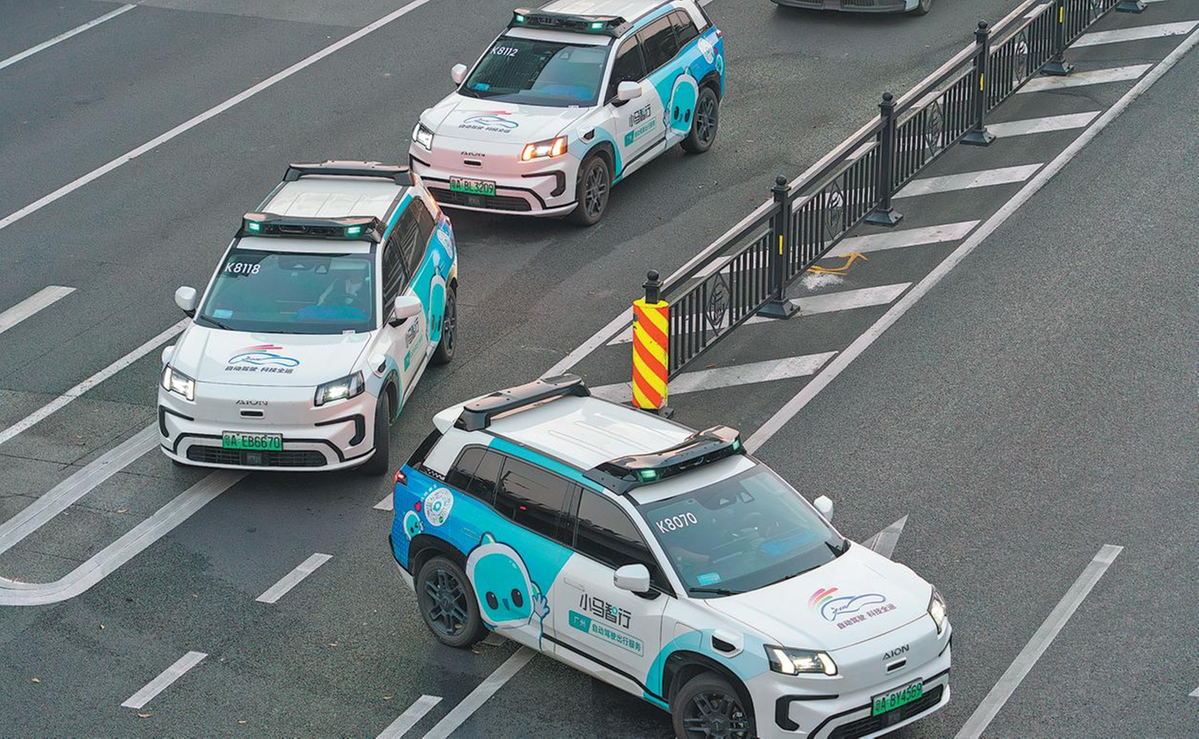
China's autonomous driving industry is accelerating toward the commercialization of autonomous taxis, as leading enterprises optimize their technological frameworks and business models to meet growing market demand.
After years of technical breakthroughs and pilot programs, the sector is transitioning into a phase characterized by large-scale operations and international expansion. Companies are now focused on achieving sustainable profitability by balancing cost control with expanded revenue streams.
Chinese autonomous driving company Pony.ai recently announced that its robotaxi fleet in Guangzhou, Guangdong province, has reached positive single vehicle profitability. This marks a step forward in the commercial viability of driverless ride-hailing services.
"The achievement of positive unit economics in Guangzhou was reached after excluding fixed costs, indicating that the business model is now capable of delivering overall profitability through the expansion of its operational scale," said Wang Haojun, CFO of Pony.ai.
Wang added that the path to profitability for Pony.ai has been driven by hardware innovation and cost management. The company has moved away from traditional industrial PCs in its autonomous driving systems, which are bulky and power-intensive units difficult to integrate into mass-produced vehicles. It has also become the first in the industry to achieve large-scale application of four automotive-grade Nvidia Orin X system-on-chip units in its robotaxis.
This transition has reduced size and cooling requirements of the onboard systems while enhancing reliability. The bill of materials for the company's seventh-generation autonomous driving kit has fallen by nearly 70 percent.
On the revenue side, Pony.ai has seen consistent growth through improved vehicle utilization and expanding fleet size.
In the third quarter of 2025, the company reported a fleet of 961 robotaxis, with 667 being the seventh-generation models. The average daily revenue of each vehicle reached 299 yuan ($42.47), supported by a daily average of 23 orders per vehicle.
In total, the revenue of the company in the robotaxi segment exceeded 47.7 million yuan in the third quarter, representing a year-on-year surge of 89 percent.
Wang also said that Pony.ai is shifting toward an asset-light business model to aid rapid expansion, evolving from a heavy-asset operator who owns its fleet into a technology enabler for the wider industry.
Under this strategy, Pony.ai has established a collaborative value chain where original equipment manufacturers handle vehicle production, while asset holders or operating companies manage vehicle fleets. Ride-hailing platforms are responsible for order distribution, while Pony.ai provides the core technology.
This model allows the company to diversify its income through vehicle sales, technology licensing and revenue sharing from order commissions. Partnerships with platforms such as Sunshine Mobility and Shenzhen Westlake Group have been initiated under this framework.
Pony.ai plans to expand its fleet to 3,000 vehicles by the end of 2026 and aims for a 100,000-unit fleet by 2030, at which point the company expects to reach overall breakeven.
Additionally, experts said competition in the autonomous taxi sector has shifted from being focused on algorithms and sensors to building a comprehensive technological and platform ecosystem as technical barriers in the industry are diminishing.
Caocao, a ride-hailing platform under the Chinese automaker Geely, began robotaxi operations in February 2025 and is now leveraging the Geely ecosystem to accelerate the commercialization of its robotaxi service.
"While autonomous driving technology is a prerequisite for entry, the ultimate market winners will be those who have systematic operational capabilities," said Gong Xin, CEO of Caocao.
The company is regarded as an essential part of Geely Group's efforts to commercialize robotaxi operations.
Caocao has integrated the core components of robotaxi commercialization through a model that combines purpose-built vehicles, autonomous technology and a sophisticated operations platform. Supported by Geely's manufacturing and R&D expertise, the company leverages its extensive ride-hailing network and large user base to provide real-world scenarios essential for large-scale deployment.
Furthermore, through a partnership with Chongqing Qianli Intelligent Driving Technology, a provider of full-stack autonomous driving technology, Caocao utilizes its vast operational network to refine its algorithms.
The company currently operates in 163 cities with over 5 million drivers, generating 300 million kilometers of driving data every day. The high-quality data provide a continuous feedback loop for improving the ability of robotaxis to navigate complex urban road conditions.
In addition, Caocao has accumulated substantial capabilities in fleet management, asset management, user services and regulatory compliance, creating a digital operations platform that can quickly adapt to robotaxi services.
For instance, in terms of vehicle management, the company has built a full-life-cycle system spanning procurement, insurance, maintenance and residual value, providing refined cost control and commercial validation.
Caocao also introduced a prototype future mobility hub called green intelligent transit island. According to Gong, the facility combines automated battery swapping, interior cleaning, intelligent dispatching and automatic billing.
A blueprint for replicating this facility has been developed, which will accelerate the scaling and commercialization of Caocao's robotaxi services.
While some firms focus on domestic growth, Chinese autonomous driving company WeRide is spearheading its international expansion. The company launched its robotaxi service on the Uber app in Dubai, the United Arab Emirates, on Dec 12, in collaboration with Dubai's Roads and Transport Authority.
Initially covering busy areas in the city, WeRide operates the service through Tawasul, a local transport company, and utilizes safety drivers, with plans to transition to fully driverless commercial operations by early 2026.
WeRide also recently secured a landmark license in Abu Dhabi, the UAE, for fully driverless robotaxi commercial operations. This is the world's first urban Level 4 commercial license granted outside the United States, allowing the company to operate without safety drivers and achieve unit breakeven in the region.
In the third quarter of 2025, WeRide's global autonomous fleet exceeded 1,600 vehicles, including nearly 750 robotaxis. In Abu Dhabi alone, the fleet has accumulated nearly 1 million km of operational mileage.
The company now holds operating permits in eight countries: China, the UAE, Saudi Arabia, Singapore, the US and three in Europe. The company aims to expand its Middle Eastern fleet to 1,000 units by 2026 and targets tens of thousands of vehicles globally by 2030.
According to WeRide, its choice of international markets is driven by clear regulatory frameworks, high market demand and stable operational conditions. This dual-city success in the UAE serves as a blueprint for the company's expansion across the Middle East, North Africa and Europe as it explores opportunities in other potential markets.
wangyuchen@chinadaily.com.cn