China's smart cars on cusp on global spread
Advanced know-how gives domestic automakers a distinct advantage







China's intelligent driving industry is poised to rapidly expand globally, driven by technological advancements, scale and cost advantages, positioning Chinese companies to lead in international markets.
Whether in products, technologies and the supply chain, Chinese companies are at least one generation ahead in overseas markets excluding the United States, so they have great opportunities to go global, said Zhang Yongwei, president of China EV100, at the 7th Global Intelligent Driving Conference last week.
Thanks to the market size in China, the cost of key components has been slashed, said Zhang.
For example, the price of light detection and ranging products has fallen from around 200,000 yuan ($28,315) in 2017 to below 10,000 yuan, and domain controller costs have decreased from over 10,000 yuan to about 2,000 yuan, supporting China's growth in the global intelligent automotive sector.
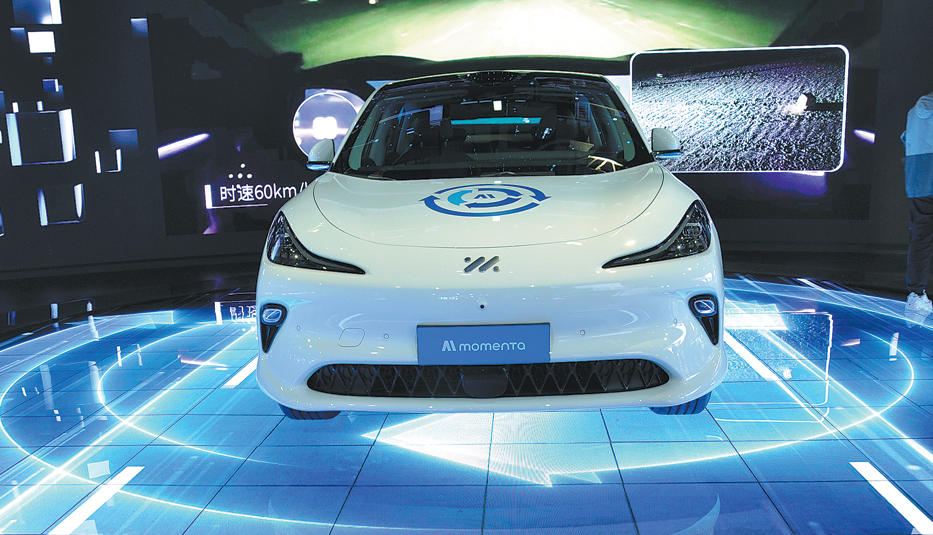
In the past, China's intelligent driving technologies were mainly exported as part of vehicles from automakers such as Nio and XPeng. However, with Chinese smart driving solution providers such as Momenta, Horizon Robotics, Deep-Route.ai and QCraft expanding into international markets, the export of smart driving technologies has entered a new phase.
This expansion takes various forms, including collaborations with international suppliers, direct partnerships with overseas automakers, leveraging relationships with Chinese firms to export products, and joint ventures with platform service providers to develop and operate Level 4 autonomous vehicles. These have become the leading models for smart driving companies expanding internationally.
Regions such as the Middle East, Southeast Asia and Europe have become key markets for Chinese intelligent driving companies, which are now deeply involved in the vehicle strategies of foreign and joint venture automakers.
For instance, Momenta and Uber announced a strategic partnership in May 2025 to introduce autonomous vehicles on Uber's platform in international markets outside the US and China.
In September, they revealed plans to launch Robotaxi services by 2026, with Munich, Germany, as the first city for their project. According to Xinhua, Momenta has formed in-depth partnerships with over 20 leading global automakers.
This shift toward the cross-border expansion of China's intelligent driving industry — focusing more on technology solutions and international collaborations — is driven by two critical factors: the technological maturity of the industry and the strength of its supply chain.
Zhang highlighted that the penetration rate of advanced driver assistance systems in new cars in China has surpassed 65 percent, while the adoption of intelligent cockpits has exceeded 80 percent, outpacing Europe, Japan and other regions. These factors lay a foundation for the worldwide expansion of China's intelligent driving technologies.
In addition, China's road conditions and urban environments are more challenging than those in many international markets. This has driven technological advancements, allowing Chinese companies to develop solutions that are more adaptable to diverse conditions abroad.
"China has the most diverse road scenarios and vehicle usage conditions, with its data volume leading globally," said Chen Qi, vice-president of Zeekr.
"This provides China with a distinct advantage in expanding its autonomous driving solutions internationally," he added.
Mogo AI, a Chinese self-driving startup, which recently launched L4 autonomous buses in Singapore, has also underscored China's advantage in its variety of road scenarios.
The company noted that its algorithm models and operational strategies — tested in China under complex terrain and rainy weather conditions — are now being adapted and localized for international markets.
Cities such as Dali in Yunnan province, which experience heavy rainfall, provide a natural training environment for autonomous driving technologies.
Despite the obvious advantages of China's intelligent driving industry, international expansion is challenged by localization barriers.
Zhang noted that the export of smart driving technologies faces compliance and certification hurdles, as overseas markets are often unfamiliar with new technologies, and Chinese companies struggle with limited brand recognition.
Zhang Ning, vice-president of Pony.ai, said that international expansion requires navigating the diverse regulatory frameworks and standards across different regions and markets.
For instance, certain Middle Eastern countries mandate that autonomous vehicles yield to royal convoys, while Germany's unrestricted highway speed limits require intelligent driving algorithms to adapt to high-speed conditions.
"Understanding local regulations is essential to providing value to the local market and achieving economic returns," said Zhao Gang, vice-president of QCraft.
To address these gaps, Zhang Yongwei said that companies should collaborate with local firms and multinational corporations to capitalize on their compliance advantages and leverage their network resources.
Localization is essential for international expansion, and the adaptation of intelligent driving to local markets is more complex than in traditional automotive manufacturing.
Zhang Yongwei emphasized that the focus of intelligent driving exports should shift from product-based models to solution-based approaches. Furthermore, development and research centers should align with these efforts, with companies establishing overseas research facilities to better meet local market demands.
wangyuchen@chinadaily.com.cn