



Coffee needs cooperation, not confrontation







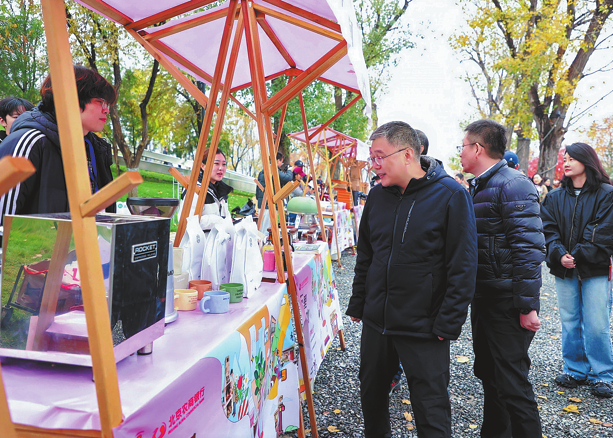
For centuries, coffee has powered conversations, commerce and creativity. It has fueled revolutions, supported trading empires and driven scientific breakthroughs. Today, it energizes offices, parliaments, universities, trading floors, hospitals and armies. Yet behind its familiar aroma, a profound transformation is quietly percolating. What is changing now is not coffee's cultural role, but its place in the evolving architecture of global trade.
As global supply chains reorganize and emerging economies play a larger role in shaping demand, coffee is entering a new phase of globalization — one more defined by South-South cooperation, infrastructure connectivity and diversified consumption. In this transition, the Belt and Road Initiative has become an important platform through which coffee-producing and coffee-consuming economies are more closely linked.
At the heart of this transformation lies a stark imbalance. According to my study, roughly 80 percent of coffee-producing countries lie in the Global South, while 80 percent of the global coffee consumption takes place outside them. The tropics of Latin America, Africa and Asia grow the beans. The heaviest consumers, including Europe, North America and parts of East Asia, are almost entirely dependent on imports. This geography is not new, but what is new is the way trade, logistics, finance and consumption patterns are adapting to it.
Coffee production is concentrated in a climate-sensitive belt and is highly sensitive to climate change, while consumption is strongest in productivity-driven advanced economies where the beverage has become part of professional and social life. At the same time, the expansion of South-South trade is reducing the historical dependence on a few export destinations. Together, these shifts are gradually redrawing the global coffee map — not through disruption, but through diversification.
Meanwhile, China's coffee trade is rapidly growing, with volumes doubling every five years. Once on the periphery of the coffee trade, the country is now a key player. Also, a larger proportion of the world coffee trade now goes through the BRI infrastructure, supported by improved financing mechanisms and closer cooperation among producing countries. In this sense, China is helping coffee travel more efficiently from plantations to markets, reducing the friction in what used to be a fragmented value chain.
A more profound shift is China's emergence as a coffee-producing nation. Experimental plantations in Yunnan, Hainan and Fujian provinces show that coffee can grow well in those regions and yield high-quality beans. China's track record in scaling agriculture and technology — from tea and apples to aquaculture, solar panels and battery technology — shows that once China commits, results tend to follow. This is also true of coffee. But these efforts complement, rather than replace, the role of traditional producing countries.
At the same time, China is becoming a major consumer of coffee. China's expanding middle-income group is reshaping the global coffee demand. Chinese brands such as Luckin Coffee, which has spread like wildfire on campuses and in cities since it was launched in 2017, show how deeply the beverage is embedding itself in social and economic life, much like it did in Europe centuries ago.
Add to this advanced agricultural technology, China's ability to set standards and its capacity to organize logistics, and it is clear that a change is brewing in the coffee industry.
Historically, commodities have often marked turning points in the global economic order. Oil reshaped geopolitics in the 20th century. Coffee's story is different. It is not a resource for survival, but for connection and cognition. It supports millions of smallholder farmers, especially in Africa and Latin America, anchors the hospitality, food culture and tourism industries, and fuels global retail brands and digital consumer ecosystems.
It is also essential to the functioning of modern systems. European urban culture and productivity are deeply coffee-dependent, and North American services, logistics networks and offices run on caffeine. For universities, research labs, think tanks and start-ups, coffee is a symbol of knowledge exchange.
If the current trends continue, the global coffee economy is likely to become more plural rather than polarized. Infrastructure investment, diversified financing, and growing domestic markets across the Global South can strengthen resilience for producers, while consumers worldwide benefit from more stable supply and richer variety.
With the large-scale consolidation of global supply networks, coupled with growth in production, even the substance essential for keeping modern societies alert and functioning has the potential to become a bridge between production and consumption.
Coffee, after all, has always been about exchange: of ideas, labor, culture and time. As the beverage finds a new place in the evolving global trade landscape, it has become not a reason for confrontation, but a reminder that even simple daily rituals can lead to cooperation, development and shared prosperity.
The author is a professor of innovation studies at Liaoning University.
The views don't necessarily reflect those of China Daily.
If you have a specific expertise, or would like to share your thought about our stories, then send us your writings at opinion@chinadaily.com.cn, and comment@chinadaily.com.cn.





