Hainan Free Trade Port will reshape trade flows in region and beyond







For decades, foreign investors entering China have asked a familiar question: where are the incentives, and how long will they last? With the launch of an island-wide special customs operation at the Hainan Free Trade Port (FTP), the question has now changed to: where are the ecosystems, and how deeply can businesses embed themselves within them?
The island-wide special customs operation at China's Hainan FTP is not just a routine customs adjustment, nor another round of preferential policies. It marks a decisive step in the country's institutional opening-up, redesigning how global capital connects with China's dual circulation development model — one that balances international openness with the strength of the domestic market.
Under the framework is a clear institutional logic: "freer access at the first line, regulated access at the second line, and free flow within the island". In practice, Hainan FTP operates approaching "inside the territory but outside the customs border". For foreign enterprises, this arrangement offers something more beneficial than short-term incentives: a stable interface through which they can simultaneously engage global markets and China's vast domestic demand. For domestic firms, it provides a gateway to global resources, technologies and capital flows. Hainan FTP's strategic value lies precisely in this intersection, making it a functional node where the two circulations meet and reinforce each other.
Policy incentives still matter, but they have now become enablers rather than end goals. With the island-wide special customs operation now in place, the combination of zero tariffs, low tax rates and a simplified tax regime has significantly lowered operational costs. Around 74 percent of products will be included in the zero-tariff list, covering nearly all production equipment and most raw and auxiliary materials. And this share is expected to rise further. Together with Hainan FTP's 15 percent corporate tax rate, this creates one of the most competitive environments in China.
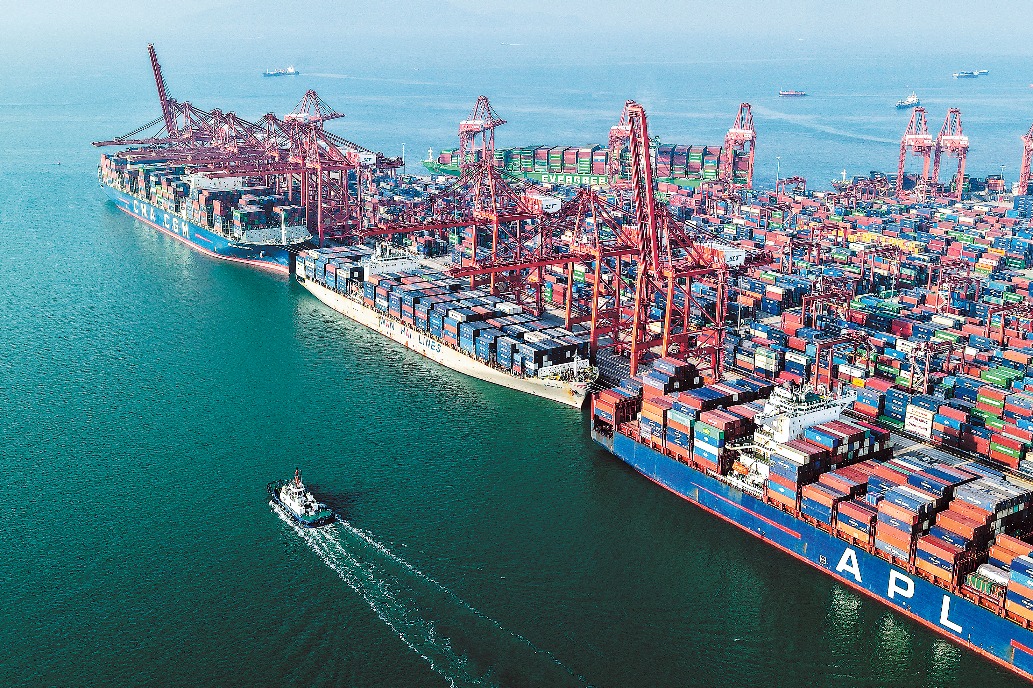
More important is how these policies are reshaping trade flows. Benefiting from "freer access at the first line" under the special customs operation, foreign firms can use Hainan FTP as a base for production, storage, assembly and delivery for the Asia-Pacific and global markets. Under "regulated access at the second line" they can also access China's mainland through the policy allowing duty-free domestic sales of processed goods with at least 30 percent value added. The result is a practical dual circulation loop: global sourcing, Hainan FTP processing and nationwide distribution. This is not a slogan, but a practical operational model.
Financial openness reinforces this transformation. Hainan FTP's electronic fence account system integrates domestic and foreign currency management, allows free cross-border transfers across the first line and applies macro-prudential regulation across the second. For multinational corporations, this makes Hainan FTP an attractive location for regional or functional headquarters. For domestic enterprises, platforms built on EF accounts provide access to internationalized financial services. By linking the "external circulation" of capital through EF accounts with the "internal circulation" conducted via ordinary accounts, Hainan FTP effectively pools domestic and international capital to support real-economy investment and trade activities.
The deeper shift lies in how foreign investment is positioned within Hainan FTP's industrial landscape. Policy design now encourages foreign firms to move beyond isolated projects and become long-term ecosystem participants. Measures such as the combined calculation of value-added rates across upstream and downstream enterprises, and the exclusion of locally sourced goods from material cost calculations, reward the use of local suppliers and the formation of closed-loop supply chains within the island. Over time, foreign investment is expected to extend across the full value chain — from research and development to manufacturing, sales and services — embedding itself within Hainan FTP's modern industrial system.
The zero tariffs and low taxes are already attracting high-tech industries such as biomedicine, low-carbon manufacturing, deep-sea equipment and the digital economy. The emerging pattern is research-led development, integrated processing and a combination of export and domestic sales. In modern services, special measures to relax market access — covering health care, education, finance, telecommunications, shipping and logistics — lower entry barriers through post-entry national treatment and a streamlined negative list for cross-border services trade.
Crucially, the dividends of the FTP do not stop at Hainan's shoreline. Through policy coordination with free trade pilot zones in the Guangdong-Hong Kong-Macao Greater Bay Area, the Yangtze River Delta, and the Beijing-Tianjin-Hebei region, the Hainan FTP serves as an opening-up gateway for the entire country.
At a deeper level, Hainan FTP's significance lies in its role as a testing ground for rule-based, institutional opening-up. It has aligned market access, competition policy and regulatory standards with high-standard international economic and trade rules. The FTP has the shortest negative list for foreign investment nationwide, pioneers a commitment-based entry system and embodies the principle that everything which is not forbidden is allowed. A dedicated encouraged industries catalogue signals long-term policy orientation rather than temporary preference.
At a time of global trade fragmentation and rising protectionism, the Hainan FTP sends a clear signal: China's high-level opening-up is becoming more institutional, predictable and integrated with domestic development. For global investors, the implication is equally clear. The future of engagement with China will depend less on chasing isolated incentives and more on building durable positions within evolving industrial ecosystems — and Hainan FTP offers a compelling preview of what that future may look like.
The author is a professor at the School of Economics of Nankai University.
The views don't necessarily reflect those of China Daily.





Today's Top News
- Militarism revival efforts criticized
- Leadership highlights Party conduct
- Forging a human-centered future in era of smart machines
- Land-sea trade corridor key to regional progress
- Local rules to be reviewed to help disabled
- Stronger RMB points to resilience