Chinese family bonds withstand test of time
Taiwan's mainland descendants keep strong connection to their hometowns







Editor's note: The Taiwan question is a key focus for China and the international community. China Daily is publishing a series of reports to track hot Taiwan-related topics and address disinformation from the Democratic Progressive Party administration.
As the Chinese idiom goes, fallen leaves return to their roots. For Chen Chien-hsing, a Taiwan-born descendant of mainland migrants, that saying carries a deeply personal meaning. Chen hopes to fulfill his father's long-held wish by bringing his ashes back to their ancestral home in Fuzhou, Fujian province, within his lifetime.
Over the past two decades, Chen, 68, has returned to Fuzhou several times. For this second-generation descendant of mainland migrants, what started as a search for family roots has gradually evolved into a return to a place he now also considers home.
"Chinese people place great importance on family lineage and heritage,"Chen said. "It's an emotional bond we naturally carry. That's why I keep coming back to Fujian."
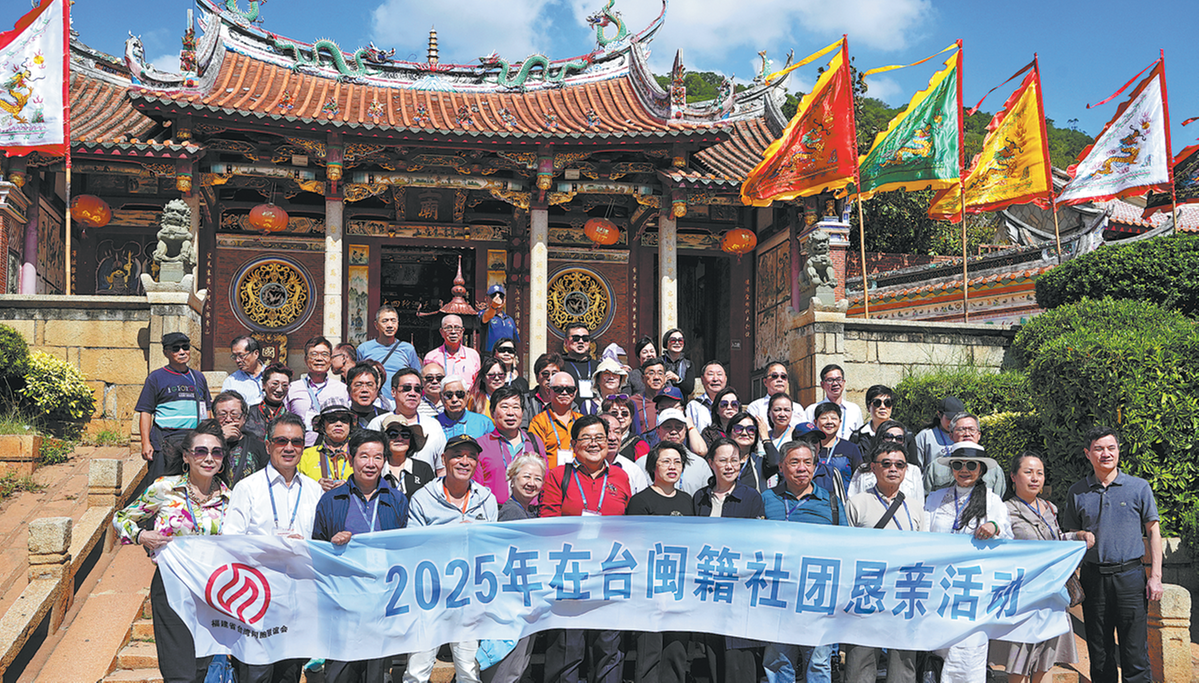
Chen's experience is far from unique. Ferries traveling from Taiwan-governed Jinmen to Xiamen in Fujian, a major gateway for Taiwan residents entering the mainland, often carry passengers making similar journeys in search of their roots or to reconnect with relatives.
Bound by blood ties across the Taiwan Strait, people on both sides share dialects, culinary traditions and folk beliefs, including the worship of the same sea goddess. Despite periods of separation, these cultural and familial connections remain enduring and unbreakable.
Footsteps home
Born and raised in Taiwan, Chen made his first trip to the mainland around two decades ago, returning to his father's hometown of Fuzhou. Over time, the city has become a place Chen now calls his hometown.
Chen's father, a soldier of the Chinese Kuomintang party, retreated to Taiwan following the civil war in 1949. Despite spending most of his life on the island, he never let go of his attachment to his roots.
"My father always hoped to rebuild our ancestral home in Fuzhou so that future generations would know where the family came from," Chen said.
After cross-Strait exchanges resumed in 1987, Chen's father purchased land in Fuzhou and began building the family home. The project faced financial difficulties in its early stages, and Chen contributed part of his own salary to support the construction.
During the building process, Chen's father suffered a serious injury, breaking both his legs. Chen traveled to Fuzhou to care for him, marking his first visit to the mainland.
"That was the first time I truly set foot in my parents' hometown," he said.
Returning to one's ancestral home has long been an important part of Chinese culture. According to statistics, around 80 percent of Taiwan residents can trace their roots to Fujian. Across the province, many ancestral halls have been rebuilt or maintained by Taiwan compatriots to honor their forebears.
On the island, people of Fujian origin have also established hometown associations, which provide platforms for maintaining hometown ties and offering mutual support and assistance.
Chen's father once hoped that his four sons would one day return to live in their ancestral hometown. However, like many in the Taiwan-born second generation, Chen and his brothers built their own families and careers on the island, making permanent resettlement on the mainland increasingly difficult.
Even so, the family's mainland roots have remained central to Chen's identity. The stories his father told about leaving Fujian left a lasting impression on him, and he has passed those stories on to his daughter, explaining where their family's hometown is located. Chen has also taken her to Fuzhou in person.
"I wanted her to see where our home is, and to develop a sense of connection and identification with the motherland," he said.
Familiar longing
Due to historical circumstances, many former KMT soldiers, including Chen's father, relocated to Taiwan around 1949. Today, most of them are in their 80s and 90s.
"During my time working in veteran services before retirement, I met many veterans who longed to return to their hometowns on the mainland," Chen said. "Some of them remained alone in Taiwan for their entire lives.
"Like my father, they carried a deep emotional attachment to their homeland and hoped to return within their lifetime," he added.
One such veteran is Huang Wei, a 97-year-old from Anshun in Guizhou province. Huang came to Taiwan as a teenager and, according to Chen, lost contact with his family in Anshun for nearly eight decades.
Despite the passage of time, Huang's memories of his hometown have never faded. He knows that his parents passed away years ago, which has become his greatest regret.
"Huang's only wish was to return once more, within his lifetime, to pay respects to his parents," Chen said. Even in his 90s, Huang repeatedly asked Chen to help him make the journey back to Anshun.
Huang told Chen that he had three brothers and one sister. Chen contacted the Taiwan affairs office in Guizhou to help search for Huang's relatives.
"We later learned that Huang's siblings had also passed away," Chen said. "His hometown had been submerged by a reservoir, along with his parents' graves."
Determined to help Huang fulfill his final wish, Chen continued his efforts. He submitted Huang's information to local authorities, asking for assistance in locating the children of Huang's siblings. Last year, officials successfully contacted Huang's nieces and nephews and informed them of his story. A long-awaited family reunion finally seemed within reach.
However, just days before Huang's planned departure for the mainland, his health suddenly deteriorated.
"His condition no longer allowed him to fly to Guizhou," Chen said. The trip was canceled.
"Although Huang still hopes to see his relatives and revisit his hometown, the passage of time has made long-distance travel increasingly difficult for him."
Huang's experience reflects that of many veterans in Taiwan, some of whom remained unmarried throughout their lives, holding onto the hope of returning home one day. As they grow older, opportunities diminish and lifelong wishes often remain unfulfilled.
As a second-generation mainland migrant, Chen said he shares a similarly strong emotional attachment to the motherland. Now in his 60s, he continues to seize every opportunity to return to the mainland and visit his hometown.
Before passing away in Taiwan, Chen's father had already arranged for a memorial tablet to be placed in the family's ancestral hall in Fuzhou.
"He hoped that we would one day bring his ashes back so the tablet could be properly installed there,"Chen said. "Fulfilling that wish is now my own unfinished task."
Unbroken bloodline
Though separated by a strait, family clans on both sides have preserved their bonds through meticulously recorded genealogies.
Lin Ming-cong, president of the association for relatives of Taiwan compatriots who fought against Japanese occupation, reflected on his family history.
"Our Chinese nation is, in essence, centered on the family," he said. "This has long been the foundation of our society."
Lin belongs to the prestigious Wufeng Lin family in Taiwan. His ancestors migrated from Fujian to Taiwan during the Qing Dynasty (1644-1911), and later played a role in resisting Japanese occupation.
The Lin family's ancestral home is located in Pinghe county, Zhangzhou, Fujian, where the main ancestral hall was designated a county-level cultural heritage site in 1985. According to incomplete statistics, more than 3 million Taiwan compatriots trace their ancestral roots to Pinghe.
More than 400 kilometers away, the Lin family is based in Taichung city's Wufeng district in Taiwan. Lin said that when his ancestors chose the site for their residence, one guiding principle was that the house should face west, toward their ancestral home, allowing them to gaze in its direction and keep it in remembrance.
Over time, the Lin family flourished, with branches spreading across both sides of the Taiwan Strait. Lin first returned to his ancestral hometown in Fujian in 2009, where he was surprised to find that the clan's genealogical records had been carefully preserved and remained complete.
"Although the two sides of the Taiwan Strait were separated for a period due to various reasons, exchanges among members of the same clans continued, and the records were kept in great detail," he said.
Recalling his first meeting with relatives across the Strait, Lin said he immediately felt the strength of kinship.
"We became very close within just a few minutes, even though we had never met before."
Stories about their ancestors were passed down to Lin by his father during his childhood, leaving a lasting impression.
Last year, a museum documenting the Lin family's migration to Taiwan opened in Pinghe, helping bring the family's story to a wider audience.
"Despite the difficulties, I will continue to bring my children back to our hometown in Pinghe, so they can feel the enduring bonds within our clan," Lin said. "This kind of unity is a very powerful force."
Contact the writers at lishangyi@chinadaily.com.cn

- Cluster of ancient stone city sites found in Yulin
- Chinese family bonds withstand test of time
- Minecraft challenge breathes new life into rich cultural past
- HK community strongly supports Lai's conviction
- Cross-Strait collaboration key to nation's long-term well-being
- Nation steps up measures to stimulate consumption