Sino-EU ties need pragmatic adaptation








At the invitation of President Xi Jinping, French President Emmanuel Macron will visit China from Dec 3 to 5, marking a reciprocal visit following Xi's historic trip to France last year. Beyond ceremonial exchanges, this visit reflects a broader strategic moment: under growing global uncertainty and geopolitical competition, China-France cooperation can serve as a stabilizing force in Europe-Asia relations. Macron's engagement signals Paris' intent to balance transatlantic pressures while deepening ties with Beijing, highlighting the enduring value of pragmatic dialogue, multilateral coordination, and long-term strategic partnership in shaping regional and global stability.
And this year marks the 50th anniversary of diplomatic relations between China and the European Union. Amid growing geopolitical competition, a global economic downturn and fragmented global governance, their relationship must navigate both external pressures and internal dynamics. How they manage these challenges will not only shape the future of their bilateral ties but also have a profound impact on the global landscape.
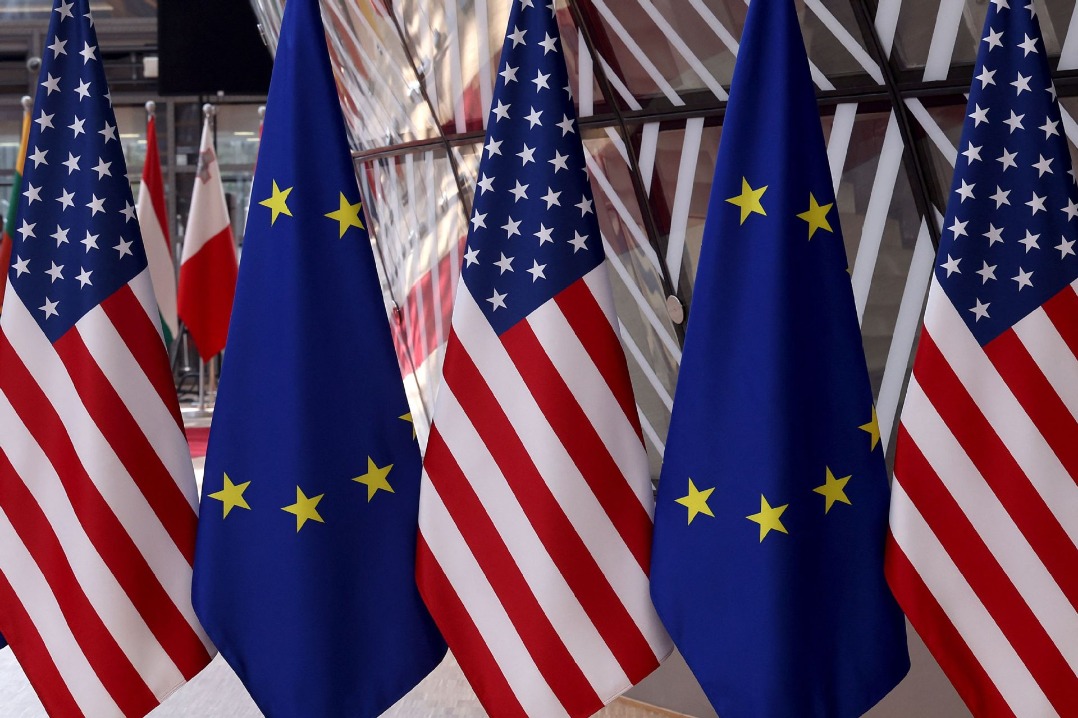
The external pressures on the EU are evident. The "America First" policy of the United States administration has introduced volatility into international relations. The increasingly transactional nature of US-EU relations, particularly their gaming over interests in the Chinese market, is adding complexities to China-EU dynamics.
The ambiguous security commitments of the US to Europe have hampered the EU's efforts to achieve strategic autonomy on security matters. Washington's pursuit of economic nationalism and unilateralism has marginalized the EU's attempts to position itself as a "rules-setter" of global governance. This disturbing pressure from across the Atlantic is forcing the EU into an increasingly awkward position in its foreign relations. A dual sense of insecurity — both in terms of security and the economy — is fueling calls for strategic autonomy in Brussels.
The reality is that the EU remains heavily reliant on the US for security, while economically it has to face both Washington's punitive tariffs as well as its push for "decoupling" from China. However, despite Washington's pressure on the EU to restructure supply chains, China remains a crucial supplier for Europe, and plays an irreplaceable role in areas such as infrastructure. In the backdrop of globalization, geopolitical conflicts cannot halt the flow of economic factors. For the EU, maintaining close economic and trade ties with China is not only a practical necessity but also a key driver for post-COVID economic recovery and transformation.
Internal dynamics are equally significant. A long-standing hurdle is the tendency among some European politicians and media to view China through an ideological lens, framing it as an institutional rival. This entrenched mindset has created a considerable barrier to the progress of Sino-EU ties.
The interplay of external pressures and internal dynamics has introduced uncertainties and presented new challenges to China-EU relations. To forge a path of cooperation that serves their long-term development interests and contributes to global stability and governance, the EU must clearly recognize that the essence of China-EU relations is cooperation, not confrontation. In the face of complex and shifting geopolitics, their relationship cannot be simply classified as "good" or "bad". Instead, it demands pragmatic and flexible strategic adaptation.
Despite the constraints of the transatlantic alliance, Brussels seeks a certain degree of strategic autonomy. This is particularly evident as the US administration's coercive trade tactics have significantly intensified transatlantic tensions in the areas of security, economics and global governance. This friction has created the need for Sino-EU collaboration, particularly in resisting US unilateral tariffs and jointly shaping international rules and regulations. It presents an opportunity for the two sides to deepen practical cooperation and enhance strategic mutual trust.
On the one hand, both sides need to uphold sound perspectives of history, the broader landscape and their respective roles. Globalization is an irreversible trend, and any attempt to "decouple" will be cast aside by history. In the broader context, the world faces common challenges such as climate change, geopolitical conflicts and economic downturns, which no country can solve alone. These require global cooperation.
As two major forces safeguarding world peace, China and the EU are not engaged in a "hegemonic rivalry" or a zero-sum game. Each can follow its own development path, and still play a crucial role in upholding multilateralism and advancing global governance.
Strengthening communication and cooperation, while seeking common ground and shelving differences, should form the foundation for navigating China-EU relations. Competition and disagreements are inevitable, but the key is to keep these differences within manageable limits. Therefore, both sides should respect each other's core interests and major concerns, avoid crossing red lines, and thus preserve space for practical cooperation.
This principle of "seeking common ground while shelving differences" is essential for building resilience in China-EU relations amid the current complex global environment. It requires both parties to build consensus through dialogue, manage disagreements through cooperation, and maintain rationality in competition.
As stabilizing forces in the process of multipolarization, China and the EU should not merely adapt to geopolitical dynamics. Instead, they must proactively strengthen the resilience of their relations through a pragmatic convergence of interests, despite existing pressures and complexities, and jointly explore a sustainable development path that aligns with their respective interests. This is a challenge but also an opportunity.
Liu Zhongwei is deputy head of the research department at University of International Relations; Zhou Zicong is a research fellow at the same university.
The views don't necessarily represent those of China Daily.




Today's Top News
- Disrupting market under fabricated veneer of 'national security' hurts US' own interest: China Daily editorial
- Yasukuni visit would add insult to injury: China Daily editorial
- Judicial reform critical for modernizing governance
- Effective use of investment emphasized
- China's shuttle diplomacy strives to reach ceasefire
- Nanjing Museum's handling of donated art, relics being probed