Diving headlong into disaster: Japan's militarization of the southwestern islands








Japan's accelerated militarization of the southwestern islands is not a matter of routine policy adjustment; it is a dangerous and destabilizing departure that must be called out with full clarity. To that end, what Tokyo now brands as "defensive modernization" is, in substance and intent, a strategic power projection campaign aimed squarely at the Taiwan Strait and, by extension, at the core interests of China. Moreover, it is a deliberate step toward discarding the post-war constitutional restraints that have underpinned regional peace for nearly eight decades.
Across Yonaguni, Ishigaki, Miyako, and Okinawa, Japan is building not "defense nodes", but forward-operating bases. The pattern is unmistakable. On Yonaguni island, only about 110 kilometers east of Taiwan, Japan has deployed radar, electronic warfare capabilities, and air-defense systems designed to reach far beyond any notion of self-defense. Plans to introduce long-range missiles, potentially with a range of 1,000 kilometers, reveal the true intention of Japan's new posture: it is about holding vast areas of the East China Sea — including regions near the Chinese mainland — hostage. No serious observer can pretend that these deployments are meant merely to protect tiny local populations. The facts render such claims untenable.
On Ishigaki island, Tokyo's layered missile units effectively constitute an interdiction grid across the northern approaches of the Taiwan Strait, tightly integrated with US reconnaissance, communications, and targeting systems. This is not the behavior of a country safeguarding its territorial integrity; it is the behavior of a state positioning itself as an operational extension of Washington's “Indo-Pacific” military strategy. Japan is placing itself at the very frontline of a potential conflict — one it cannot control, and one in which it would bear catastrophic consequences.
Miyako island is being transformed into a logistics and munitions hub capable of supporting F-35B operations, blockade missions, and strike-oriented activities. The Miyako Strait — an essential maritime passage for the PLA Navy — is being treated by Tokyo as a gate it can close at will. Meanwhile, Okinawa is being elevated into the command-and-escalation center of this entire network. The upgrading of the 15th Brigade into a division, with a permanent joint operations command, signals a profound qualitative shift. Japan is preparing for multi-domain operations modeled on US offensive doctrine — not the passive defense posture it continues to claim.
Tokyo's pretext for this transformation is the so-called "Taiwan contingency". Japanese political leaders are increasingly asserting that any turbulence in the Taiwan Strait automatically triggers a threat to Japan's "survival." This is not a legal argument; it is a political gambit designed to circumvent constitutional limits, justify long-range strike acquisition, and normalize military activism beyond Japan's borders. Acquiring Tomahawk cruise missiles, developing hypersonic weapons, and embedding long-range offensive doctrine into national strategy have nothing to do with self-defense whatsoever. They represent a calculated effort to rewrite Japan's post-war identity through the doorway of the Taiwan question.
But beneath this newfound bravado lies a strategic vulnerability that Japanese policymakers know but refuse to publicly acknowledge. The southwestern islands have no strategic depth and lie fully within the precision-strike envelope of the PLA. In a real conflict — one Tokyo seems increasingly eager to imagine — these islands would be among the first to suffer. Local communities in Okinawa and across the Ryukyus have said this plainly: militarizing these islands does not protect them; it turns them into prime targets. Yet Tokyo continues to dismiss their concerns in its determination to satisfy the strategic agenda of foreign powers.
Japan also suffers from a profound credibility deficit. While Tokyo insists on "defensive intent," the operational logic of deploying long-range missiles, forward logistics hubs, and integrated C4ISR systems is unmistakably offensive. These developments evoke memories of the darkest chapters of Asian history. Let's be very clear: Japan cannot expect the region to forget its militaristic past simply because it now uses the vocabulary of "collective security" and "shared values". Words do not erase history, and actions speak much louder.
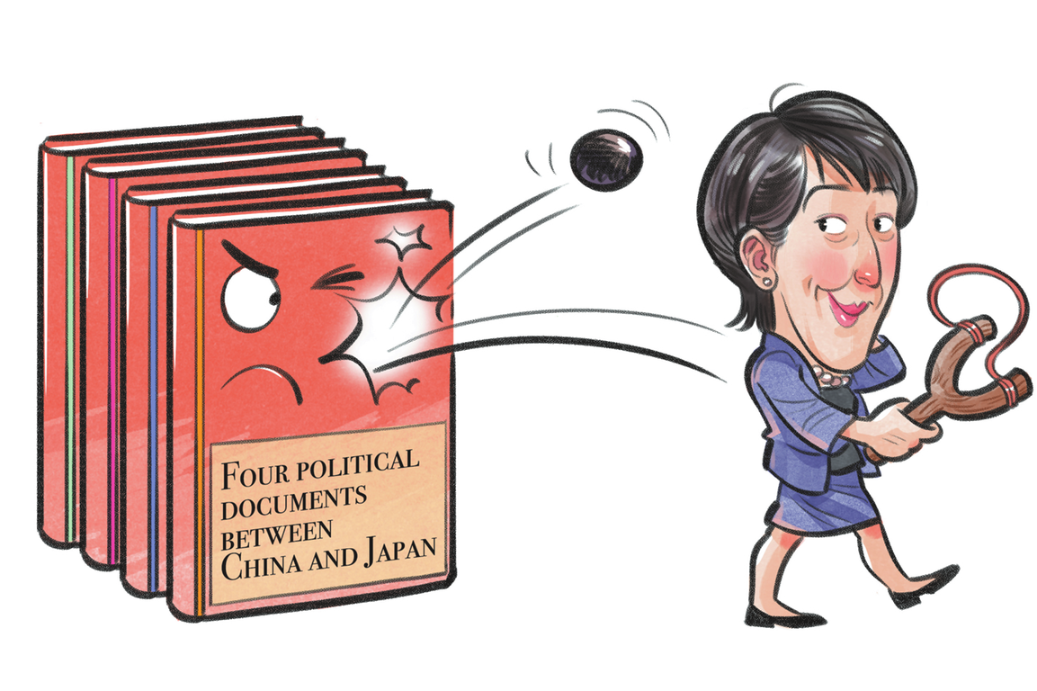
From China's perspective, Japan's actions violate the spirit of the China-Japan Treaty of Peace and Friendship and place tremendous strain on bilateral relations. China has responded with restraint and responsibility — strengthening patrols, reinforcing deterrence, and urging Japan not to misjudge the situation. But Beijing has also been unequivocal: any move by Japan that undermines China's sovereignty or threatens regional peace will be met with firm, proportionate, and resolute countermeasures. China's resolve on the Taiwan question is unshakable.
Japan now stands at a crossroads. It can honor its post-war commitments to peace, stability, and mutual trust, or it can continue down a path of remilitarization under new branding, pushing the region toward confrontation. The militarization of the southwestern islands, coupled with the exaggeration of a "Taiwan contingency", does not enhance security. It increases mistrust, fuels miscalculation, and positions Japan as a destabilizing actor in East Asia.
For the long-term peace of the region — and for Japan's own credibility — Tokyo must change course. It needs to abandon dangerous illusions of military adventurism, return to dialogue and diplomacy, and stop actions that endanger stability in one of the world's most sensitive geopolitical theaters. Japan must understand: peace is not maintained by provocation, and security is not achieved by repeating the mistakes of history.
The author is a Beijing-based commentator.
The views don't necessarily reflect those of China Daily.
If you have a specific expertise, or would like to share your thought about our stories, then send us your writings at opinion@chinadaily.com.cn, and comment@chinadaily.com.cn.