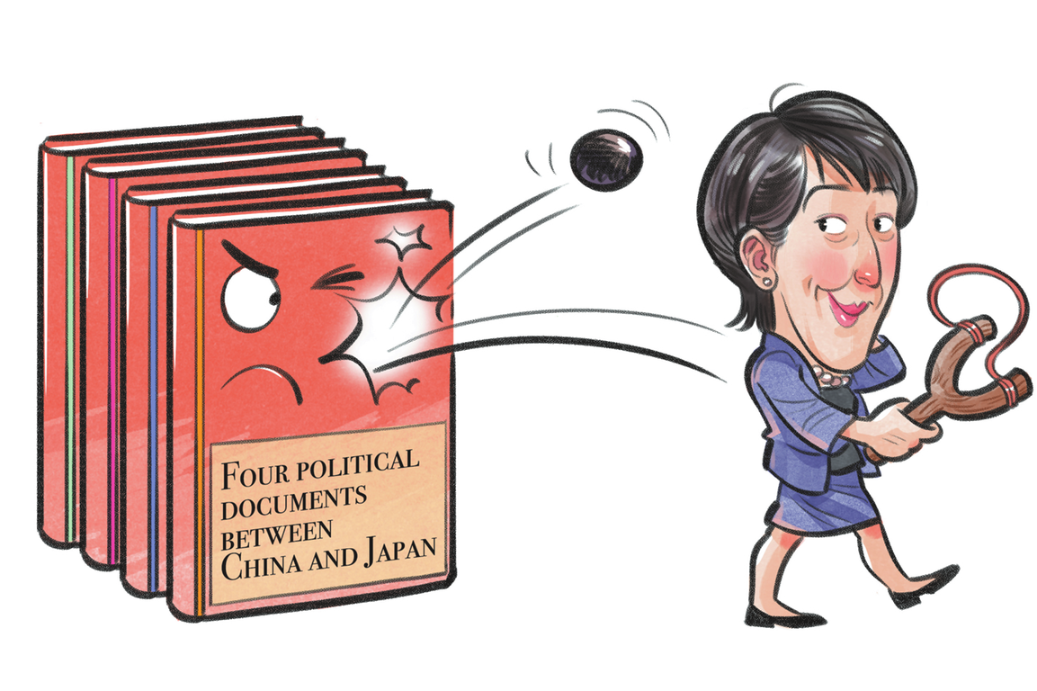
Japanese PM remarks expose military ambitions








The Chinese government has been lodging strong protests against the erroneous remarks made by Japanese Prime Minister Sanae Takaichi during a Diet session on Nov 7, where she hinted that Japan could consider a military intervention in the Taiwan Strait in a "survival-threatening situation". Her remarks have strained Sino-Japanese relations and complicated efforts to advance a strategic relationship of mutual benefit.
Facing growing domestic pressure due to her failure to curb soaring prices, stimulate economic growth and crack down on corruption, Takaichi has resorted to a political diversion. By exploiting the Taiwan question, she tried to claim a diplomatic "achievement" and justify her attempts to expand Japan's military capabilities, increase the defense budget, rewrite key security documents, export weapons, and even tamper with the country's long-held "Three Non-Nuclear Principles". All of this is packaged as strengthening Japan's "defense capabilities" and "deterrence" while reinforcing its alliance with the US.
The phrase "survival-threatening situation" stems from the 2015 US-Japan defense cooperation guidelines. It refers to a scenario in which armed attacks on countries with close ties to Japan pose an "existential" threat to Japan. Japan can exercise the right to "collective self-defense" if there are no means to "repel" the threat. Even then, the use of force must be the bare minimum necessary.
During Shinzo Abe's second administration (2012-20), Japan bent its Constitution to justify the deployment of the Self-Defense Forces on overseas missions. However, Taiwan is a province of China. In the 1998 Japan-China Joint Declaration, Tokyo pledged to maintain only private and regional exchanges with Taiwan. The two sides cannot be considered to have "close ties".
Treating a "contingency" for Taiwan as one for Japan and contemplating military intervention in the Taiwan Strait violates Japan's exclusively defense-oriented defense policy. The policy allows the deployment of the SDF only in response to an armed attack from an external force. It not only strictly confines the SDF operations to Japanese territory and surrounding areas but also limits the use of force to the bare minimum. Likewise, the defense capabilities that Japan maintains are restricted to the minimum necessary. This embodies the pacifist spirit of Japan's Constitution and constitutes the bedrock of its passive defense doctrine.
This changed when Japan's National Security Strategy of 2022 announced plans to establish "counterattack capabilities", thus enabling the SDF to use standoff weapons such as ballistic missiles in an adversary's territory when the country is under attack.
To build such capabilities, Japan needs to enhance its defense capabilities. The country has planned major arms procurement programs and is constructing training facilities. This requires an enormous financial outlay. The National Security Strategy and National Defense Strategy of 2022 had outlined a two-phase plan: 43 trillion yen ($270 billion) in defense spending from 2023 to 2027 and defense expenditure rising to 2 percent of the country's GDP by 2027.
That did not quench Japan's thirst for arms. On Nov 21, Japan's Diet passed a new economic package that includes an additional 1.7 trillion yen in the supplementary budget to bolster defense and diplomatic capabilities. This effectively advances the defense spending target by two years. The Takaichi Cabinet also plans to revise the National Security Strategy in 2026 to address hypothetical "threats", reflecting a misguided pursuit of its ambition to make Japan a military power.
It is becoming increasingly clear that the Takaichi Cabinet wants to "revitalize" the country through military means. By meddling in the Taiwan question, it aims to advance its rearmament agenda. Such actions demand heightened vigilance from both China and the international community.
Any attempt by Japanese authorities to intervene in the cross-Strait situation severely undermines China-Japan relations. Takaichi's erroneous remarks gravely violate the one-China principle, the four political documents signed between the two countries, and the basic norms governing international relations. They are a blatant interference in China's internal affairs, a challenge to China's core interests, and an intended infringement upon China's sovereignty.
The fact that Taiwan is part of China is supported by irrefutable evidence under international law and is widely recognized by the international community. On the Taiwan question, Japan must adhere to its explicit commitments in the four political documents. This is both a requirement of these documents and an obligation for Japan to uphold its own Constitution.
The author is a professor at the School of International Affairs and Public Administration of the Ocean University of China.
The views don't necessarily represent those of China Daily.
If you have a specific expertise, or would like to share your thought about our stories, then send us your writings at opinion@chinadaily.com.cn, and comment@chinadaily.com.cn.