China's scientific satellites yield key results, refreshing humanity's understanding of universe







BEIJING -- A series of scientific satellites launched by China have achieved major discoveries in fields such as cosmic transient objects, cosmic-ray propagation and solar eruptions, renewing humanity's understanding of the universe.
Focusing on major frontier questions such as the origin of the universe, the origin of space weather and the origin of life, China will launch and implement a series of scientific satellite missions during its 15th Five-Year Plan period (2026-2030), striving to achieve new breakthroughs in areas like the cosmic dark age, solar magnetic activity cycles and the detection of Earth-like exoplanets, according to Wang Chi, an academician of the Chinese Academy of Sciences (CAS) and director general of its National Space Science Center.
Through the advancement of these missions, China will continue delivering more key, original and leading scientific achievements, advancing the comprehensive development of the country's space science, space technology and space applications, Wang said.
Since the launch of a CAS space science program in 2011, eight scientific satellites have been sent into space: the Dark Matter Particle Explorer (DAMPE), the Shijian-10 retrievable satellite, the Quantum Experiments at Space Scale (QUESS), the Hard X-ray Modulation Telescope (also called Insight-HXMT), the Taiji-1 satellite, the Gravitational Wave High-energy Electromagnetic Counterpart All-sky Monitor (GECAM), the Advanced Space-based Solar Observatory (ASO-S) and the Einstein Probe (EP).
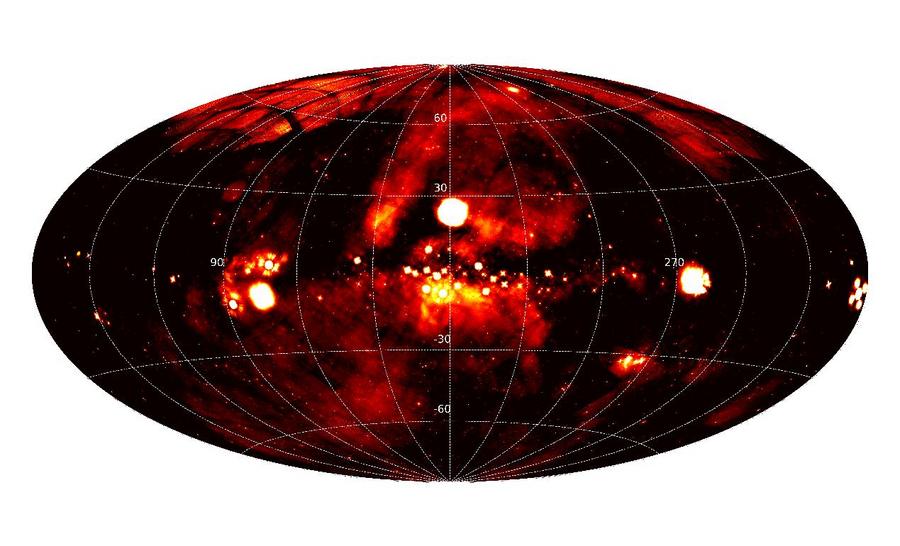
On an extreme macroscopic scale, the program has produced the world's first all-sky X-ray map. And on an extreme microscopic scale, it has obtained the most precise fine structures to date in the energy spectra of cosmic-ray electrons, protons, helium and boron nuclei. A Chinese satellite has for the first time directly measured the strongest magnetic field in the universe and detected the high-speed jet closest to a black hole. These missions have also seen a high degree of integration between science, technology and engineering, Wang said.
While achieving scientific breakthroughs, the program has also driven leapfrog development in cutting-edge payload and satellite platform technologies. In just a few examples, China has mastered key technologies such as satellite-to-ground optical-link alignment, realized an integrated satellite platform and payload design, and developed the world's leading large-field, high-sensitivity lobster-eye X-ray telescope.
The program also carries out comprehensive international cooperation on multiple levels. The Solar wind Magnetosphere Ionosphere Link Explorer (SMILE) satellite is the first in-depth, full-lifecycle comprehensive cooperation project between the CAS and the European Space Agency (ESA). The EP satellite -- led by China, with participation from the ESA, Germany and France -- marks the first time the ESA has participated in a Chinese space science mission as an "opportunity mission." Such missions have established international science teams and promoted data sharing.
The EP satellite has discovered a new type of X-ray transient source, EP241021a, providing key information for our understanding of mysterious transient objects; detected a weak X-ray burst, EP240904a, within the Milky Way, opening new pathway for locating stellar-mass black holes; and for the first time detected the EP240801a transient source, challenging the established classification of gamma-ray bursts, according to Yuan Weimin, principal investigator of the EP mission.
The Insight-HXMT mission has yielded fruitful results in the measurement of Earth's atmospheric density, the flaring mechanism of black-hole accretion outbursts in the Milky Way, the radiation mechanism and surface magnetic field of accreting millisecond pulsars, the ignition locations of surface nuclear burning on neutron stars, and the minimum variability timescale of the brightest gamma-ray burst ever observed, said Zhang Shuangnan, principal investigator of the Insight-HXMT mission.
GECAM discovered a new subclass of gamma-ray bursts produced by compact-object mergers, expanding our knowledge of gravitational-wave electromagnetic counterparts, said Xiong Shaolin, principal investigator of the GECAM mission.
"GECAM is a small but very fruitful gamma-ray mission. The presented results on gamma-ray bursts and magnetars are very interesting and had a significant science impact," said Dmitry Svinkin, a researcher at the Loffe Institute of Russia.
The DAMPE mission discovered a hardening structure in the boron-nucleus spectrum of secondary cosmic rays for the first time, which is significant to revealing cosmic-ray propagation mechanisms, according to Fan Yizhong, the DAMPE satellite's scientific team leader.
Observations from ASO-S have provided new evidence for deciphering the mechanisms of solar eruptions and the origin of high-energy particles, said Su Yang, a scientist representing the ASO-S team.
"I am very impressed by the success of China's ASO-S, which provides unique observations of our sun. ESA's Solar Orbiter mission is very happy about the joint collaboration opportunities, which open a new window to explore our sun," said Samuel Krucker, a professor from the University of Applied Sciences and Arts Northwestern Switzerland.
Andrea Santangelo, a professor at the University of Tübingen of Germany, said that China is at the forefront of space science and is positioned to become the world leader in high energy astrophysics in the next decade. "China has emerged as a reliable, committed space science actor, oriented to success in science and innovation. This trend will continue."






- China's scientific satellites yield key results, refreshing humanity's understanding of universe
- Aerial view of China's Huangyan Island in South China Sea
- Fact box: The development of the under-forest economy in China
- Psychological abuse a form of domestic violence: Top court
- Decades of effort at Saihanba repay green dividends
- Spacecraft to launch with full cargo load