


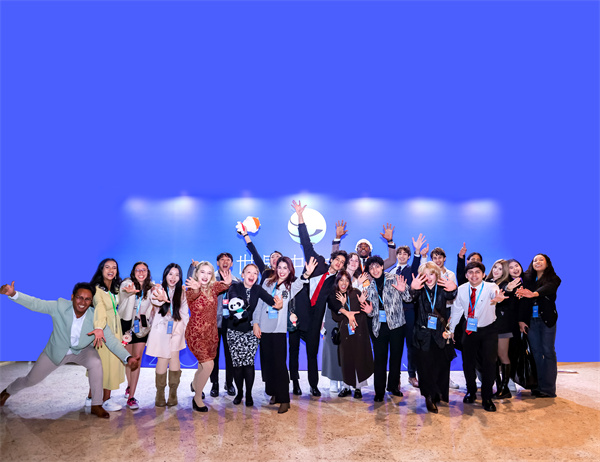
Sabrina Malikova, born in Tajikistan and raised in Russia, is fluent in Chinese — a skill she has cultivated for more than a decade.
Her interest in the language began in primary school, when her school briefly offered Chinese classes. Even after the classes were canceled, she continued learning with private tutors. "In my city, I was the only child who could speak the language, and that gave me a real sense of pride," she recalled.
Now a student of international Chinese education at Beijing Foreign Studies University, Malikova was among the participants at the 2025 World Chinese Language Conference, held in Beijing from Nov 14 to 16. Her experience reflects the growing international enthusiasm for learning Chinese, a trend celebrated at the event.
Hosted by the Ministry of Education under the theme "Innovation Leads, AI Empowers: Learning Chinese Without Borders", the conference brought together more than 5,000 participants from over 160 countries and regions.
It highlighted the role of Chinese as a global language in an increasingly interconnected world.
"Our mission is to help the younger generation develop future-oriented skills such as digital literacy, critical thinking, and multilingual capability. Among these abilities, Chinese is an indispensable bridge," Thai Minister of Education Narumon Pinyosinwat said at the opening ceremony. "As China stands at the forefront of technological and economic innovation, Chinese becomes the gateway for cooperation in economy, technology, and academia."
Daniel J. Broadwater, a graduate student from the United States at Beijing Normal University, said China's strong support for research drew him to study anthropology and archaeology here.
"In the US, opportunities for archaeology are limited," he said. "But in China, research is being funded on a large scale, and foreign talent is welcomed. With more than 5,000 years of history, I can find a period I truly want to specialize in."
The language itself also fascinates him. "Chinese is poetic and beautiful. You add one character, and the whole meaning changes," he said. "That's how I fell in love with it."
Nama Didier Dieudonne, chief inspector of Chinese language at Cameroon's Ministry of Secondary Education, has noticed a surge in young learners. "Learning Chinese has gradually become a global trend," he said. "Even primary school students in Cameroon are now showing a strong interest."
To meet this growing enthusiasm, companies and educators are developing new tools. One example is Wisdom House International Culture Communication Group, founded in China in 2011 and active across the Arab world.
According to Jia Qingzhou, who leads the group's international Chinese education and overseas study division, they have translated over 1,600 Chinese books into Arabic and produced more than 300 Chinese animated and live-action works for local audiences. They have also created a free Chinese-Arabic translation app.
"Many young people in Arab countries want to study abroad. As China grows stronger and offers more opportunities, Chinese becomes a skill that opens doors," Jia explained. "We provide a complete pathway — from learning Chinese and studying in China to finding career opportunities afterward."
AI is also starting to play a role in Chinese language learning. Malikova said she often uses AI to polish essays or check whether her phrasing sounds natural. "Before, I always had to ask my Chinese friends," she said. "Now, with AI, I can solve many problems by myself."

Yu Zhi, director of academic affairs at the International College of Changsha University of Science &Technology in Hunan province, noted that some institutions have developed AI-powered HSK (Chinese Proficiency Test) apps that integrate listening, speaking, reading, and writing. Students can simply download the apps to practice anytime, anywhere.
"AI has brought major changes to Chinese teaching," Yu said. "It allows content to be updated quickly, incorporates real-life scenarios and videos, and can even turn teachers' photos into digital instructors who appear in context to explain concepts."
Despite AI's growing role, scholars stress that language learning remains rooted in human connection.
Elena Kozhevnikova, a Russian doctoral student at Peking University, agreed, noting that AI cannot replace real cultural experiences.
"Many students study China without ever coming here," she said. "Even with highly developed internet connectivity, misunderstandings or a lack of accurate information between nations still persist. This is an area we must focus on."
The positive side, Kozhevnikova added, is that increased exchanges, simplified visa processes, and more opportunities for mutual visits would help learners gain a more complete understanding of China.
"As future Chinese language teachers and sinologists, we should build on these opportunities," she said. "We must make greater efforts to showcase the authentic power of the Chinese language and provide an accurate picture of China."
Following this emphasis on connecting cultures, Lin Shangli, president of Renmin University of China, highlighted the broader significance of the Chinese language.
"As the core carrier of a great civilization, Chinese connects China with the world and promotes mutual learning among cultures," he said at the event's opening ceremony. "Today, it contributes to global knowledge systems with unprecedented depth. How to invigorate Chinese in the digital age is a question we must address."








