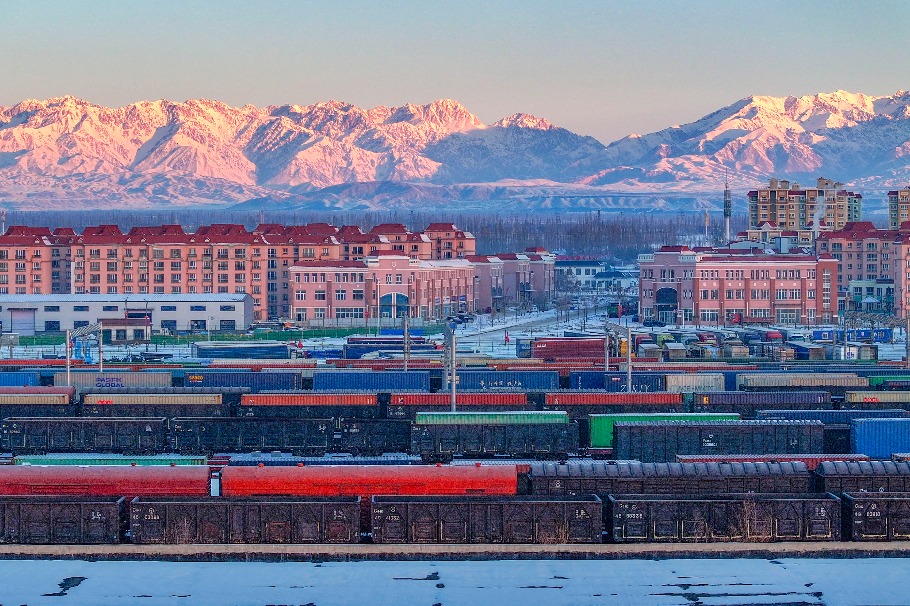
Xinjiang's farm produce on global map








A smartphone can now connect small farmers to big markets, and a single broadband line can add "digital wings" to the special produce of the Xinjiang Uygur autonomous region, helping them reach dining tables across the world. Last year, Xinjiang's online retail sales hit 72.33 billion yuan ($10.17 billion), up 13.62 percent year-on-year. Rural e-commerce, in particular, performed exceptionally well, with rural online sales growing by 18.18 percent, and farm products' sales rising by 14.08 percent, highlighting Xinjiang's huge potential in digital commerce.
That rural e-commerce has taken off for good is evident from Xinjiang's decision to intensively implement its "digital countryside" policy. Farmers now increasingly rely on platforms like Taobao, JD.com and Pinduoduo, as well as livestreaming channels on Douyin, Kuaishou and Xiaohongshu, or RedNote, to sell their produce. Especially, livestreaming has become their new "farm tool". The logistical problem, once the biggest barrier preventing farmers from accessing markets, has been solved with highways reaching farmlands even in remote areas, and cold-chain logistics, rail-road links, and even air freight transporting fresh produce across China overnight.
Xinjiang now has more airports than any other province or region in China, and has extended 5G base stations, cold storage, and pre-cooling facilities to the grassroots level. That means Korla pears, Aksu apples, Luntai apricots, and Atushi figs can be, with one click, shipped across the Tianshan Mountains, and put on dining tables nationwide and abroad.
In a livestreaming session, a simple "click the link" instantly connects remote orchards to global markets. County-level e-commerce service centers and livestream incubators turn online traffic into orders, and orders into income — consolidating the gains of poverty alleviation while creating new jobs and income channels. Indeed, digital technology is weaving Xinjiang's fields into the "cloud", painting a new picture of rural revitalization.
Livestreaming hasn't just expanded sales channels; it has also prompted farmers to standardize and upgrade their products. Take Korla for instance.
Known as China's "pear city", it has integrated remote sensing, GIS, GPS, automation, and communications technology, and built a big-data platform for pear farming.
The system monitors production, manages data and guides the entire value chain. Korla's pear industry practices smart farming, does digital trading and provides integrated industrial services, boosting efficiency, brand value and global reach. Today, Korla pears are exported to more than 20 countries and regions.
The digital economy is emerging as a new engine, driving Xinjiang's development. It has not only enhanced the value of "original" farm specialties but also triggered systemic upgrading across industry chains, infrastructure and the talent structures. By enabling the seamless flow of data, it connects logistics, finance and human resources, restructuring the entire chain of production, supply, sales and services. This offers a rare chance for Xinjiang's remote areas to leapfrog onto a faster track of growth.
Specifically, digitalization is unlocking five types of potential for Xinjiang's development. The first is market potential. The digital economy is breaking geographical barriers, directly connecting supply with real-time demand, and unleashing hidden consumption capacity.
The second is value potential. Data as a new production factor enables graded pricing and branded sales, ensuring "good quality at good prices" for Xinjiang's farm products.
The third is structural potential. Digital platforms are facilitating the upgrade of logistics, cold storage, processing and finance, linking agriculture, industry and services.
The fourth is human potential. Livestreaming, e-commerce operations and supply-chain management create new jobs, encouraging youth to return home and reshape the rural knowledge base.
And the fifth is openness potential. With cross-border e-commerce, data flows and cold-chain corridors, Xinjiang's agricultural specialties are embedding themselves into global value chains. As cold-chain logistics, talent pools and industry standards improve, Xinjiang's digital economy will gain greater momentum, powering regional development and contributing to the broader goal of common prosperity.
Xinjiang's story proves that the digital economy is not the preserve of coastal cities; it can flourish even in mountain valleys and the heart of deserts. For local farmers, data have become new inputs, smartphones new farm tools, and livestreaming a new form of labor. Rural areas of Xinjiang are no longer just recipients of support but also active partners in cooperation, no longer only suppliers of raw materials but also sources of emerging brands.
The snowmelt from the Tianshan Mountains continues to flow, but through fiber-optic cables flows something just as vital: the promise of shared prosperity.
The author is an associate researcher at the Xinjiang Academy of Social Sciences.
The views don't necessarily represent those of China Daily.
If you have a specific expertise, or would like to share your thought about our stories, then send us your writings at opinion@chinadaily.com.cn, and comment@chinadaily.com.cn.