Higher education tailored to suit needs
Three-year plan aims to revitalize academic disciplines to better support development







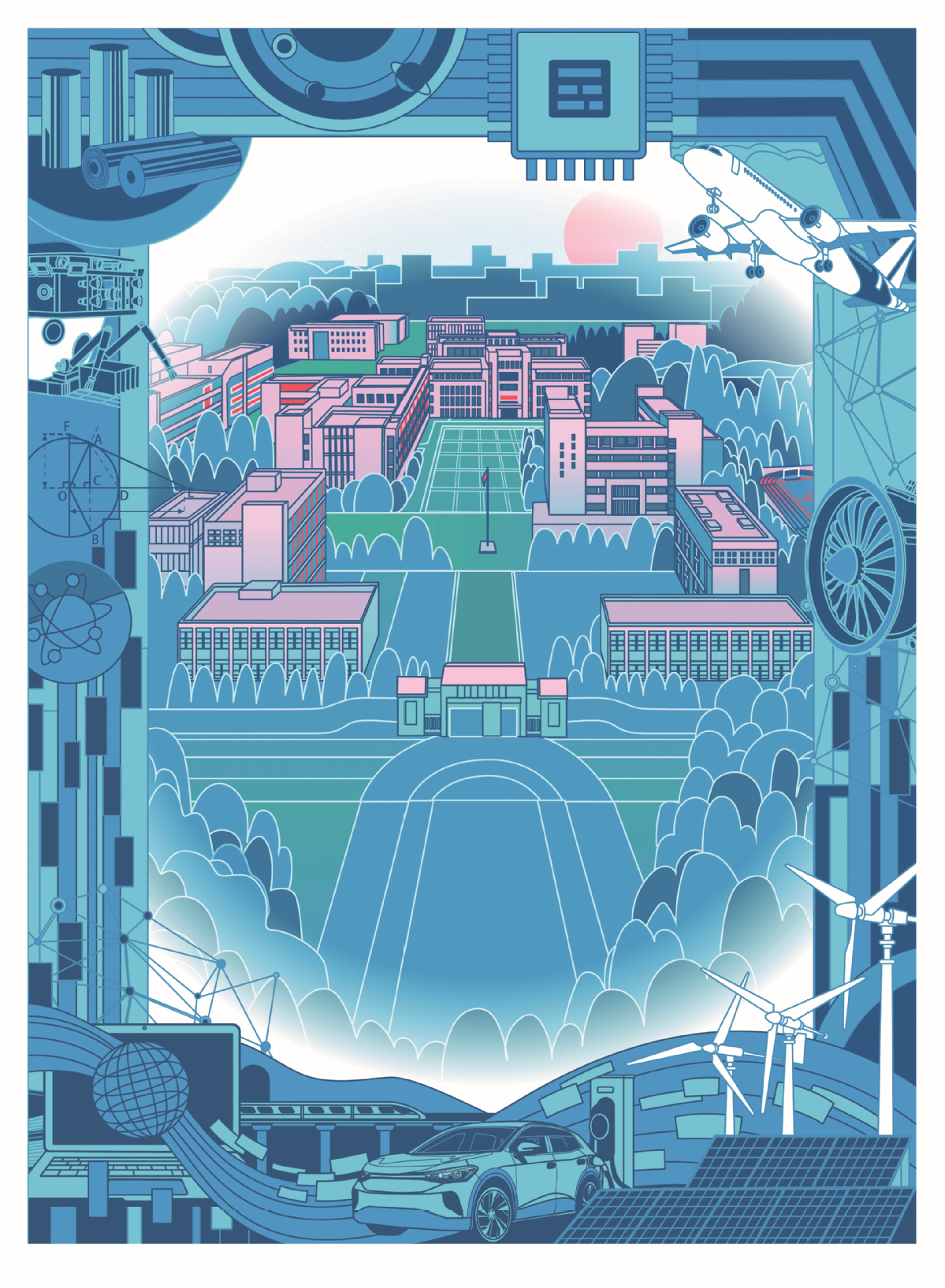
China's recently launched three-year action plan to align higher education with the strategic needs of the country and emerging industries is expected to rebalance majors and curricula to better serve high-quality development.
The plan, issued by the Communist Party of China Central Committee's leading group for education on Aug 28, outlines systematic measures from this year to 2027 to enhance academic disciplines.
The action plan calls for an extraordinary layout of urgently needed disciplines, such as those serving strategic emerging industries, enhancing basic disciplines and incubating emerging and interdisciplinary fields.
Existing programs with insufficient demand or quality will be optimized, and teaching content will be updated with a focus on artificial intelligence empowerment, according to the plan.
It also stipulates that a national big data platform for talent supply and demand will be built.
According to the Ministry of Education, the big data platform is currently in trial operation and features six functional modules, including dynamic data query, employment support and discipline diagnosis.
Over the past two years, the Ministry of Education has supported universities in adding 1,064 doctoral programs and 2,258 master's programs, while revoking programs for 27 doctoral and 285 master's degrees.
It has also guided higher education institutions to establish 3,715 new undergraduate majors and to eliminate or suspend enrollment for 6,638 others. Vocational colleges have added 12,000 new programs and revoked over 8,200 existing ones, reflecting continuous and significant adjustments in academic disciplines and majors, according to the ministry.
In recent years, China has significantly intensified the optimization of higher education academic programs and majors, establishing a range of new disciplines aligned with emerging technologies, industries, business forms and models, according to state broadcaster China Central Television.
Newly created programs include AI, integrated circuits, and regional and country studies.
In response to strategic needs, exceptional measures have been taken to develop high-demand disciplines. For instance, in support of the low-altitude economy, universities have been allowed to establish programs beyond the current catalog with a much faster authorization process.
A total of 29 new undergraduate majors have been introduced this year, such as international cruise management, and health and medical security. A cluster training initiative for highly skilled talent has also been launched in six key advanced manufacturing sectors, including advanced rail transit equipment.
As one of the pilot institutions, Beihang University in Beijing has been experimenting with these adjustments. According to Yan Xiaojun, vice-president of Beihang, the new major in low-altitude technology and engineering is atypical — it draws faculty from six schools and seven disciplines, rather than being confined to a single department.
This program addresses the unique challenges of low-altitude transportation and unmanned aircraft, which require high safety standards and multidisciplinary knowledge integration, he said. Beyond combining disciplines, the university is developing entirely new teaching systems, including curricula, textbooks, practical training and ideological education, he added.
For China, a mismatch between talent supply and demand remains a pressing issue.
Yan said that traditional single-discipline training often fails to equip students with interdisciplinary knowledge and innovative capabilities, which are increasingly required by cutting-edge industries.
In response, Beihang's School of Future Aerospace Technology has adopted a project-based, interdisciplinary approach where students are not divided into conventional majors but instead engage in iterative knowledge-building and real-world projects to foster innovation, Yan said.
Another pilot institution, Fudan University in Shanghai, said it is actively building a new model for cultivating top-notch innovative talent. By restructuring its academic disciplines, the university aims to reshape its educational ecosystem and nurture innovators capable of leading the future and navigating change, it said.
Breaking conventional norms, the university has launched programs in areas such as integrated circuits, national security, nanoscience, artificial intelligence, quantum technology, low-altitude technology, neuroengineering, and brain-computer interfaces. These initiatives are designed to cultivate talent in emerging and critical fields more rapidly, the university said.
Fudan has also initiated a reform that promotes integration across various disciplines, and between undergraduate and graduate education. "Every degree program has revised its training plan, and all courses have been updated," a spokesman for the university said. The traditional major-based training model has been transformed into a more flexible project-based system, allowing students to earn one or multiple degrees upon graduation.
The university has also launched high-level talent training projects in AI, Chinese civilization, social development, cutting-edge technology and biomedicine.
These programs bring together multidisciplinary resources to train doctoral students tackling major scientific and societal challenges, it said.
In a pioneering move, Fudan is also piloting dual doctoral-master's degree programs, combining academic PhDs with professional master's degrees across 10 core disciplines.
Wang Chunchun, deputy director of the higher education research institute at the China National Institute of Education Sciences in Beijing, said the adjustment of academic disciplines is not only a matter within the higher education system but also a concern for the whole society. It requires the joint efforts of multiple stakeholders, including industry, government, society, students and parents.
From the industry perspective, businesses can engage more deeply in the talent cultivation process. Companies can provide students with more opportunities for internships, practical training and handson experience. They can even play a greater role in developing talent training plans and designing curricula and teaching materials, he said.
On the government side, they can better recognize the contributions of universities to local socioeconomic development in their evaluations, he said.
Students and parents need to shift some of their perspectives, too. For example, when choosing majors, they should have a rational understanding of so-called cold and hot disciplines, he said. Given the rapid advancement of technology and fast-changing social and industrial demands, it is essential to develop an awareness of and capacity for lifelong learning, said Wang.
zoushuo@chinadaily.com.cn



- Record ocean heat in 2025: a deepening climate challenge
- Beijing offers free two-dose bivalent HPV vaccination for girls
- Hunan students craft opera headpieces from recycled materials
- Haidian police crackdown on campus fraud with new safety model
- Several BRICS countries to conduct maritime military exercises near South Africa
- Shanghai to launch year-long global food festival in 2026