Powering the future, smartly
Integration of artificial intelligence and green energy can pay rich dividends for the economy







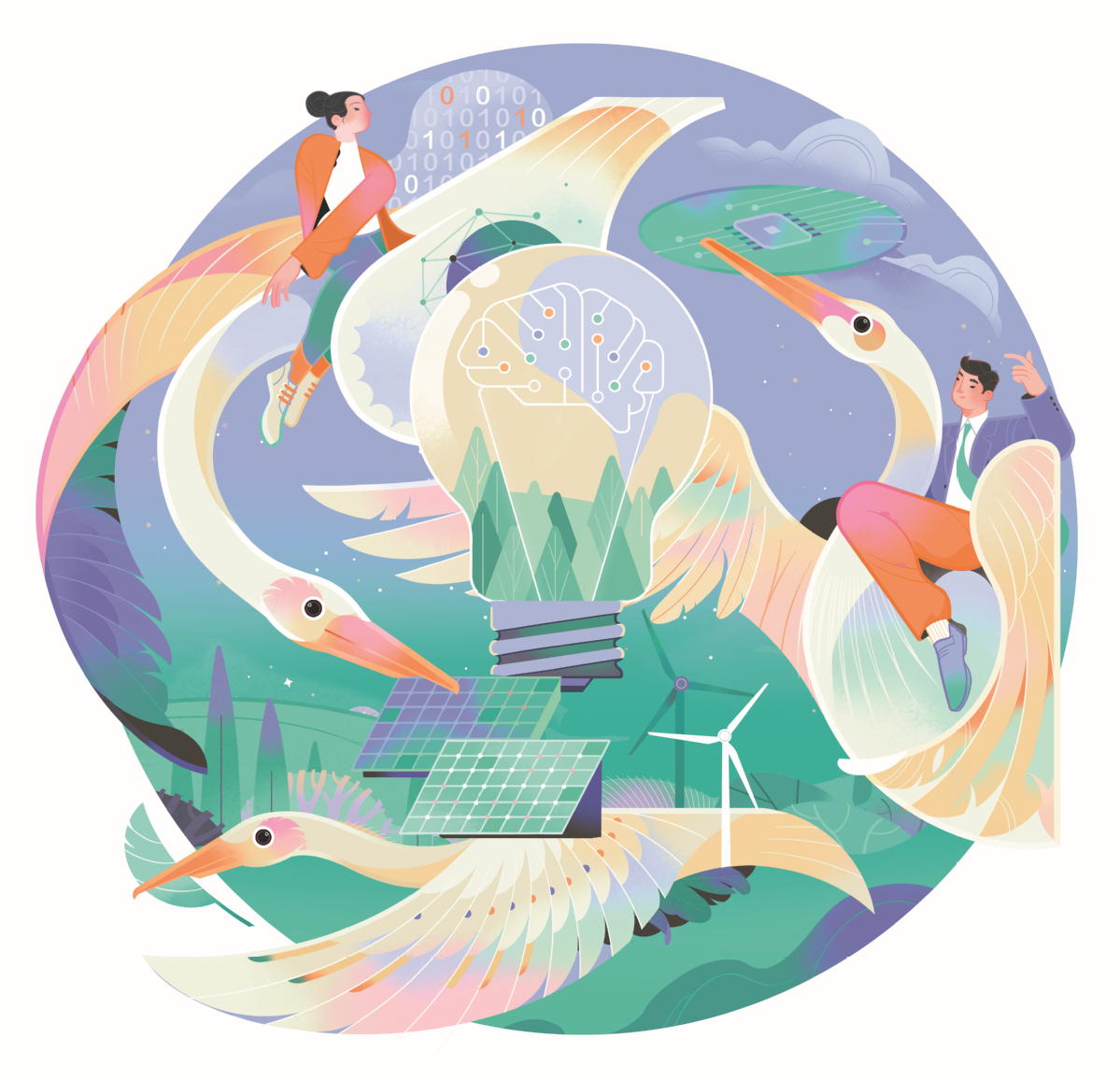
In recent years, artificial intelligence has witnessed explosive growth, while the green energy sector is undergoing a significant transformation. The fusion of AI and green energy is emerging as a key driver of economic development in this new era.
Green energy — encompassing solar, wind, hydro, biomass, and nuclear power — represents the future of energy supply and serves as the foundation for achieving the nation's dual carbon goals — peaking carbon dioxide emissions before 2030 and achieving carbon neutrality before 2060 — and sustainable development. Currently, China stands as the world's largest producer of green energy, boasting a comprehensive and robust green energy industry chain.
China has been at the forefront of developing AI models, which are versatile and applicable across various scenarios. These models promote the widespread adoption of AI across diverse fields through multimodal technology, including text, image and voice integration.
AI is poised to become a fundamental tool in achieving the dual carbon goals. According to the International Energy Agency, the widespread application of AI could reduce billions of metric tons of carbon dioxide emissions annually by 2035.
There is a synergistic relationship between AI and green energy. AI facilitates technological and operational advancements in green energy, while simultaneously requiring green energy to support its own energy consumption. This deep integration is reshaping the global industrial landscape, steering the economy toward a technology-dependent and low-carbon transformation.
Application scenarios
The convergence of AI and green energy offers numerous innovation opportunities in the energy sector, with several notable applications:
1. Smart Grids: Smart grids incorporate advanced sensors, communication technology, and AI algorithms to enable real-time monitoring and optimization of power systems. AI can autonomously adjust power generation in response to demand fluctuations, enhancing grid efficiency and minimizing energy waste. In China, the State Grid Corporation is actively advancing smart grid construction by leveraging AI to boost grid intelligence.
2. Energy Forecasting and Management: AI analyzes historical and real-time data to predict energy demand and supply. In the realm of green energy, AI can forecast solar and wind power generation, aiding companies in better planning energy production and scheduling. Numerous software firms have developed energy management solutions that provide precise management services using AI technology.
3. Smart Energy Devices: AI technology can upgrade energy devices, such as smart solar panels that automatically adjust angles to improve efficiency, and smart wind turbines that optimize blade angles based on wind speed and direction. Technology companies are continuously developing smart energy devices, utilizing AI to enhance performance and reliability.
4. Energy Storage System Optimization: AI optimizes the charging and discharging strategies of storage devices, adapting to supply-demand changes and price signals. By devising optimal storage strategies, AI enhances system efficiency, lifespan, flexibility, and stability, thereby supporting large-scale renewable energy integration.
5. Flexible Load and Virtual Power Plants: AI enables precise analysis and prediction of user energy consumption behaviors, facilitating intelligent control of flexible loads. For instance, smart algorithms analyze consumption data to predict demand changes, offering personalized energy-saving suggestions and optimization plans for users. VPPs aggregate distributed energy resources to form a virtual power plant that participates in market transactions and grid operations. With AI, VPPs can monitor and control distributed energy devices in real time, optimizing production, storage, and consumption, thereby improving efficiency and grid stability.
6. Technology Research and Material Innovation: AI algorithms can swiftly screen vast material chemical compositions and structures, predicting performance and accelerating the development of new materials and technologies. In research on new photovoltaic materials, high-performance battery materials, and efficient catalysts, AI significantly shortens development cycles and reduces costs. Exploring the deep integration of energy and information and communication technology, including energy blockchain, big data, and artificial intelligence, fuels innovation and the development of new application models in smart green energy technology.
7. Energy Consumption and Application: The development and promotion of smart appliances and lighting systems with intelligent control and energy-saving features can adjust operating states based on user habits and needs, saving energy and improving efficiency. Green buildings incorporate energy-saving, environmental protection, and low-carbon considerations in design, construction, and operation, using efficient insulation, energy-saving lighting, and smart control systems to achieve energy self-sufficiency or reduced consumption, as seen in passive solar buildings and green data centers.
8. AI and Green Finance Integration: The integration of AI and green finance emphasizes precise data management, intelligent risk assessment, and the development of innovative financial instruments. This approach encompasses various aspects of the green finance process, such as carbon accounting and monitoring, multidimensional ESG assessments, intelligent risk management, and targeted resource allocation. It also includes the innovation of financial products and services, and the development of carbon finance instruments. Together, these elements create a comprehensive cycle of AI-driven carbon reduction supported by green finance.
Innovation in methodology
The evolution of smart energy relies on methodological innovation, involving mindset transformation, technical methods, and tools for innovation. It's crucial to enhance the collaborative integration of various energy forms during production, utilizing technologies like the internet of things, big data, and AI to form an integrated smart energy system encompassing generation, grid, load, and storage.
During energy transmission, building reliable and efficient smart grids is essential. For energy storage, various technologies should be employed based on specific scenarios, including lithium batteries, flow batteries, hydrogen storage, and hydropower storage. Smart management systems can optimize the scheduling of these storage devices, enhancing their overall performance and lifespan.
In energy consumption, the goal is to achieve intelligent and efficient energy use, including automatic adjustments of appliance operation modes based on user habits and electricity price signals to conserve energy. In green energy development, emphasis should be on distributed energy construction, focusing on microgrids and local networks to enhance power supply security in emergencies.
Government policies supporting smart energy development, including financial subsidies, tax incentives, and streamlined project approvals, are vital. Enterprises are encouraged to invest in R&D and the application of smart energy technologies.
The government should guide toward smart and low-carbon development through planning and target setting, and strengthen oversight to prevent market monopolies and unfair competition. Consistency and stability in policy are crucial to avoid adverse impacts on the smart energy industry due to frequent policy changes.
The decisive role of the market in resource allocation should be fully utilized. Enterprises need to continuously innovate business models to meet diverse market demands.
Traditional energy systems, where sectors like electricity, heat, and gas operate independently, require integration to achieve multienergy complementarity and collaborative optimization. Smart energy systems must also integrate with fields such as transportation, construction, and industry to strengthen collaborative development.
Geographical constraints often lead to a mismatch between energy resource distribution and demand centers. Smart energy systems can achieve cross-regional optimal allocation of energy through technologies like the energy internet.
Innovation in smart energy methodology is evident across various aspects. For energy forecasting, traditional statistical methods fall short of high-precision needs, whereas AI deep learning algorithms handle complex nonlinear relationships, improving prediction accuracy. In energy management, big data-based analytical methods provide enterprises with comprehensive and precise solutions. Many energy companies in China are adopting these new methods to enhance efficiency and management levels.
For any energy company, integrating AI is no longer optional but essential to remain competitive. Companies should adopt selected AI tools and technologies to build a suitable toolkit while preventing data leakage, model bias, and system loss of control. This involves clarifying business needs, selecting technologies, and choosing development platforms to meet enterprise development requirements. They should expand scenarios to build a modular ecosystem, upgrading from point tools to an AI nervous system for business processes.
New energy infrastructure is pivotal for achieving China's dual carbon goals, characterized by a transformation toward clean, intelligent, and multi-energy, facing challenges in supply-demand matching, cost control, technological collaboration, security assurance, and resource constraints. Innovations include smart sensors, communication networks, and energy storage devices.
Smart sensors monitor the operational status of energy equipment in real time, providing accurate data support to AI systems. High-speed communication networks ensure rapid data transmission, enabling real-time optimization and control of energy systems. High-performance storage equipment addresses the intermittency problem of renewable energy, storing excess energy and releasing it during shortages to enhance supply stability.
The construction of smart energy infrastructure significantly impacts economic and social development, stimulating direct investment, promoting industrial upgrading, driving emerging industries, optimizing resource allocation, promoting regional development, and enhancing economic resilience. It also improves environmental quality, promotes social equity, enhances social governance, and aids smart city construction.
As a major driver of economic development in the new era, smart energy is profoundly transforming our society and economy. By combining AI with green energy, we can achieve efficient energy utilization and sustainable development. Active response and continuous innovation across society will provide strong momentum for the advancement of smart energy, leading us toward a greener, more intelligent future.
The author is a former vice-minister of science and technology.
The views don't necessarily represent those of China Daily.