Bringing new light to a dark history







I was shocked when she told me where she lived.
I'd just met my US neighbor, Cindy Vautrin — who lived a literal stone's throw, four houses, down the street from me in Mt Pleasant, Michigan — in Beijing in 2005.
That was because she's the great niece of a hero of the Chinese People's War of Resistance Against Japanese Aggression (1931-45) and the World Anti-Fascist War.
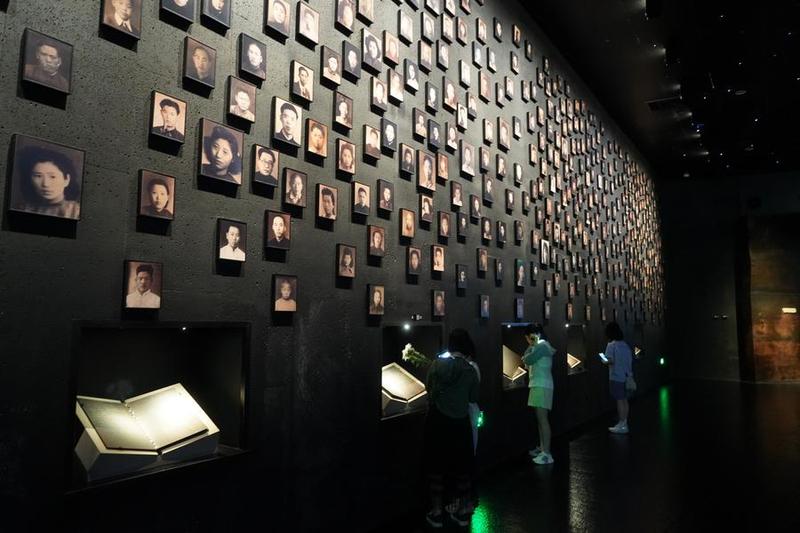
Minnie Vautrin is celebrated as an American missionary who saved thousands of Chinese women during the Nanjing Massacre. This wasn't just my first time hearing about Minnie Vautrin, who's lauded as a "real-life Goddess of Mercy", but also of hearing about the Nanjing Massacre. In fact, it was my first time hearing about Nanjing, the city, at all.
My experiences growing up in the United States demonstrate how much more needs to be done in conveying this history in North America and much of the rest of the West.
I progressed from kindergarten through university — where I focused on international affairs — learning nothing about the Japanese invasion of China, except that it happened.
Like most of my peers, I could sum up the totality of my knowledge in three words: "Japan invaded China". That's all.
Most of my classmates didn't even know that. Many still don't. And neither do their kids.
Even though my grandfathers fought against Japan — my maternal grandpa lied about his age to join the US military and fought in the Philippines; the other was sent to the European theater — I knew almost nothing about their experiences.
When I was a boy, Grandpa gave me a pipe carved by a freed prisoner of war, a knife fashioned from a downed plane and a Japanese sword. But all he ever told me about his time in Asia was that he couldn't eat rice after the war because it reminded him of the atrocities he had witnessed.
Most Americans' knowledge of Japan's role in what we call World War II begins and ends with Pearl Harbor and the atomic bombs, with virtually nothing in between. Meanwhile, the fight against the Nazis is taught in exhaustive detail.
So, I'd never heard of the Nanjing Massacre until 20 years ago, when as a China Daily intern, I covered a dance drama in Beijing about author Iris Chang, who wrote The Rape of Nanking, and Minnie Vautrin, a household name in China basically unknown in her homeland, which is also mine. Turns out, Minnie Vautrin was buried in the nearby village of Shepherd, Michigan, and I drove past her grave on my daily commute.
Her great-niece, Cindy, and another relative both lived in my neighborhood and worked at Central Michigan University, where I studied.
A couple of years later, I interviewed Iris Chang's parents while covering a docudrama about her life.
They'd narrowly escaped the massacre, which ended up claiming their daughter when she, like Vautrin, took her own life, after gazing too long and too deep into the darkness.
This is a darkness that needs to be brought to light, especially in the corners of the world where it lingers in the shadows of ignorance.
I wrote then, in 2007, "Today, the world remembers Iris Chang as a champion for justice, because Iris Chang refused to let the world forget injustice."
As the film's director told me, "People in North America never learn about this history."
It's perhaps ironic that I first learned about it in Beijing through the legacies of two American women.
While little has changed in terms of awareness in the West, the internet and social media have transformed our capacity for telling these stories globally.
The docudrama opens with footage of Chang saying: "The Rape of Nanking was something that always could happen. And it did happen. And we have to learn from history if we want to make sure it doesn't happen again."
As such, telling this story better is not only a mission but a duty — one we owe not only to the Chinese victims and victory of eight decades ago but also to all the world for all the decades yet to come.
The author is a writer with China Daily.