After a century-long ban, Parisians embrace the Seine







On a blazing August morning in Paris, I joined a queue that snaked around one full city block. The air shimmered with heat, yet the crowd waited with patience that seemed almost ceremonial. Dogs tangled their leashes among children, friends chatted idly, couples shared pastries, and still the line advanced in quiet order, with nobody complaining.
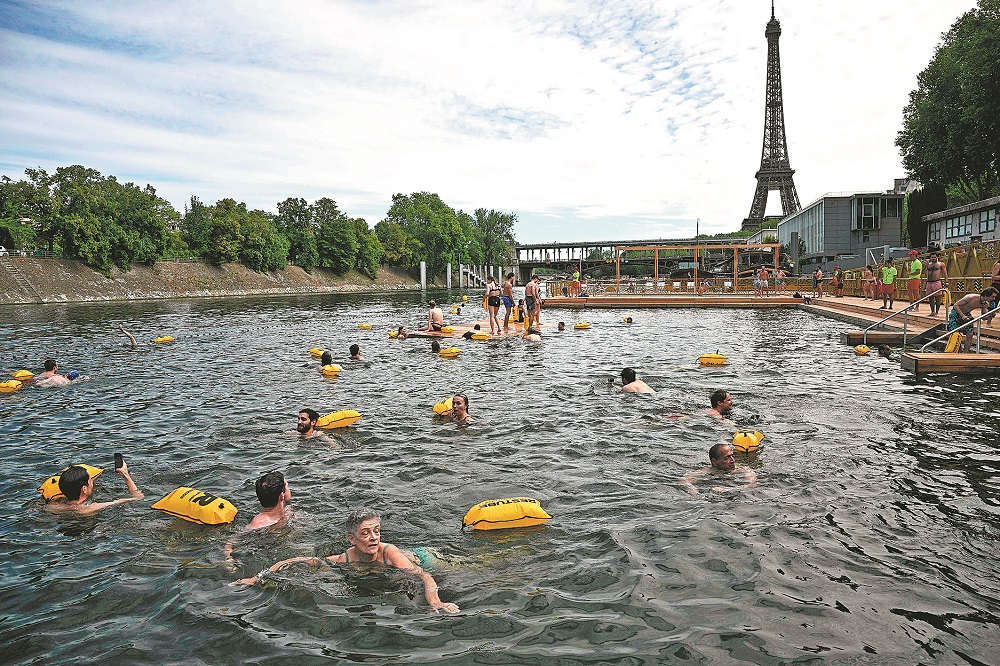
It was not the launch of a new iPhone, nor an exhibition at the Louvre, but something closer to human nature. At the head of the line lay a stretch of river water, roped off by wooden pontoons and lifeguard towers: a swimming pool carved from the Seine.
Yes, both local Parisians and tourists in the line were waiting for the last half-hour to swim in the Seine, before which they had waited for more than a hundred years.
Past the security gate, a surge of bodies moved with purpose — some darting to changing rooms, others stripping down to swimsuits they had worn beneath their clothes. The bravest raced onto the floating platforms, pausing just long enough to glance at the water before plunging in. Cheers rose with every splash.
This is one of three official bathing sites newly opened along the Seine, each part of an ambitious project to restore public swimming in the river. Since July 5, the Seine, which was long forbidden to swimmers due to pollution, has been declared safe again.
In the weeks since, the pools have become magnets. Residents arrive with families in tow, tourists stumble upon them with wide-eyed delight, and the queues remain as long as they were on day one. The Seine, that liquid spine of Paris, has finally been returned to the people who live beside it.
Few rivers are as entangled with the identity of a city as the Seine is with Paris. The Eiffel Tower presides over its banks, Notre-Dame rises from its central island, while the Louvre, Les Invalides, and the famed cafes of the Left Bank all sit within earshot of its flowing waters.
For centuries, Parisians treated the river not just as scenery but as a part of daily life, with washerwomen working along its edges and children leaping from bridges in summer. Floating bathhouses multiplied during the 19th century, where citizens could swim in cordoned-off sections of the river. In 1913, the French national diving championships took place right here, in the middle of Paris.
Then came the rupture. Industrial waste, untreated sewage, and river traffic so fouled the waters that scientists detected it contained exceedingly high amounts of E.coli.
In plainer words, the Seine had too much poop in its water.
My friend Yang Yong, a professor of environmental sciences, said that the percentage of E.coli in the Seine might have been high for a long time before the 1920s. "They just started analyzing it at that time," he said with a schadenfreude smile.
That is essentially why in 1923 the city issued an outright ban on swimming and turned the once people's playground into a forbidden zone.
Generations grew up knowing the Seine only as a sight to be admired, not touched. Efforts to reverse the damage moved slowly, often mired in politics. In 1988, Jacques Chirac, then mayor of Paris, vowed he would one day swim in the Seine to prove it had been cleaned.
Chirac later became president of France, but even his promise dissolved into empty air.
It was not until 2015, when Paris secured the 2024 Olympic Games, that urgency finally arrived. Determined to stage open-water events in the heart of the city, officials poured 1.4 billion euros ($1.62 billion) into cleaning the river. Skeptics mocked the effort, among which one US magazine even used a big headline on July 30, 2024: "Paris Spent $1.5 Billion Cleaning Poop Out of the Seine, and It's Still Too Dirty for Olympic Swimming".
Magically, when the Games began, athletes swam in the Seine without incident. The stage was set for the public to follow.
Wave of emotion
The reopening has unleashed a wave of emotion. Fan Fan, a longtime Paris resident of Chinese descent, told me she had brought her entire family, from toddlers to grandparents, to claim a spot on opening day. For her, the chance to swim in the Seine felt like both a civic ritual and a family memory in the making.
But the Seine is also drawing outsiders. Of the two dozen people I spoke with in line, eight had traveled from other parts of Europe specifically to swim here; three had even taken connecting flights. "There's only one Paris, and only one Seine," several tourists said.
By late morning, lifeguards began pacing nervously along the pontoons, scanning the water as novice swimmers clutched brightly colored floats. When the pools reached capacity, officials closed the gates, leaving newcomers to lean against the river railing. Some craned their necks to watch the swimmers inside. Others pulled out phones to capture the spectacle: hundreds of bodies colliding, floating, laughing — a vision of chaotic joy that had been absent from the river for more than a century.
The return of swimming is not only a gift of recreation but a symbol of environmental recovery. For decades, the Seine embodied the costs of industrialization, a reminder that progress could poison as easily as it could uplift. To dip into its waters today is to participate in a story of resilience — of ecosystems slowly coaxed back to life, of a city reimagining its relationship with nature.
For now, the Seine's return feels both extraordinary and fragile, a triumph that could just as easily slip away if vigilance lapses. Yet the sight of children splashing under the gaze of Notre-Dame suggests something lasting has shifted: Parisians are reclaiming their river not as backdrop, but as a part of their lives.
When I returned at 4 pm, weary from a day of reporting elsewhere in the city, the line was still there — just as long, just as patient. The sun had shifted, the shadows longer, but the atmosphere had not changed. Paris was still waiting for the Seine, and the Seine was finally waiting for Paris.
The author is the China Daily EU Bureau Chief Correspondent based in Brussels.