



From humanoids to parallel intelligence







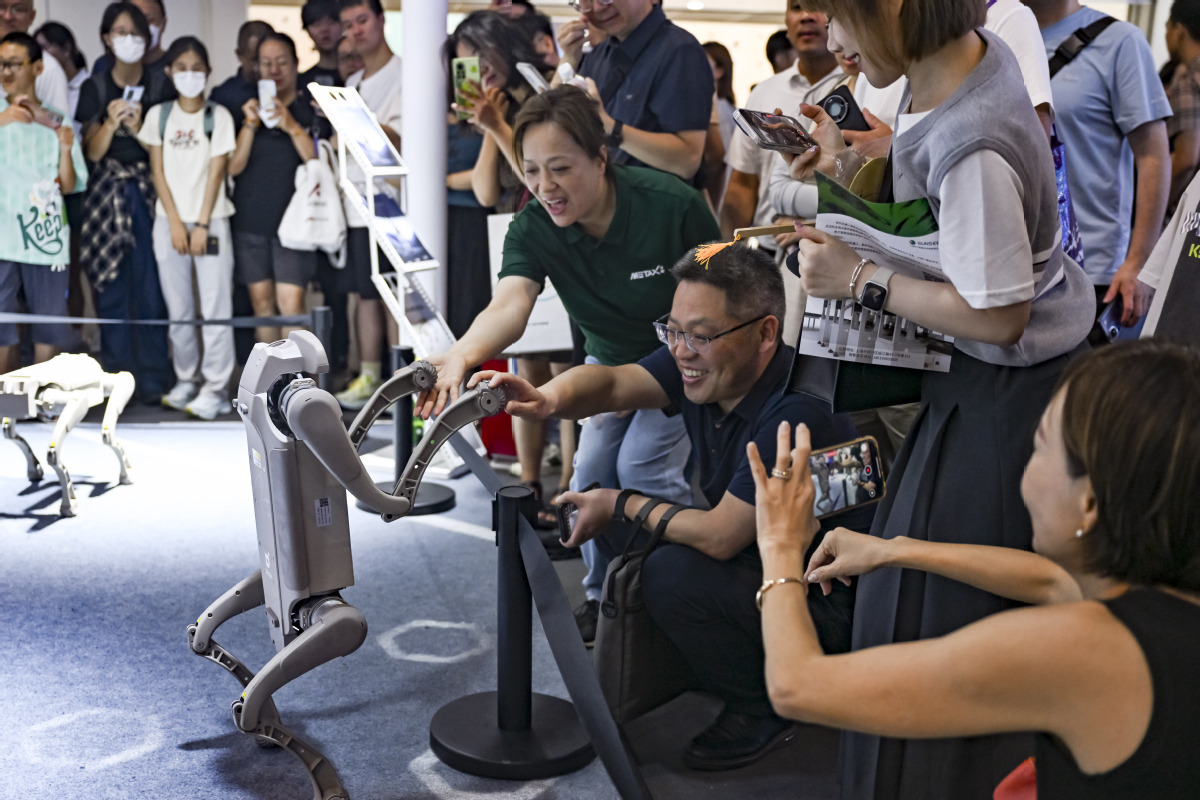
Shanghai hosted the 2025 World Artificial Intelligence Conference and the High-Level Meeting on Global AI Governance last month. Earlier this month, Beijing played host to the World Robot Conference and the World Humanoid Robot Games — a dazzling display of China's technological energy, innovation and ambition in the era of "AIR", that is, AI plus robotics.
From AI to embodied intelligence, these technologies are not just tools but also engines set to transform our world. Open, collaborative global development is one of the best ways intelligent science and technology can benefit humanity and help countries achieve sustainable growth.
Tesla and SpaceX founder Elon Musk recently said: "The path to solving hunger, disease, and poverty is AI and robotics." But he was only half-right, because AIR represents only a new paradigm for human survival, a kind of "intelligent air" that sentient life cannot do without.
The real showstopper is the humanoid robot. This was reflected at the World Humanoid Robot Games, which featured 26 events and 487 matches, with more than 500 humanoid robots from 127 brands.
Teams from 16 countries across five continents, including 192 university squads and 88 corporate teams, competed in the games. According to the International Federation of Robotics' Aug 14, 2025, report, "Vision and Reality", humanoid robots are on track to become "the next big thing in robotics".
China, as the world's largest industrial robotics market, has laid out concrete plans and targets, and begun large-scale production and application. The goals are clear: transformation of manufacturing, embedding robotic intelligence in society, and accelerating the rise of a knowledge-driven, intelligent industrial ecosystem.
But behind the glittering spectacle lies serious engineering. Participants tested hardware platforms, multimodal perceptions, decision-making, execution control, communications and energy management. The arena featured a mix of jaw-dropping leaps, awkward tumbles and occasionally comical missteps. They reminded us that humanoid robotics remains a frontier field, full of experimentation and rapid evolution.
The competition highlighted both the performance limits of individual machines and the immense promise of collaboration. To fully realize this potential, open, shared data and model coordination, cross-platform interaction and multi-robot collective intelligence are essential. And with the end of the games, these skills must migrate from the stadium to the real world — factories, hospitals and homes — where robots can continuously improve safety, adaptability and intelligence.
The games were more than a tournament; they were parallel experiments in motion, bringing together AI computational experiments and embodied agents' prescriptive intelligence. The goal was not merely winning medals but also practical, scenario-driven deployment. Robotics divorced from real-world application risks stagnating in low-level, repetitive development.
By testing humanoids under extremely challenging situations, the games publicly assessed motion control, environmental perception and autonomous navigation, embodying the ACP methodology of parallel intelligence: artificial societies plus computational experiments plus parallel execution. Every physical robot has a digital twin in the virtual world. Pre-game algorithm optimization counts as computational experiment; each graceful jump — or spectacular fall — feeds priceless real-world data. This feedback is prescriptive intelligence, guiding the next iteration toward smarter decisions and more effective actions.
The games also acted as a prism, reflecting the broader ecosystem, economic dynamics and social impact of humanoid robotics. First, they showed that intense competition can expose the industry's Achilles' heel. When a robot falters due to the limit of a gearbox or servo motor, the failure is far more visceral than any report.
Second, the games helped reassure investors, redirecting capital from abstract hype to tangible applications, and making sure that enterprises clear core technical bottlenecks and increase real-world deployment.
Third, they proved that robots on the field are athletes, not sci-fi villains. They assuaged the fear that "machines would replace humans" and instead helped many realize the fact that robots will liberate humans from repetitive or dangerous tasks while creating new value and employment opportunities. One minute a robot nails a flawless kick, the next, it trips spectacularly — both moments teach us the importance of persistence, learning and continuous technological development.
And fourth, the games raised a fundamental question: What does AIR really stand for? As scientists like Geoffrey Hinton caution, without careful guidance, AIR could serve capital rather than humanity. Beyond showcasing the "hard power" of robotics, the games provoke reflection on its soft power — policies, ethics and rules shaping its development. True intelligence is not measured by how fast a robot runs but by our ability to craft a safe, inclusive, and sustainable path through the parallel interaction of virtual and physical worlds.
In this sense, the World Humanoid Robot Games are far more than a competition. They are a thought experiment in action, blending spectacle, strategy and social insight. They demonstrate China's leadership in shaping an AIR era that is not only technologically advanced but also ethically grounded, economically rational and socially beneficial — a world where robots will not replace humans but empower them, and where intelligent machines become a true extension of human capability.
The author is director of the State Key Laboratory of Management and Control for Complex Systems, Institute of Automation, Chinese Academy of Sciences.
The views don't necessarily represent those of China Daily.
If you have a specific expertise, or would like to share your thought about our stories, then send us your writings at opinion@chinadaily.com.cn, and comment@chinadaily.com.cn.





