Exemplary vision drives development







Over the last 10 years, China has undergone a remarkable economic shift guided by Xi Jinping Thought on Economy, which emphasizes innovation-driven high-quality development, and a dual circulation development paradigm that prioritizes domestic consumption while maintaining global engagement.
China has not only consolidated its position as the world's second-largest economy but also become the main driver of global growth. Indeed, according to Baillie Gifford, an independent investment manager, China has contributed more to global economic expansion in the past decade than all G7 countries combined.
This highlights the depth and adaptability of China's economic framework. Despite facing headwinds such as regulatory tightening, geopolitical tensions and a slowing property sector, China's economic fundamentals remain robust and dynamic.
A particularly vivid sign of China's economic dynamism can be seen in the scale of its capital markets. As someone who has followed emerging markets for years, I find it remarkable that China's stock exchanges are now the second largest globally, hosting more than 6,000 listed companies, with nearly 3,000 new listings on the A-share indexes in just the past decade. While stock market performance does not fully reflect underlying economic fundamentals, this surge in entrepreneurship nevertheless indicates China's capacity for adaptation and innovation at scale.
In 2024, China was the best-performing major stock market globally, with the Baillie Gifford China Growth Trust reporting a net asset value increase of 38.1 percent and a share price rise of 39.7 percent in the 12 months to March 2025. These figures are not just impressive; they signal a broader recovery in investor sentiment and renewed confidence in China's domestic growth drivers, even if they should be interpreted alongside broader economic indicators.
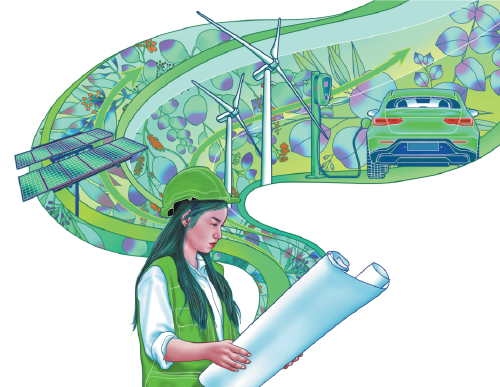
China's industrial boom is particularly evident in its global leadership in electric vehicles (EVs), solar power technology and automation. The country now accounts for nearly one-third of global manufacturing output, leading in sectors such as green technology and artificial intelligence.
Companies like BYD, China's leading EV manufacturer, have overtaken Tesla in new EV sales in Europe and are expanding aggressively into Southeast Asia, Latin America — particularly Brazil — and Australia. Chinese enterprises' global growth signals its transition from "Made in China" to "Invented in China", a transformation that is reshaping global supply chains and consumer markets.
Arguably, the most telling aspect of China's current development stage is not the inflow of talent, but the fact that talent is here to stay, and the retention of talent marks a significant shift in global innovation dynamics. The country's innovation ecosystem is further strengthened by its vast and growing talent pool — universities are working in tandem with industries to become "talent nurseries" where aptitude is well rewarded. China produces about 40 percent of the world's STEM(science, technology, engineering, and mathematics) graduates each year, laying a formidable foundation for sustained technological leadership.
In this regard, Apple CEO Tim Cook's observation is particularly illuminating: "In the U.S., you could have a meeting of tooling engineers, and I'm not sure we could fill the room. In China, you could fill multiple football fields."
China's digital economy, too, is flourishing, driven by tech giants such as Tencent, Alibaba, PDD and Meituan. These firms have doubled their aggregate profits since 2021, despite a significant drop in market capitalization, thus creating opportunities for long-term investors. On the consumer front, brands such as Pop Mart are making waves internationally. Known for its collectible toys and youth-focused appeal, Pop Mart has received enthusiastic reception in Western markets, with long queues forming outside its London store — a testament to China's expanding cultural and commercial footprint.
Besides, despite macroeconomic challenges, including a declining labor force and shifting global trade dynamics, China's domestic consumption is showing signs of recovery.
President Xi has also emphasized the importance of self-reliance in strategic sectors — a response to external pressures such as the United States' restrictions on exports of various products and technologies to China. As expected, Chinese enterprises like AMEC and Naura are stepping up to fill the gaps in semiconductor manufacturing, while Horizon Robotics is emerging as a domestic alternative to global AI chip leaders. These shifts point to a wider movement toward domestic innovation and technological independence.
China's economic path has been marked by both change and durability. While short-term volatility and geopolitical risks persist, the long-term outlook is shaped by innovation, strategic policymaking and a vast domestic market. For global investors and observers alike, understanding the nuances of this evolution is essential to not only grasp China's role in the world economy, but also appreciate the opportunities it continues to offer.
China's economic journey under the leadership of President Xi illustrates a strategic blend of innovation, industrial capacity and global integration. The country's ability to retain talent, lead in emerging technologies, and expand its cultural and commercial influence underscores its growing role in shaping the global economy.
As China continues to navigate complex macroeconomic and geopolitical challenges, its commitment to high-quality development and self-reliance positions it as a resilient and transformative force in the international landscape.
The author is with the University of Macau (China). The views don't necessarily reflect those of China Daily.
If you have a specific expertise, or would like to share your thought about our stories, then send us your writings at opinion@chinadaily.com.cn, and comment@chinadaily.com.cn.