



Japan's politicians demonizing China to garner right-wing support







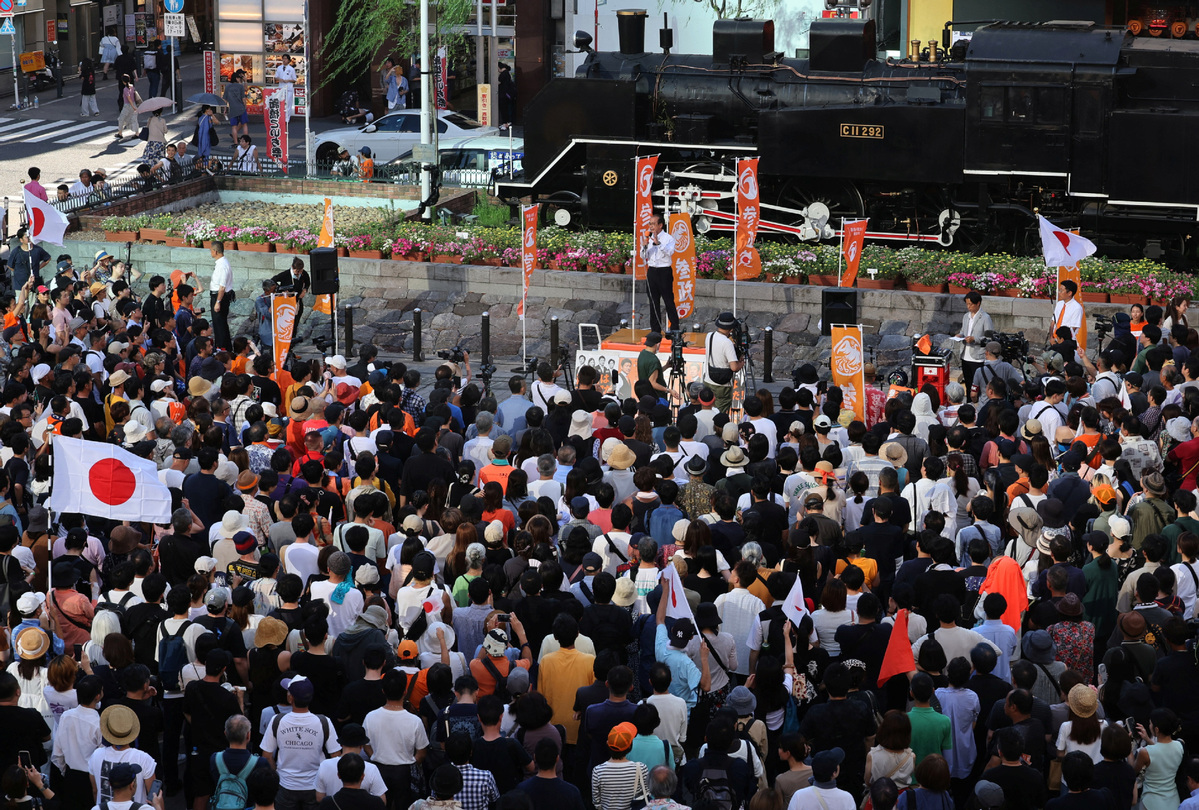
This year marks the 80th anniversary of the victory in the Chinese People's War of Resistance Against Japanese Aggression and the World Anti-Fascist War. But far from introspecting and regretting its past, Japan's 2025 defense white paper has once again labeled China as its "an unprecedented and the greatest strategic challenge".
China has been a constant subject of attention since Japan began publishing its defense white paper in the 1970s. Over the decades, references to China have evolved from sparse mentions to being the central focus of the annual treastise. The 1976 edition expanded its focus to China's nuclear capability and military modernization. In 1983, China was assigned a dedicated section. By 2011, as China overtook Japan as the world's second-largest economy, the word "China" began to appear prominently in the defense minister's foreword in the white papers. Since 2013, "China" has often topped the list of concerns in these forewords.
That these white papers are aimed at influencing public opinion against China is clear from the way Japan has been propagating them. In fact, as early as 2006, Japan began publishing comic versions of the white paper, and the target audience was clear. In 2021, it even released a children's version of the white paper aimed at primary and middle school students. In addition, for years the defense white paper has only offered detailed versions in Japanese, with only abridged versions in English and Chinese.
The 2023 edition of the white paper was the first to describe China as "an unprecedented and the greatest strategic challenge", a phrase that has now appeared for three consecutive years. The 2025 edition has no substantive change in content. It still focuses on China's defense budget, military capacity and activities, topics that have featured in previous editions. Notably, the frequency of the "strategic challenge" phrase has decreased, from eight mentions in 2023, five in 2024 to only two in 2025.
What is more telling is the timing of the white paper's release this year. The 2025 edition was marked as "issued in June" but was not released until July 15, just five days before Japan's upper house election. This suggests that the paper's release was likely aimed at rallying nationalist sentiment and influencing undecided voters.
Despite this maneuver, the election results speak volumes. The ruling coalition of the Liberal Democratic Party and Komeito failed to secure a majority, making the LDP a minority in both houses for the first time in nearly 70 years. This is the third election failure of Prime Minister Shigeru Ishiba's cabinet after 10 months in office.
The blame lies not just with Ishiba, but with the deep-seated disillusionment toward the LDP, fueled by repeated scandals, faltering domestic policies and trade talks with the United States.
In response, the LDP has sought to mobilize all possible demographics, regardless of age or political leaning. The Japanese public is becoming increasingly disengaged from politics. According to official data, the average voter turnout across all age groups in the general election for the House of Representatives (lower house) held in October 2024 was only 53.85 percent. This means nearly half of eligible voters did not cast a ballot. Additionally, an NHK public opinion poll released two weeks ago, showed that only 32 percent of respondents said they were very interested in the House of Councillors (upper house) election scheduled this month.
Besides, voter turnout among Japan's younger generation has remained consistently low. In 2015, Japan lowered the voting age from 20 to 18 in an effort to increase participation, but the impact has been limited. According to the same NHK poll, more young people expressed a willingness to vote this year, with 44 percent of respondents aged 18-29 and 52 percent of those aged 30-39 saying they planned to vote.
However, these figures only reflect pre-election intentions. According to official statistics from the October 2024 House of Representatives election, voter turnout was 39.43 percent among those aged 18-20, 34.62 percent among those aged 21-29, and 45.66 percent among voters in their 30s.
This political disengagement means the electoral field is dominated by just two groups. Voter turnout among those aged 60 and above was approximately 74 percent. This age group also tends to be more "patriotic". According to a 2024 public opinion survey by Japan's Cabinet Office, 67.7 percent of respondents in their 70s said they love their country and 63.1 percent expressed overall satisfaction with society.
Another key group is the politically engaged right-wing and right-leaning voters, who, for a long time, have largely come from this same "patriotic" older demographic. This skew is helping the right wing. The ultra-right party Sanseito ranked as the second most supported political party among people aged 30-39 and 50-59.
However, though many voters are deeply dissatisfied with the ruling coalition and are eager for political change, the absence of a viable opposition party capable of challenging the LDP's entrenched power leaves them with no alternative. As a result, far-right parties have become the default recipients of this floating support, absorbing protest votes and political frustration.
Although there is no concrete data showing that vote-getting tactics, including the early release of the defense white paper, directly benefited the ruling coalition, their impact on right and ultra-right parties is visibly significant. The ultra-right party Sanseito emerged as a dark horse, increasing its seats from one to fourteen. Another ultra-right party Nippon Ishin also performed well in the elections. Even the Chinese-born Japanese right-wing commentator Seki Hei was elected a member of parliament.
In this environment, demonizing China has become bipartisan "political correctness". Whether under the long-standing LDP-Komeito coalition or during the brief rule of the pre-split Democratic Party, the "China threat" narrative has remained central to each year's defense white paper. This year's edition adds a new accusation that China is allegedly using "united front tactics" to promote "Ryukyu independence", an inflammatory and unsubstantiated claim designed to stir public anxiety.
Japan, a country with a history of aggression against its Asian neighbors, especially China, appears increasingly unwilling to engage in self-reflection. Instead, it clings to outdated narratives that serve three purposes: to justify its military buildup, to prepare public opinion for further remilitarization and to manipulate domestic political outcomes, particularly by appealing to older and right-wing voters.
As China grows in strength, so too will its capacity to safeguard its sovereignty and security. Chinese culture has never harbored expansionist ambitions, and China has never invaded another country. Japan's continued distortion of this reality not only misleads its own people but also destabilizes regional trust.
The author is an associate professor at the Beijing Center for Japanese Studies of Beijing Foreign Studies University. The views don't necessarily reflect those of China Daily.
If you have a specific expertise, or would like to share your thought about our stories, then send us your writings at opinion@chinadaily.com.cn, and comment@chinadaily.com.cn.





