



Beijing-Brussels digital and service FTA is a challenge







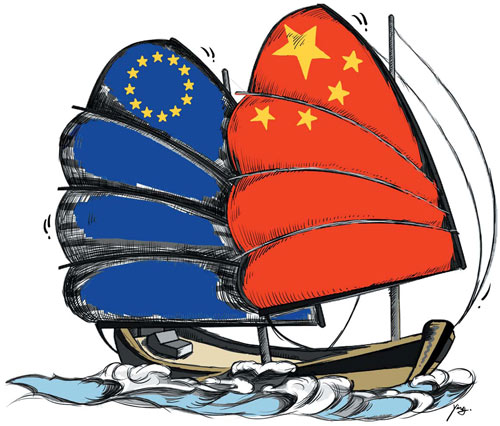
Driven by new technologies, the global trading landscape is undergoing a profound transformation, with digital and services trade becoming an important engine driving economic growth and innovation. Indeed, digital and services trade is reshaping how countries and businesses interact, creating new opportunities as well as unique challenges. They affect how enterprises coordinate supply chains, how they reach customers, and how innovations such as artificial intelligence are being integrated into the basic workings of global markets and economies.
Given the huge importance of digital and services trade, one would think that deep trade agreements in the field offer the potential for better growth opportunities and long-term, sustainable benefits for the countries involved. Yet while there are significant potential benefits, there are also significant challenges to reaching such an agreement. The technology of digital trade is changing rapidly, making regulators play catch-up, with different regions following different models of regulation and data protection. Also, there is an ongoing policy "re-calibration" as countries integrate their concerns for trade and security linkages into their policy frameworks.
In this context, the formulation of a "deep" China-European Union free trade agreement (FTA) in the domain of digital and services trade is both tempting and problematic. Such an agreement would need to involve comprehensive provisions aimed at lowering digital trade barriers and promoting international cooperation, addressing issues like data localization, data privacy and cross-border data flows, non-discriminatory treatment of digital products, establishing standards for electronic transactions and the protection of intellectual property rights.
There are certainly potential mutual benefits from a deep China-EU FTA on digital and services trade. For the EU, it would mean gaining enhanced market access to China's vast digital economy — the world's second largest according to recent measures. China's cross-border e-commerce alone reached about $378 billion in 2024. It also means potential for substantial new growth opportunities as EU-based companies capitalize on China's growing digital consumer base.
In addition, negotiated relaxation of cross-border data flow rules, particularly for cross-border e-commerce and human resources management, could directly benefit both EU and Chinese companies operating in or with China by easing high compliance conditions. Basically, for both the EU and China, a deep FTA could lower overall economic costs for enterprises currently navigating a fragmented regulatory landscape by facilitating frameworks for better regulatory cooperation and more consistent data governance.
This is a potential pathway to success (that is, a major benefit) for China in its goal of taking the lead in shaping international rules on data governance. A joint China-EU regulatory initiative (assuming successful negotiations, which would not be easy) would have more leverage and scope for adoption by third countries than separate efforts. Additionally, China's development in areas like AI would benefit from better cross-border data flows.
The governance of global digital trade is characterized by a landscape of diverse regional rules and regulatory philosophies. While there has been some recent convergence, noticeable differences remain on issues like non-discriminatory treatment of digital products, data localization and source code protection.
The recent rise in concerns over trade and security linkages means yet more hesitation to ease cross-border flows and data protection, while a heightened security focus also raises concerns about the scope for weaponization of technological interdependence, and helps focus on reducing dependencies and vulnerabilities (aka, "de-risking").
A further challenge relates to how trade agreements are negotiated and approved in the EU. When a EU trade agreement includes areas where member states have shared or supporting competence with the EU itself, we have what is known as a "mixed agreement", which requires ratification by both the EU and the relevant national parliaments.
This was the case with the EU-Canada Comprehensive Economic and Trade Agreement and led to long delays and doubts about ratification. A China-EU FTA covering digital and services trade would be a mixed agreement, requiring not just negotiations with Brussels but also navigating issues at the EU member state or even subnational level. Taken together, all of this means the feasibility of a truly deep China-EU FTA is constrained by basic differences in regulatory strategies, approaches to trade governance, and geopolitical interests.
To reiterate, while a deep China-EU FTA on digital and services trade has the potential for significant mutual economic benefits, the feasibility of such an agreement is challenged by the differences on regulatory, geopolitical, and security grounds. The path to significant mutual economic gain is littered with major obstacles. A successful agreement would need to bridge those differences.
The author is a professor of Economics, and director of the World Trade Institute at the University of Bern (Switzerland) and a senior fellow at the Centre for Economic Policy Research (London, UK). The views don't necessarily reflect those of China Daily.
If you have a specific expertise, or would like to share your thought about our stories, then send us your writings at opinion@chinadaily.com.cn, and comment@chinadaily.com.cn.





