Introduction of gaokao in Braille transforms lives







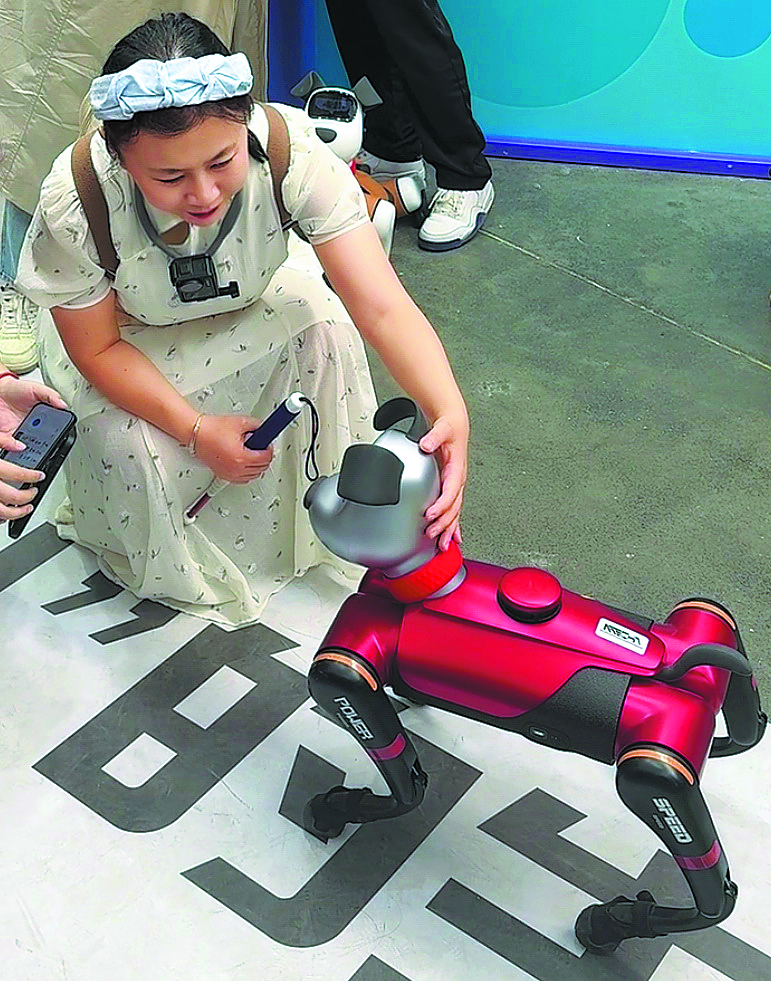
WUHAN — When Huang Ying sat for China's fiercely competitive college entrance exam, or gaokao, in 2015, she was making history, becoming the first student in Northwest China's Ningxia Hui autonomous region to take the exam using Braille.
Before blind students in the country could take the gaokao in Braille, they could only apply to a handful of universities by taking a special exam, and were restricted to majors related to either music or massage therapy.
"I don't have much musical talent, so it felt like I had only one career path," recalled Huang, 30, now a doctoral student at Wuhan University of Technology and a social media influencer. Fortunately, the introduction of Braille test papers in the 2014 gaokao allowed blind students to take the exam alongside their sighted peers. Around 80 blind individuals in China have since had their lives transformed.
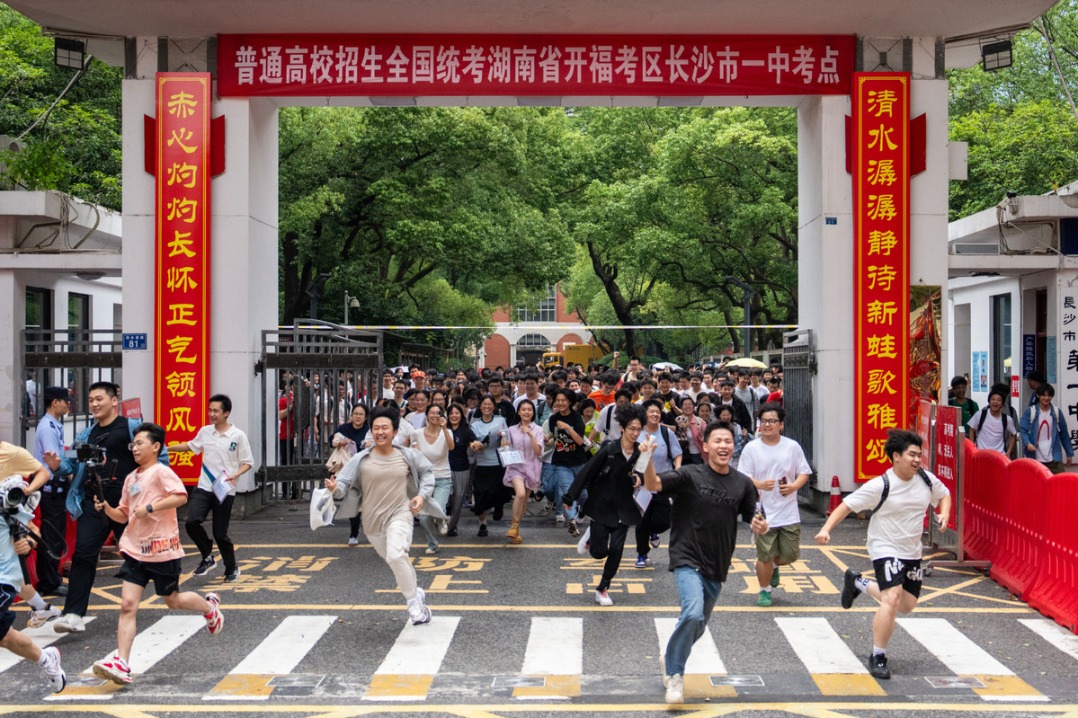
With 13.35 million students, including 16 blind candidates, having concluded this year's gaokao on Tuesday, Huang looked back on the exam she took 10 years ago, the one that changed her life and opened a world of possibilities.
Teachers encourage
Huang lost her sight to a fever at the age of 2. When she chose to enroll in senior high school — a path rarely taken by blind students at the time — gaokao test papers in Braille were unheard of.
"Opportunities come to those who are prepared. By continuing my education, I might discover other career paths," Huang said, explaining her decision.
The wheels of fate began to turn in 2014, when acting on the proposal of a political adviser, the Ministry of Education stipulated that visually impaired individuals should have access to Braille or electronic exam papers and support staff to help them take the gaokao.
Huang was in her second year of high school when she recalled the school holding a rally to encourage blind students to seize the new opportunity. During the event, a chemistry teacher read out a sample test question to give them a sense of the exam, and most managed to solve it. "The teacher encouraged us to be brave if we wanted to take the exam," Huang recalled.
The gaokao is a standardized exam, and the total score from several subjects determines students' admission to their preferred schools of higher learning. As a significant social equalizer, the gaokao symbolizes fairness, opportunity, and the idea that personal effort can alter one's destiny. This standardized system ensures transparency and accountability in university admissions for a population of over 1.4 billion people.
The gaokao was not previously available in Braille due to concerns about leaks and the quality of Braille translation, among other factors. As a result, visually impaired students were given a special exam that allowed them to apply to a limited number of universities.
Taking the grueling gaokao can be physically demanding for blind candidates, as they are given 1.5 times more time than their sighted peers for each subject. For instance, while sighted students have two hours to complete the mathematics test, blind students are allotted three.
The extended time accounts for the sheer volume of the test papers. A single subject's Braille exam can contain more than 90 pages. Braille, a tactile reading and writing system, uses raised dots arranged in cells. Typically, each Chinese syllable requires two cells, with each cell comprising six dots.
Preparing for the exam is even more arduous for blind students, with Huang recalling geometry as particularly difficult to grasp.
While Braille cannot display three-dimensional graphics, she said, "I could only rely on my imagination based on the teacher's descriptions of the X, Y, and Z axes. However, since I lost my vision at a very young age, I don't have a clear concept of spatial structures. The difficulties felt insurmountable, and I felt like giving up countless times," Huang recounted.
Nevertheless, she persevered with unwavering determination and was admitted to Wuhan University of Technology in 2015, scoring 85 points above the enrollment cutoff for first-tier universities. She chose to major in social work.
Leading normal life
Huang said she loves dressing up like any girl her age, and describes herself as "someone who can do everything but see." Now pursuing a PhD focused on the "behaviors and responses of disabled individuals during emergency events," Huang has achieved what once seemed unimaginable, a testament to her indomitable spirit and the support she's received along the way.
She has fully embraced campus life, participating in daily routines — from academics to exercise — right alongside her fellow students. Each semester, her college counselor provides scanned electronic copies of all her textbooks so she can study using screen-reading software.
When she encountered challenges — particularly because screen readers cannot interpret mathematical symbols — a senior student would step in to help her navigate the Advanced Mathematics course. With that support, Huang painstakingly transcribed the lectures into more than 300 pages of Braille notes and ultimately aced the course with an impressive score of 97.
Beyond her academic pursuits, Huang was driven by a desire to empower others with visual impairments. She became a part-time tutor, teaching them practical skills, from running errands to navigating smartphones, to help them step out of their homes and engage more confidently with the world.
In addition to giving public speeches, Huang began sharing glimpses of her life online in 2019. Over time, she started filming videos that documented her daily routines, from ordering takeout and applying makeup to shopping solo and enjoying leisure activities like ice skating, boating, and playing the piano, all captured from a first-person perspective. Her friend Che Meng helps edit the content, bringing her unique experiences to a wider audience through social media.
She has gained over 2 million followers across various social media platforms. A video of her navigating through crowds to buy a birthday cake for Che has received over 720,000 likes. One comment states, "I will never park my car on the blind path." In another video, Huang expressed her gratitude to her followers, saying, "Any small change resulting from our advocacy makes me feel that my efforts are worthwhile."
Huang's personal stories mirror the country's unrelenting efforts to improve the lives of its disabled population, including building barrier-free living environments, promoting inclusive education, and helping the disabled find employment.
On the academic front, China has implemented a range of supportive policies to enhance access to higher education for disabled individuals. This year, over 14,000 candidates with disabilities took the gaokao. As of September 2023, more than 90,000 students with disabilities were enrolled into colleges, and the enrollment rate for compulsory education among disabled children and adolescents had reached 95 percent.
Looking back on the past decade, Huang is proud of what she has achieved, from academic excellence to becoming a voice for her community.
"I've met so many incredible people and proven to myself that I really can do everything, except seeing," she said.
Xinhua