Chinese, German scientists discover super-Earth planet in Sun-like star's habitable zone







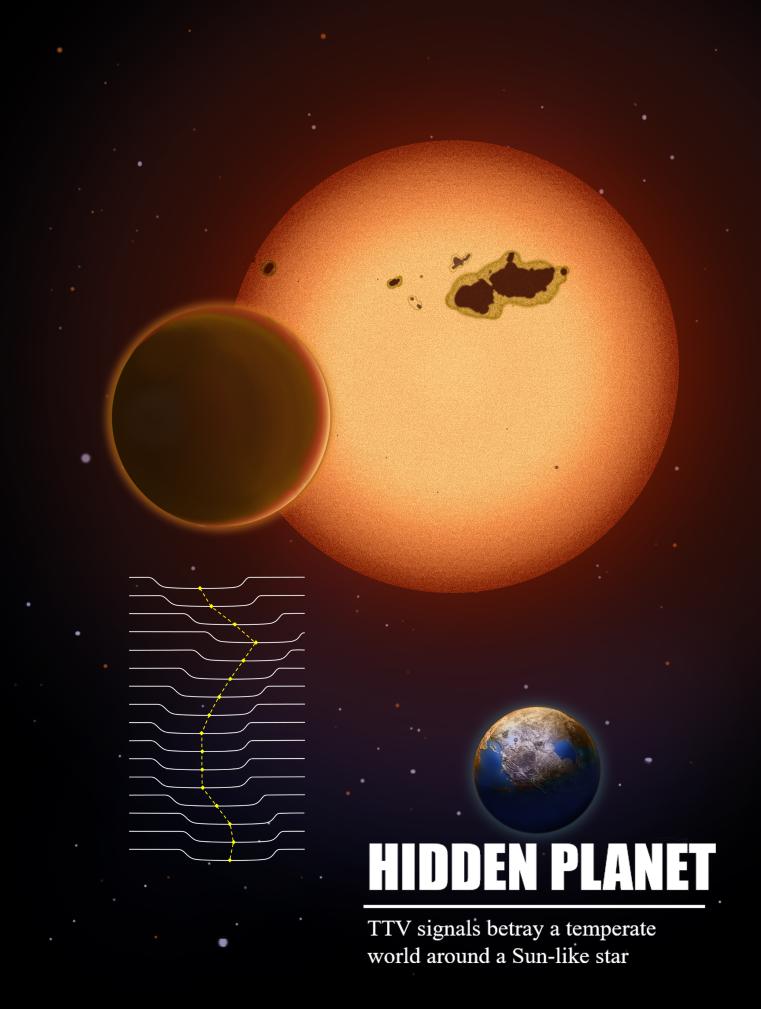
KUNMING -- For centuries, the question of whether life exists beyond Earth has intrigued humanity, and now a joint discovery by Chinese and German scientists may offer a significant clue.
Based on the Transit Timing Variation (TTV) technique for the first time, the super-Earth, Kepler-725c, with 10 times the mass of the Earth, has been detected within the habitable zone of the Sun-like star Kepler-725, which is a promising candidate for potential habitability.
"This newly discovered non-transiting planet and its host star are located at a place about 2,472 light-years from the solar system," said Gu Shenghong, team leader from the Yunnan Observatories of the Chinese Academy of Sciences.
"More crucially, this planet resides within the habitable zone of its host star, the region around a star where the temperature is suitable for liquid water to exist. It orbits around its host star with a period of 207.5 days, comparable to Earth's one-year period," Gu added.
"By analyzing the TTV signals of Kepler-725b, a gas giant planet with a 39.64-day period in the same system, the team has successfully inferred the mass and orbital parameters of the hidden planet Kepler-725c," said Sun Leilei, the first and co-corresponding author of the study, who is with the Yunnan observatories.
Unlike the transit method and radial velocity method, the TTV technique is not subject to their specific observational challenges. Instead, it can indirectly detect the presence of a planet by simply measuring the TTVs of another known planet in orbital resonance with it, Sun said.
"It demonstrates the potential of the TTV technique to detect low-mass planets in habitable zones of Sun-like stars," Sun added.
Gu also noted that it requires further investigation to assess whether the discovered habitable planet truly possesses conditions suitable for Earth-like life.
The research is jointly conducted by the Yunnan Observatories of the Chinese Academy of Sciences, Xi'an Jiaotong-Liverpool University, Nanjing Institute of Astronomical Optics and Technology of the Chinese Academy of Sciences, and Hamburg Observatory.
The research was published in the journal Nature Astronomy on Tuesday.






- Latest addition to Shiziyang Bridge constructions brings main tower above 300 meters
- Hebei's 'ancient pressure cooker' setting internet ablaze
- Major urban renovation restores Xi'an's ancient moat
- China launches nationwide employment assistance program
- Shanghai braces for record passenger numbers during Spring Festival
- China’s disciplinary bodies penalize over 3,700 staff in 2025