



Staunch supporters of UN-centered system







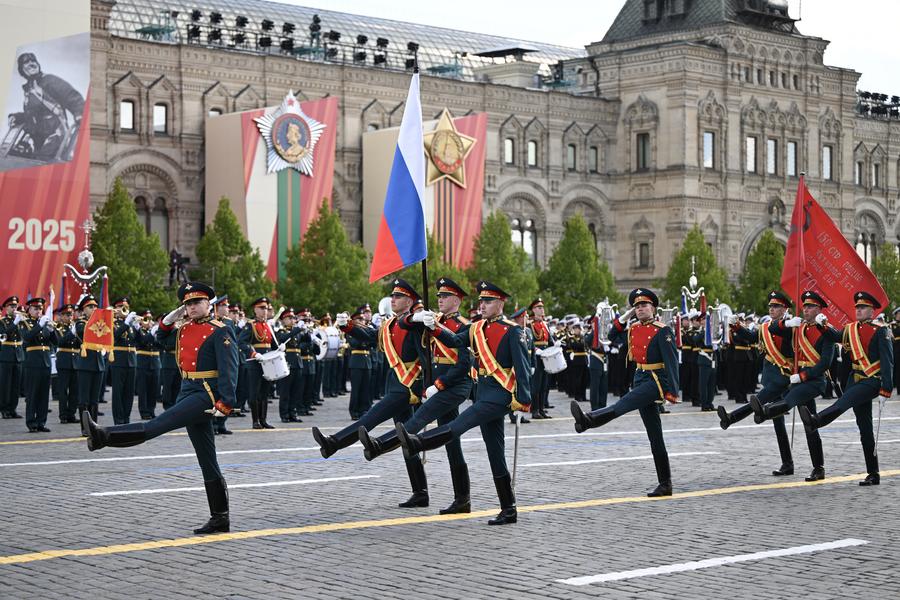
The visit of Chinese President Xi Jinping to Moscow to attend the celebrations marking the 80th anniversary of the victory in the Soviet Union's Great Patriotic War was very significant for Sino-Russian relations as well as the international community as a whole.
The Soviet Union and China played significant roles in the victory of the World Anti-Fascist War. They were among the Allies' principal members. After the war, they played a key role in establishing the United Nations, which was envisioned as a guarantor of global peace and the foundation of the postwar international system.
Unfortunately, the cooperation of the allies did not last long after the war. Russia and China laid the foundation for a multipolar world order — what is referred to in China as an "equal and orderly multipolar world". Hence, the Sino-Russian strategic partnership is important for not only the two countries and stability in East Asia, but also consolidating the foundation of such a world.
In fact, Sino-Russian cooperation gave rise to the Shanghai Cooperation Organization in 2001. The SCO evolved from Sino-Soviet border negotiations and confidence-building measures, which after the disintegration of the Soviet Union led to the formation of the "Shanghai Five", comprising China and four former Soviet republics, including Russia. The SCO was officially launched in Shanghai after Uzbekistan joined it in 2001. Over the years, the SCO has become an influential international organization with 10 full members, two observer states, and 14 dialogue partners.
The SCO member states cover about 36 million square kilometers, have a combined population of more than 3.4 billion, and account for about a quarter of global GDP and more than 15 percent of international trade.
Despite all their differences, the Shanghai Spirit respects diversity, supports every country's right to choose its political system and development model, promotes shared prosperity, aims to reduce disparities between the Global North and Global South, and calls for abandoning the Cold War mentality.
Another crucial process jointly initiated by China and Russia is the linkage of the Eurasian Economic Union, comprising five former Soviet republics-Russia, Kazakhstan, Belarus, Kyrgyzstan and Armenia — with the China-proposed Belt and Road Initiative, which laid the groundwork for a new system of economic partnership in "Greater Eurasia".
Meanwhile, the BRICS grouping has acquired even more importance as it offers its own vision of global governance, with the reform of the global economy being one of its key concerns. BRICS member states strongly advocate increasing the representation of non-Western countries in international financial institutions.
Initially, BRICS served as a voice for the Global South and an alternative to the G7. But this role proved insufficient. Facing strong resistance from traditional centers of global finance, BRICS countries are making efforts to help reform international financial institutions by establishing their own development bank and currency reserve pool, offering developing countries an alternative for development funding and crisis response.
BRICS also aims to strengthen the UN Security Council's central role in international relations and the world order, and leverage the complementarity of its member economies for accelerated development.
Supporting the central role of the UN and its Security Council in maintaining stability in a multipolar world is a key idea of the Sino-Russian strategic partnership, continuing the vision of the key allies, which after the end of World War II believed that despite their differences, they could preserve their wartime cooperation to maintain global peace and prevent another catastrophic war. That's why the UN Security Council was designed in a way that would require a consensus among its permanent members to make a decision and reach a compromise. Unfortunately, that commitment to compromise was not sustained.
After the disintegration of the Soviet Union, some big power tried to promote a new system based on its own rules, leading to numerous global conflicts, and undermined the UN's ability to resolve them. It labelled Russia and China "revisionist" powers, although it is Russia and China that work to preserve the international system with the UN at its core.
The "unipolar moment" has ended, and multipolarity is strengthening. In this environment, there is no higher arbiter or coordinator of global affairs than the UN. It is for this reason that BRICS, the SCO and the Global South insist on strengthening the UN's central role.
China and Russia suffered huge losses in World War II, with tens of millions of their citizens perishing, prompting them to consistently uphold the tradition of cooperation between the wartime allies. Hopefully, their former allies will soon remember that fruitful cooperation.
The author is academic head of the Institute of China and Contemporary Asia of the Russian Academy of Sciences.
The views don't necessarily reflect those of China Daily.
If you have a specific expertise, or would like to share your thought about our stories, then send us your writings at opinion@chinadaily.com.cn, and comment@chinadaily.com.cn.





