Sino-Russian cooperation beyond energy







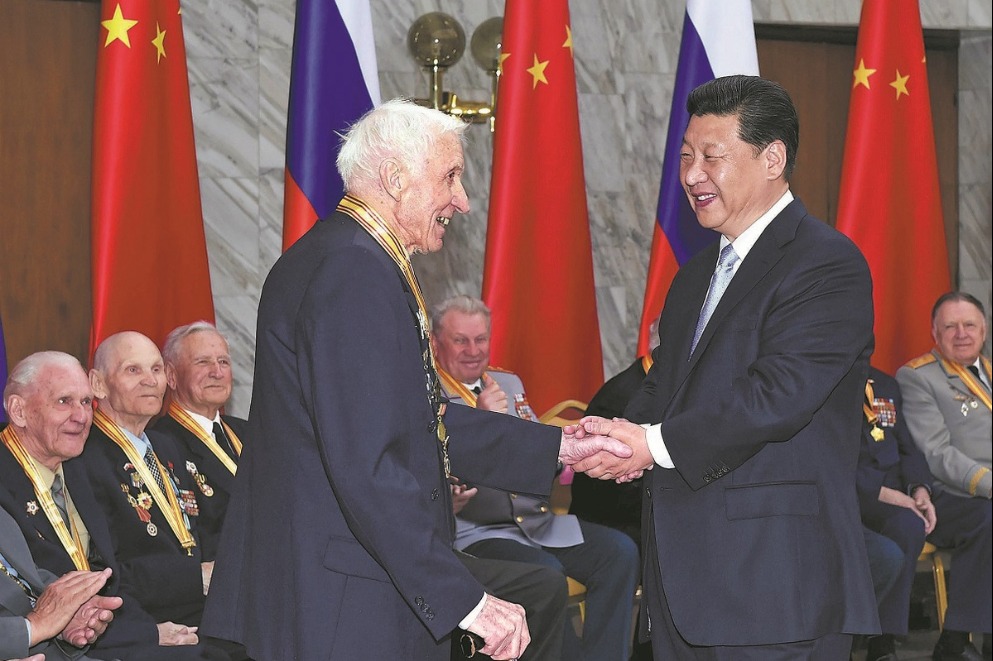
Editor's note: China and Russia made great contributions to the victory of the World Anti-Fascist War. In the face of global challenges, the two countries will promote the correct historical perspective on World War II, and promote an equal and orderly multipolar world. Experts share their views on the issue with China Daily.

Amid the current environment of global instability and escalating trade tensions among major economies, the strategic partnership between Russia and China has acquired added importance. Despite the mounting pressure of sanctions on Russia and growing protectionist pressure on China, Sino-Russian relations remain resilient and continue to develop steadily.
In fact, some big power's rising trade protectionism has become a catalyst for deepening economic cooperation between China and Russia, reinforcing their mutual interest in building a global trade and financial architecture that can withstand external shocks.
From a political standpoint, the Sino-Russian strategic partnership reflects the independent and sovereign course of the two major economies.
Having faced external economic shocks before other countries, Russia has had time to adapt its economy to the changing times, gaining temporary advantage at a time of intensifying global protectionist trends.
Sino-Russian cooperation is deepening in different fields including trade, investment, finance and legal coordination, and they are boosting their partnership and seizing the opportunities across different strategic domains.
Sino-Russian trade and economic ties have been growing at a rapid pace. In 2024, bilateral trade reached a record $244.8 billion, surpassing the previous high of $240.1 billion. The foundation for this trade relationship was laid by the exchange of energy resources, machinery and equipment, food products and high-tech goods. China continues to increase its exports to Russia, becoming a leading player in sectors such as cars, home appliances and consumer electronics.
Thanks to the withdrawal of Western brands from Russia, Russian and Chinese automakers together now make up 90 percent of the domestic car segment, with the competition among leading Chinese brands such as Geely, Haval, Chery and Changan helping improve the quality of cars and promoting technological innovation. In fact, in the Russian market, Chinese goods are more popular than South Korean, European, Japanese and US products.
The tourism sector, too, is showing signs of robust recovery. Thanks to the mutual easing of visa requirements and the resumption of visa-free group travel, the total number of tours between the two countries increased to 1.2 million in 2023. In 2024, the number of Chinese tourists traveling to Russia reached 848,000, accounting for half of the total number of tourists visiting Russia.
The growth of cultural exchanges and tourism amid geopolitical tensions has made tourism an important aspect of bilateral "soft power". That's why improving tourism infrastructure and the quality of services remains priorities for both governments.
Given the volatile global energy markets, a decline in oil prices due to the global slowdown could decrease Russian export revenues. But that could be partly offset by increasing Russian exports as trade flows shift away from the US. No wonder Russia has been emphasizing the importance of trade volumes and investments for deepening cooperation that includes the relocation and localization of production, technology transfer, and the creation of high value-added industry chains.
In August 2024, Russia and China agreed to an updated Plan for Bilateral Investment Cooperation. As a result, Chinese foreign direct investment has been helping Russia diversify its trade and build long-term economic resilience. Also, increasing outbound Russian investment will further strengthen the Sino-Russian partnership and help mitigate the effects of Western sanctions.
The growing presence of major Russian and Chinese companies in each other's markets is facilitating cross-border transactions and intracountry settlements between companies' subsidiaries through local branches, and thus reducing the need for traceable global transfers.
The expansion of Sino-Russian trade and investment dialogue is complemented by the deepening of bilateral and multilateral financial cooperation.
The trade war hovering over the world, along with the evolving trends across the Global South, is stimulating the development of an alternative global financial architecture, marked by increased global interest in initiatives such as BRICS Pay, the integration of domestic payment systems, and the establishment of new forms of trade settlements.
And on multilateral cooperation platforms such as BRICS, there is a growing demand for institutionalizing mechanisms for joint legal defense against secondary sanctions, including the creation of arbitration bodies and global dispute-resolution systems.
Comprehensive support for banks and external economic players provide legal protection for their foreign operations, and the construction of a normative base for collective arbitration has become essential to boosting financial resilience. There is a growing demand to reform the World Trade Organization to counter trade wars, ensuring it operates impartially in resolving disputes and reducing dominance by any single economy.
In short, the strategic partnership between Russia and China continues to deepen in spite of the deteriorating geopolitical environment, with the trade war catalyzing the emergence of a multipolar model of global economic interaction — one in which Moscow and Beijing play leading roles.

The views don't necessarily represent those of China Daily.
If you have a specific expertise, or would like to share your thought about our stories, then send us your writings at opinion@chinadaily.com.cn, and comment@chinadaily.com.cn.