US tariffs prompt Latin American nations to push for diversification







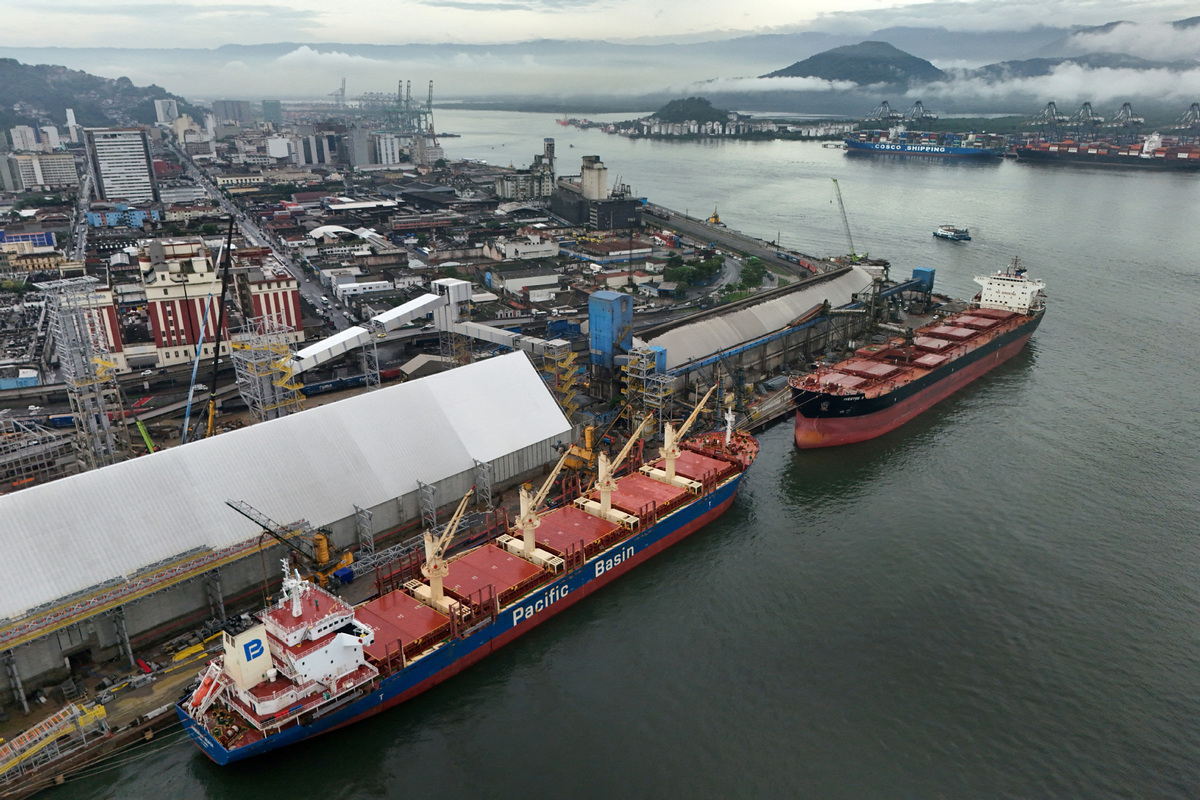
As the United States moves ahead with global tariffs, experts say that growing economic uncertainty is moving Latin American nations to renew their efforts to reduce reliance on Washington.
Welber Barral, a former foreign trade secretary of Brazil, noted that the recent US tariffs move may prompt significant adjustments among Latin America's key trading partners.
"What's happening now isn't new. Trump has followed this approach for years," Barral told China Daily.
He showed concern that the measures' full impact on international trade remains unclear, despite their predictable nature.
"I don't think Trump fully understands the impacts on international trade - all the negative consequences," he said.
Latin American leaders gathered in Tegucigalpa on April 9 for the ninth summit of the Community of Latin American and Caribbean States (CELAC), where 11 heads of state criticized US tariffs and migration restrictions.
"Trade wars have no winners," said Brazilian President Luiz Inácio Lula da Silva, highlighting that "arbitrary tariffs destabilize the international economy and raise prices".
He added that the region's "autonomy is in jeopardy" due to "attempts to restore former hegemonies".
CELAC's incoming chair, Colombian President Gustavo Petro, called for stronger regional coordination. "We must decide whether we help each other or retreat into loneliness," he said.
Focusing on Latin America, Barral provided a nuanced assessment of tariff effects on exports from countries such as Brazil, Argentina and Peru.
"We export a variety of products to the United States," he said.
Using Brazil as an example, he pointed out that "one-third of Brazilian exports are not affected with products like oil, certain pharmaceuticals and lumber exempt under the executive act's annex.
Yet sectors reliant on raw materials face harsher terms. "For this sector we have a problem because 25 percent is too high," Barral said regarding exports of materials like iron and metals that are critical to US manufacturing.
He noted that while some Brazilian exports would continue despite the tariff, the higher rates "are going to create more pressure upon Trump to review the tariffs".
Barral also said that mounting US pressure is prompting Latin American countries to diversify their export markets.
"Everybody, especially those that export a lot to the United States, is going to look for alternatives," he said, hinting at a strategic pivot away from a US-dominated market.
Barral highlighted the role of China in regional trade. "China is investing in Latin America," he said.
As of early 2025, 21 out of 33 Latin American and Caribbean countries had joined China's Belt and Road Initiative, according to a report by the European Parliamentary Research Service (EPRS).
The same report also noted that China has become the top trading partner of major South American countries, including Brazil, Peru and Chile.
"China plays a significant role in Latin America," Barral said. "I talked to some Latin Americans here in Brasilia, and there's a lot of talk regarding the recent China-CELAC Forum."
He added that "the relevance of this moment for the bilateral relationship between China and Latin America is not lost on regional leaders".
On the shifting trade landscape, Barral concluded, "In this situation, the barriers the US is creating offer a very good opportunity to promote other agreements."
He emphasized that rising tariffs may ultimately catalyze deeper intraregional partnerships and enhance Latin America's collective bargaining power on the global stage.
Barral also acknowledged that US policy remains unpredictable. "Of course, you can never predict what Trump is thinking and what is going to do," he said.
Juan Carlos Baker, former Mexican vice-minister for foreign trade, says Mexico must brace for economic uncertainty and prepare to push back if necessary.
"The US tariff policy really is to rewrite the rules for international trade and to change the narrative," he told China Daily.
"The announcement reflects a shift toward a much more unilateral and transactional approach to trade," Baker said, referring to US President Donald Trump's push for across-the-board tariffs.
"It's ironic that it was the US who helped build a rules-based global trade system, and now it's openly questioning its core principles," he said.
Although Trump has suspended the tariffs for 90 days, Baker noted that a 25 percent tariff on auto imports is still casting long shadows across North America's integrated supply chains.
Baker argued that such measures, if sustained, could shake investor confidence and destabilize key Mexican industries.
"Mexico risks losing its relative advantage in key sectors like autos, steel and electronics," he said. "The uncertainty also complicates investment decisions and may reduce Mexico's attractiveness in the eyes of long-term investors."
Baker said that while Mexico remains committed to dialogue, it is not without options.
"President Sheinbaum has stated that we privilege conversation and dialogue, but she has not ruled out the use of other mechanisms — dispute resolution and perhaps even tariff retaliation," he said.
That flexibility marks a subtle but important shift. "Retaliation is not off the table, it's just not the first tool we reach for," he said.
Responding to suggestions that US tariffs could drive companies to relocate manufacturing from Mexico to the US, Baker was blunt. "I am very skeptical of that."
"Relocating entire production networks is costly, complex and time-consuming," he said. "Tariffs can change cost structures, but they don't erase the fundamental logic of North American value chains."
gaoyang@chinadailyusa.com