Munich Security Conference needs reforms







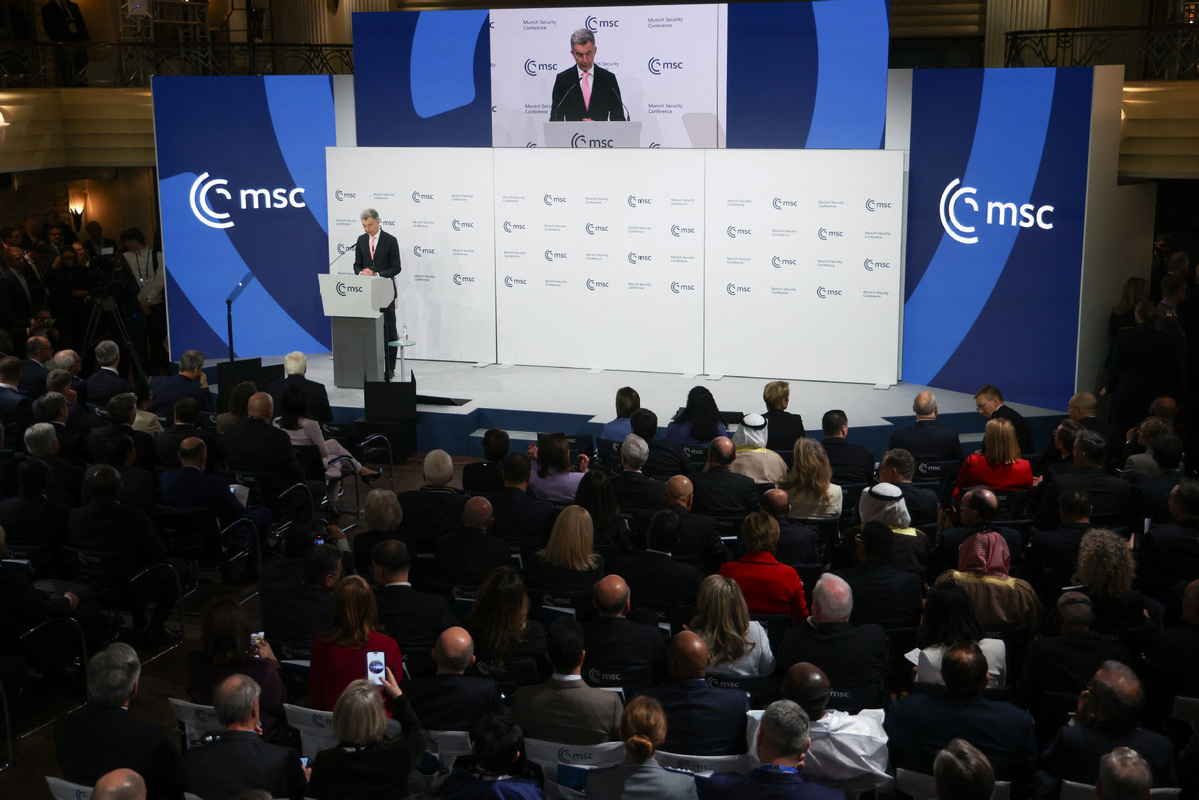
The Munich Security Conference has become an important annual conference on global security. Launched in 1963, the conference organizes high-level discussions, and fosters agreements and transnational cooperation on global security.
Despite these traits, the MSC needs reforms to regain its status in global security management.
The MSC operates in a center-periphery power structure: the G7 member states set the core agenda, while the countries of the Global South often remain passive recipients. Long-term Western dominance has led the MSC to neglect the views and interests of some non-Western countries, and turn into a platform for the West to promote its values and policies. As such, some developing countries are reluctant to take part in the conference.
The selective approach of the MSC, especially on key issues, exposes the structural flaws of the conference. The MSC claims to reach strategic consensuses through closed-door meetings among developed countries. But in today's multipolar world, the platform lacks institutional power-sharing dialogue mechanisms and the capacity to check major power competition. Hence, it cannot meet the security demands of small and medium-sized countries.
No wonder disagreements on multiple topics and doubts about the conference being fair and effective have increased. The conference's efficacy in promoting agreements and suggesting viable solutions to burning issues has declined.
The international community still expects the MSC to promote fair and equitable security dialogues. For instance, in 2024, about 700 representatives from more than 120 countries and regions attended the conference, including about 50 heads of state and government, because they expected to find answers to their questions at the MSC.
The MSC faces many challenges including geopolitical differences, increasingly complex security issues, and outdated security mechanisms because of the declining trust between countries. While the Russia-Ukraine conflict and the Israel-Palestine conflict are new major geopolitical hotspots, emerging cybersecurity threats, artificial intelligence, national security issues and climate change have further complicated the security agenda.
The rising differences in the stances and interests of, and the lack of trust between Western and non-Western nations have made it even more difficult to reach a consensus, leading to a deadlock in dialogues at times.
The MSC's problems are a result of the rapid changes in the world order. Globalization is accelerating. Non-state actors have emerged. BRICS member states account for a bigger percentage of the global economy. Global South countries have refused to take sides between Western and non-Western nations. And the world is incapable of addressing the complex security challenges with traditional security mechanisms and geopolitical confrontation narratives.
The MSC must evolve beyond traditional thinking and frameworks to promote cooperation in security. Otherwise, it will become a club for the West to amuse itself.
The MSC needs to expand the scope of security discussions. Traditional security thinking focuses on state-centric military confrontations and territorial security while underestimating economic, social and environmental security. Today, the impact of non-traditional security threats including cyberattacks, financial insecurity, resource shortage and climate change is as much as that of traditional security threats. The two threats sometimes intertwine to pose a bigger threat to society.
That's why measures should be taken to make the MSC's decision-making mechanism more flexible. Despite not having the binding power of the United Nations Security Council, the MSC remains an important platform addressing both traditional and nontraditional security issues. The MSC should also devise flexible, efficient policies to address transnational security issues, for which a quick and unified response is crucial.
Reforming the global governance system, too, is important. Although full of twists and turns, the development of a multipolar world order is an unstoppable trend. Acknowledgment of the trend can help countries and organizations to innovate and develop multilateral mechanisms.
Listening to the voices of developing countries and strengthening cooperation with emerging economies instead of seeking dominance is the only way the developed economies can establish a multi-layered, multi-dimensional global governance network and ensure fairness in rule-making.
The MSC reflects the deep-seated problems of traditional security governance systems in adapting to changing situations. In a complex and changing world, every country has the responsibility to help maintain global peace and promote global development. But irrational thinking is crippling the global security governance system. The MSC should become a facilitator of good governance and a dialogue platform that can answer questions on different security issues, balance different interests, and promote communication, mutual understanding and trust among countries.
While drafting rules for global governance, world leaders should take into consideration cultural, religious and social differences, with the aim of building a community with a shared future for mankind. And the international community should use advanced technologies to improve governance capacity and efficiency, and leverage big data, AI and blockchain to improve information management, sharing and analysis. By reforming and adapting to the changes in global security, the MSC can better address new challenges and contribute to world peace and stability. Otherwise, it risks becoming irrelevant.

The author is the director of the Academic Council and a senior research fellow at the Shanghai Center for RimPac Strategic and International Studies. The views don't necessarily reflect those of China Daily.
If you have a specific expertise, or would like to share your thought about our stories, then send us your writings at opinion@chinadaily.com.cn, and comment@chinadaily.com.cn.