New Trump tariffs are ill-conceived







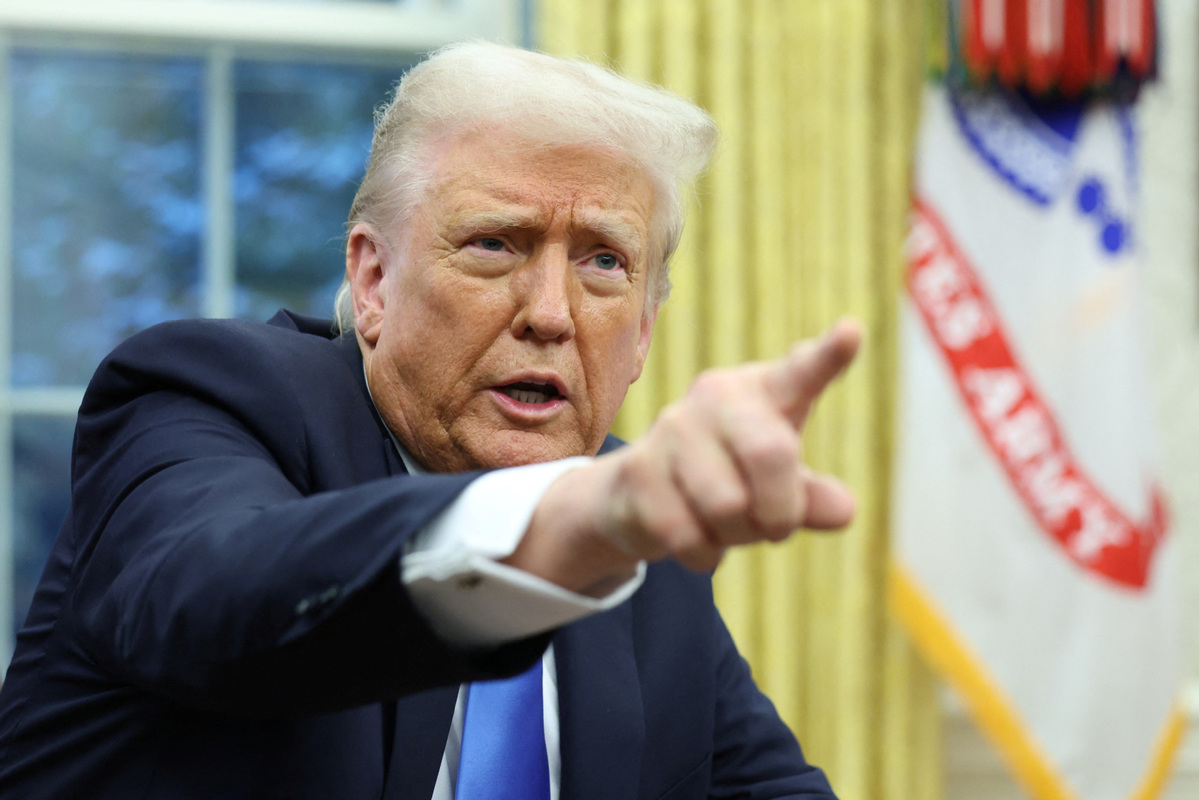
Keeping his campaign promise, United States President Donald Trump unleashed his tariff agenda almost immediately after assuming office. For imports from China, an extra 10 percent tariff was introduced on top of the existing ones, and the de minimis exemption for Chinese products was revoked, only to be restored. However, these new measures are neither well-founded, nor will they prove to be any good for the US.
One reason for Trump to raise tariffs — one that may find some support from economics theory — is that tariffs could bring manufacturing back to the US. Trump likes to liken himself to the 25th US president William McKinley, who imposed high tariffs to protect domestic industry and took land from foreign countries. In the second half of the 19th century when McKinley lived, the US was a "developing" country that struggled to catch up with the industrial powers in Europe, so the so-called infant industry theory would have applied.
The US was a latecomer and tariff protection could help the country quickly build up its own production capacities. However, the US economy is in a very different state today.
The US became an industrial powerhouse and a leader in technological progress a long time ago. Today, the growth of the US economy almost totally depends on the productivity growth of its high-tech industries. While some competitors do exist elsewhere, the seven US tech giants — Alphabet, Amazon, Apple, Meta Platforms, Microsoft, Nvidia and Tesla — dominate the world. Their markets are global and do not need protection of tariffs. Other US high-tech companies, for example those in the pharmaceutical sector, do face international competition. These heavily rely on imported goods to make their final products. High tariffs hurt instead of protecting them.
The medium- and low-range industries have long been hollowed out in the US. The most serious challenge for the country in rebuilding those industries is not the competition from other countries, but the lack of proper human capital. Instead of producing engineers for manufacturing companies, elite universities are now preparing their graduates for Wall Street, Silicon Valley and the pharmaceutical triangle. In addition, financiers from Wall Street have no appetite for investing in those industries. With money pouring in from all over the world, Wall Street managers are chasing projects that promise high and often risky returns. Ordinary manufacturing companies are not their targets; only high-tech companies are.
Tariffs are not able to compensate for the lack of engineers and the bias of the financial sector. This was evident from Trump's first round of tariffs. On the surface, direct Sino-US trade dropped substantially. However, if counted by the rules of origin, China's exports to the US increased. This is because Chinese companies moved to other countries and continued to export to the US from there. The Joe Biden administration realized this and tried to impose high tariffs on electric vehicles and batteries imported from countries that received large investments from China. However, due to a lack of a broad manufacturing base in the domestic economy, those high tariffs have not helped produce world-class companies. No US company ranks among the top 10 battery producers in the world.
Rationale behind tariffs
Using tariffs to balance trade is a falsely founded idea. The US' trade deficit with China has declined since 2018, but its total deficit in goods trade has increased by 50 percent from 2017 to reach $1.21 trillion in 2024. Trade imbalances are a matter of multilateral trade and cannot be corrected by bilateral tariffs.
Another rationale is to use tariffs to raise revenue for the federal budget. One of Trump's campaign promises was cutting taxes. This will inevitably increase government deficits if he does not find ways to raise revenue or cut spending. While Elon Musk's Department of Government Efficiency may cut some spending, tariffs will only help marginally. Even if a 10 percent tariff were imposed on all imports from other countries, the US federal government would only get an extra revenue of $330 billion, which is peanuts compared with the federal debt of $36 trillion.
The last reason is to use the tariffs to extract concessions. After Canada and Mexico promised to tighten border control, Trump postponed the 25 percent tariffs on those two countries. Likewise, the new China tariffs were linked with fentanyl. But China and the US are already cooperating to tighten cross-border flows of fentanyl. It is bewildering why tariffs were still hiked.
This leaves only one plausible explanation — Trump did not think through the whole issue and announced the tariffs in a spontaneous manner. His quick turn on Canada and Mexico indicates this. Another example was the turn on the de minimis exemption for Chinese imports. The de minimis policy exempts tariffs and customs report for cross-border purchases under $800. Revoking de minimis will not just hurt platform companies and small manufacturers in China, but will also hurt US companies such as Amazon and Walmart, and more importantly, millions of ordinary US citizens would be affected. This was probably why Trump reverted his de minimis decision in less than a week after announcing it.
Fighting inflation was one of Trump's campaign promises, but tariffs will only make inflation worse. High inflation under the Biden administration was one of the key factors that sent Trump back to the White House. Trump may not care about how angry the Democrats are about his policies, but he needs to care about the reaction of his political base.
If the Trump administration is serious about bringing manufacturing jobs back to the US and reducing its trade deficit, its most sensible policy is to allow Chinese companies to invest in the country. China's industrial structure is complementary to that of the US — the US is strong in high-tech industries, and China is strong in medium-range industries.
In the past, China benefited from foreign investment and technologies to develop its manufacturing sector; today, with one-third of the world's manufacturing capacity, China is ready to contribute to the industrial development in other countries, including the US. Trump is good at cutting deals, but he may soon realize that welcoming Chinese investment is a much better deal than imposing tariffs on Chinese exports.
The author is Liberal Arts Chair Professor at the China Center for Economic Research and the National School of Development, Peking University. The views do not necessarily reflect those of China Daily.