



For global prosperity and shared development
Assisting developing countries to better integrate into and benefit from the global industrial and supply chains is of paramount importance for their industrialization







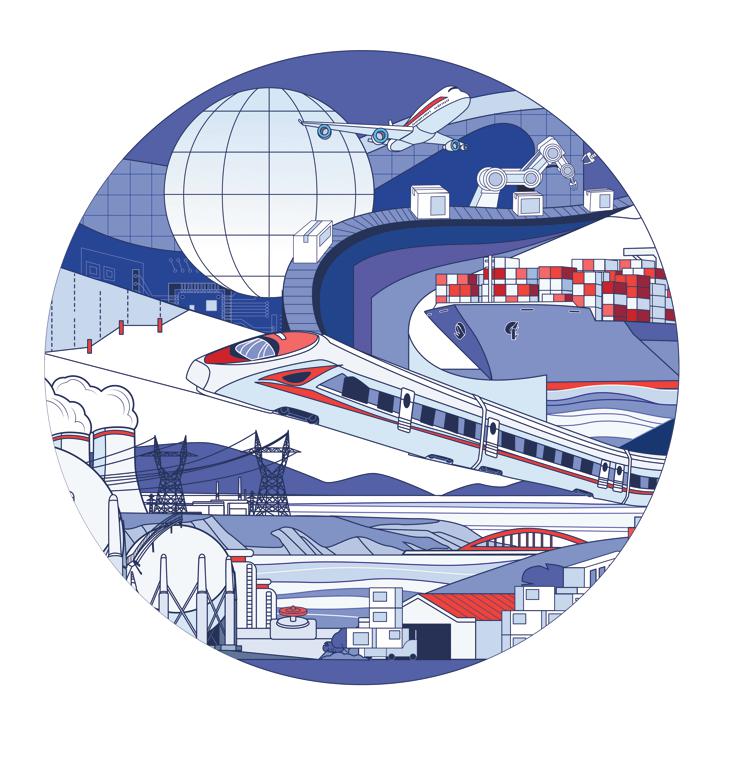
Since the 1980s, the global industrial and supply chains have become pivotal mechanisms for the international division of labor and economic collaboration. These chains enable developing countries to engage in specific segments of the global production system and connect with the international market, thereby lowering the threshold for their industrialization. By integrating into open and cooperative global industrial and supply chains, developing countries can have access to stable capital, technology and talent, as well as a substantial supply of cost-effective intermediate products that are crucial for industrial development.
However, as noted in the Global Development Report 2024 released by the Center for International Knowledge on Development, the global industrial and supply chains have been undergoing significant transformations and multiple disruptions in recent years. These changes present various challenges to global economic development and the industrialization of developing countries. There is an urgent imperative to enhance international cooperation in building open, inclusive, efficient and stable global industrial and supply chains for global prosperity and shared development.
Global industrial and supply chains are leveraging the momentum of diversification, digitalization and green development. Multinational corporations have been expanding their industrial and supply chains to diversify, thereby circumventing trade restrictions, reducing costs and mitigating risks. The swift progress in digital technologies, including the internet, big data, the internet of things, artificial intelligence, robotics and 3D printing, has facilitated the transformation of manufacturing into a more digital, intelligent, flexible and service-oriented sector. Numerous countries and enterprises have implemented strategies for green and low-carbon transitions, promoting the development of green industrial and supply chains.
By September 2023, 151 countries — accounting for 88 percent of global carbon dioxide emissions, 92 percent of the global GDP and 89 percent of the global population — had made commitments to achieving carbon neutrality or net-zero emissions. These transformative changes present opportunities as well as challenges for the industrialization of developing countries.
Global industrial and supply chains have also encountered various disruptions. The COVID-19 pandemic and geopolitical conflicts have impeded global logistics, leading to a shift in the considerations for the distribution of global industrial and supply chains from prioritizing higher economic efficiency to emphasizing greater security and stability. Additionally, protectionism is interfering with the global economic order.
According to statistics from the Global Trade Alert, the number of new discriminatory interventions increased sharply from 3,122 in 2019 to 4,976 in 2023. Some countries have adopted excessive protectionist measures, undermining cooperation within the global industrial and supply chains. The International Monetary Fund estimated that if global geo-economic fragmentation occurs, the global GDP loss could be 2.3 percent, with losses in developed economies and emerging markets ranging from 2 percent to 3 percent, while low-income countries would suffer the greatest losses, exceeding 4 percent.
Over the past decade, the trajectory of industrialization in developing countries has been characterized by slow and divergent progress. Between 2014 and 2023, the disparity in industrialization levels between 141 developing countries and 52 developed ones had widened, particularly with respect to per capita manufacturing added-value. While some developing countries, such as China, Mexico and Vietnam, have emerged as key industrial and supply chain hubs, achieving notable industrial advancements, many underdeveloped nations, particularly those in Africa, possess weak industrial competitiveness and limited engagement in the global industrial and supply chains, resulting in them reaping minimal benefits from the global production system. Disruptions to the global industrial and supply chains will hinder the optimal utilization of global resources and the full exploitation of international market potential for numerous countries, impeding their long-term industrial development.
In 2025, to foster industrialization in developing countries, it is essential to cultivate open, inclusive cooperation to promote stable industrial and supply chains, based on mutual trust. Assisting developing countries to better integrate into and benefit from these chains is of paramount importance.
First, supporting developing countries to select an industrialization path that aligns with their national conditions. For countries with large populations and a basic industrial foundation, support should be given to develop labor-intensive and export-oriented manufacturing sectors. Countries rich in oil, minerals and other natural resources should be empowered to advance in resource processing and manufacturing, gradually extending their local industrial chains. Nations with strong industrial capabilities should be aided in developing technology-intensive industries, thereby increasing the added-value of their products and helping them gradually climb up the global value chains. Countries with advantageous geographical positions and a well-developed service sector should be supported to develop services such as transportation, warehousing and information services.
Second, assisting developing countries in leveraging industrial parks as a starting point for industrialization. Industrial parks serve as vital conduits and vehicles for integrating into the global industrial and supply chains and promoting industrialization. International cooperation can support developing countries in prioritizing the development of industrial parks in areas with favorable geographical conditions, proactively investing in infrastructure construction, and formulating policies related to taxation, management, finance and trade to attract investors. While connecting to the international market, these countries should focus on establishing pillar industries based on the principle of industrial agglomeration, deepening and expanding the local industrial and supply chains, and enhancing their international competitiveness and local industrial embeddedness.
Third, helping developing countries develop their digital economies. Support should be provided to enable these nations to embrace digitalization and capitalize on technological innovation and opportunities within the digital economy to achieve leapfrog development. Encouragement should be extended to governments and businesses to enhance dialogue and exchange ideas regarding the digitalization of industrial and supply chains, as well as to share best practices. Developing countries should be supported in strengthening their digital infrastructure, facilitating industrial digital transformation and conducting human resources training to adapt to new technologies and industrial changes.
Last but not the least, encouraging developing countries to explore the path of green industrialization. In recent years, the costs of green and low-carbon technologies have significantly decreased, making it feasible for developing countries to pursue green industrialization. The cross-border transfer of green technologies and international mutual recognition of green products should be promoted to facilitate a coordinated green transition among upstream and downstream enterprises along industrial and supply chains. Assistance should be provided to developing countries in accelerating the construction of hydropower, wind power, solar photovoltaic, energy storage and power grids, and implementing energy conservation, emission reduction and carbon reduction measures in industrial production.

The author is an associate research fellow at the Center for International Knowledge on Development. The author contributed this article to China Watch, a think tank powered by China Daily. The views do not necessarily reflect those of China Daily.
Contact the editor at editor@chinawatch.cn.





