What's in a name for Chunjie, now put on UNESCO list?







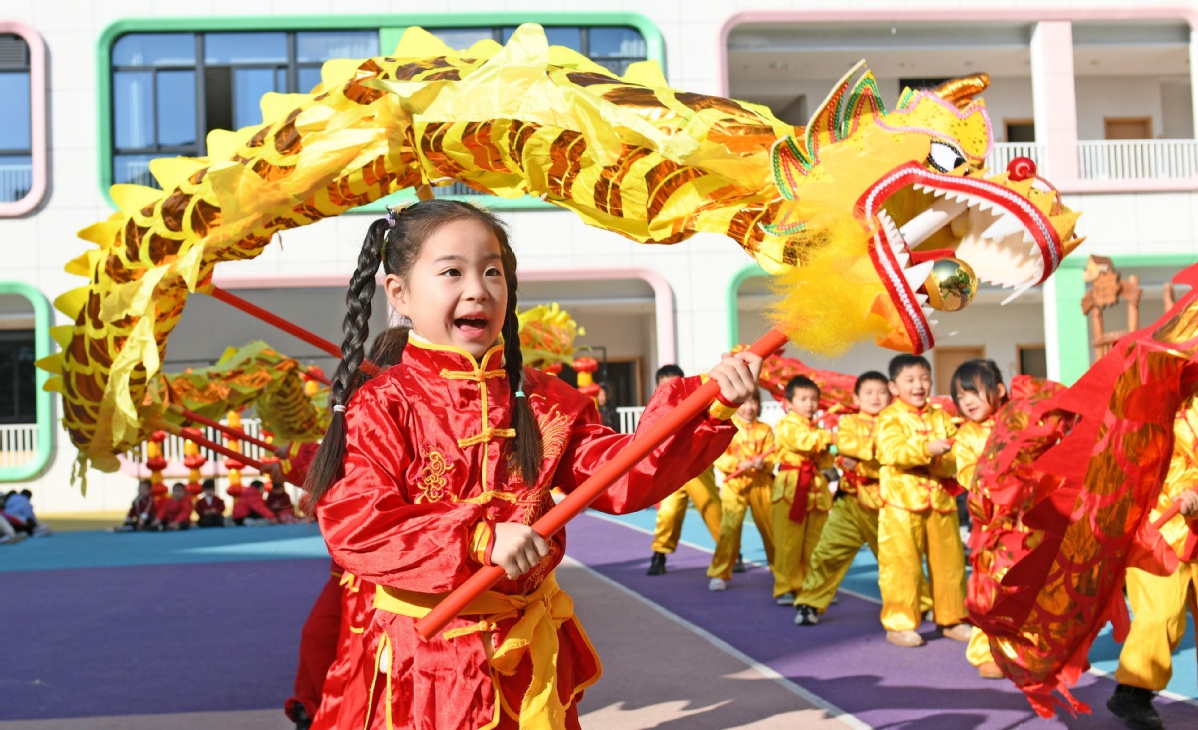
On Dec 4, 2024, Chunjie was included in UNESCO's Representative List of the Intangible Cultural Heritage of Humanity. While this recognition marks a significant milestone for Chinese culture, it also reignites an ongoing debate: What is the most appropriate English translation of Chunjie?
For decades, Chunjie has been widely translated as "Spring Festival" in English, a term now adopted by UNESCO in its lowercase form. However, according to English orthography, the name of a festival is a proper noun and should be capitalized — hence, "Spring Festival" is the grammatically correct form.
Beyond this, three main English translations are currently in use: Spring Festival, Chinese New Year and Lunar New Year. All the three terms are documented in major Chinese-English dictionaries, with "Spring Festival" being the most favored, followed by "Chinese New Year".
In fact, calling Chunjie "Lunar New Year" could be misunderstood as diluting the Chinese nature and characteristic of Spring Festival, or even seen as an attempt to undermine the cultural heritage. This translation could be controversial, and seen as disrespectful to traditional Chinese culture.
The Chinese lunar calendar is, in reality, a lunisolar calendar. Therefore, calling it "Lunar New Year" is not accurate, and may lead to people misunderstanding its scientific nature.
Interestingly, the preference of people in English-speaking countries is different from that of the Chinese people. In the United Kingdom and the United States, for example, Chinese New Year is the most commonly used term, followed by Lunar New Year. Notably, the Collins English Dictionary includes the pinyin-transliterated Chunjie, making it a unique and somewhat isolated case in English lexicography.
Dictionaries, with their scholarly rigor and authoritative status, play a crucial role in shaping language norms. However, they often lag behind the rapid evolution of languages. To gain a more comprehensive understanding, it is necessary to turn to large language corpora, such as the NOW(News on the Web) Corpus, which tracks English language usage in real-time across online newspapers and magazines. As of Jan 1, 2025, the NOW Corpus contained more than 20.3 billion words, offering invaluable insights into contemporary language trends.
The NOW Corpus shows that Chinese New Year is the most frequently used term in the English-speaking world, followed by Lunar New Year, with Spring Festival being a distant third. The pinyin-transliterated "Chunjie", despite being recorded, remains statistically negligible. The data align with the preferences seen in English dictionaries, highlighting the clear divide between Chinese and Anglo-American perspectives on the translation of Chunjie.
One notable trend is the growing prominence of Lunar New Year in English usage. While Chinese New Year remains the most common term, its growth rate has plateaued. In contrast, Lunar New Year has seen a significant uptick in usage, particularly over the past decade. This shift can be attributed to efforts by the Republic of Korea and Vietnam to promote de-Sinicized terminology in international discourse.
The two East Asian countries, deeply influenced by Chinese culture, have sought to assert their separate cultural identities by advocating for the use of Lunar New Year instead of Chinese New Year. In some cases, using Chinese New Year in the US has even drawn criticism, further accelerating the adoption of Lunar New Year.
English, as the world's lingua franca, is no longer the exclusive domain of a few countries. The concept of "World Englishes" acknowledges the diversity and adaptability of the language. While we respect the rules and conventions of the English language, it is equally important to assert our own cultural identity in international communication. Translating culture-specific terms like Chunjie requires a balance between authenticity and comprehension.
Historical precedents offer valuable insights. Traditional Japanese festivals, such as Tanabata (Lovers' Day) and Obon (Festival of the Dead), are commonly transliterated in English and recognized by authoritative dictionaries. Similarly, Korean New Year (Seollal) and Vietnamese New Year (Tet) are widely used by English speakers. Given these examples, the transliteration of Chunjie is not only natural but also consistent with global practices.
With Chunjie now part of UNESCO's Intangible Cultural Heritage list, the time is right to reconsider its English translation. From the perspective of primary term, it is necessary to use the term Chunjie to emphasize its cultural specificity and authenticity. From the perspective of supplementary term, we can include the literal translation of Spring Festival for clarity and familiarity. From the perspective of contextual gloss, when necessary, we can use Chinese New Year to aid understanding, especially in international communication.
This approach allows us to claim our cultural discourse rights without sacrificing clarity. It is a balanced and impartial solution that respects both Chinese cultural identity and the practicalities of global communication. As the Year of the Snake approaches, let us embrace this opportunity to assert our cultural voice on the global stage. By adopting Chunjie as the primary term, supplemented by Spring Festival and Chinese New Year, we can ensure that our traditions are represented authentically and respectfully. After all, language is not just a tool for communication — it is a vessel carrying culture, history and identity.
The author is dean of the School of Foreign Languages at Sanda University in Shanghai.
The views don't necessarily represent those of China Daily.
If you have a specific expertise, or would like to share your thought about our stories, then send us your writings at opinion@chinadaily.com.cn, and comment@chinadaily.com.cn.