



An era of broad societal shift







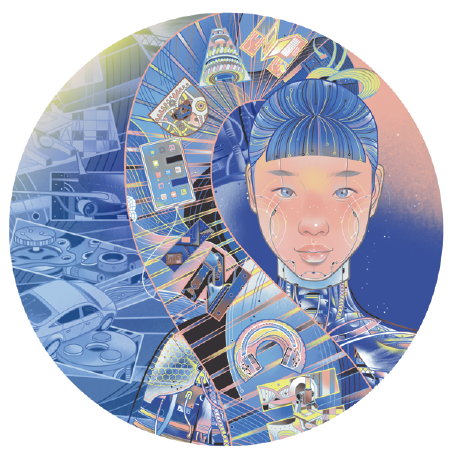
From the meteoric rise of generative language models such as ChatGPT to the shockwave caused by video model Sora's performance in February 2024, to the rapidly expanding market share of NVIDIA, the year 2024 witnessed an array of breakthrough developments in artificial intelligence technology and its applications, signaling a transformation that is reshaping industries, economies and societies.
Apple's proprietary AI is positioning the tech giant to continue its leadership in consumer products, while others, such as Tesla's humanoid robot Optimus and TikTok's Doubao — continue to push the boundaries of AI in the physical world.
But perhaps the most profound aspect of the year was the emergence of AI as an ever-present force. The Nobel Prizes in Physics and Chemistry, typically awarded for groundbreaking discoveries in traditional scientific fields, were bestowed upon AI researchers and entrepreneurs in 2024. More interestingly, a portrait of AI pioneer Alan Turing created by a robot sold at Sotheby's for nearly 10 times its expected value, showing how deeply AI has permeated the cultural and intellectual zeitgeist.
This rapid advancement is beginning to unsettle professionals in the tech industry.
The definition of "professional knowledge" is undergoing a radical shift. What was once exclusive expertise in fields such as law, medicine and engineering will soon become a set of essential skills accessible to everyone. As reports indicate, a new school in the US state of Arizona is now teaching courses entirely via AI.
This transformation signifies the arrival of a new era — one in which AI is rapidly becoming a core element of everyday life. As generative models evolve, we are transitioning from what we once called "artificial intelligence" to "agentic AI".
The reality is, AI's reach is expanding across all domains, and the implications are profound. From autonomous vehicles to unmanned aerial drones, the future of "New AI "is already taking shape. China's burgeoning low-altitude economy, along with its ecological industries, represents one of the most significant application areas for this new wave of AI.
At the heart of this transformation lies a fundamental question: What does AI mean for the future of work? As AI continues to evolve, it will not simply replace existing jobs — it will redefine them. In the short term, emerging job roles such as prompt engineers, alignment engineers, and prescription engineers are taking shape to support the growing "old", "past", and "new" AI industries. These roles will enable workers to interface with AI technologies and ensure they align with human values.
In the long term, however, AI will bring about a more profound change: it will redefine the very concept of employment, with tasks that once seemed mundane or outside the realm of traditional work becoming essential components of a new, AI-driven economy.
Furthermore, the rise of AI and intelligent technologies signals a broader societal shift — one that extends beyond the economy and touches on governance, security and international relations. As AI becomes increasingly integrated into daily life, we must also address the governance challenges it presents. AI models must be understood and controlled, and this requires a strong regulatory framework that prioritizes transparency, ethics and human oversight.
As we consider these transformations, it is important to recognize that the governance of AI is not just a technical issue; it is a matter of global importance. As UN Secretary-General António Guterres recently remarked humanity's fate can't be left to algorithms.
To ensure that AI serves the common good, we must establish global norms and regulations that keep humanity at the center of the AI conversation. Economies around the world are beginning to take notice. The European Union AI Act, which came into force in August 2024, sets a precedent for how AI technologies should be regulated to safeguard public interests.
Looking ahead, three key areas will accelerate from 2025. First, AI for Science (AI4S) and digital human intelligence will penetrate all disciplines, creating "parallel scientists" by integrating AI agents, digital humans, robots and bio-humans, transforming industries.
Second, breakthroughs in autonomous smart organizations will allow individuals to create digital-human-powered companies, greatly enhancing personal capabilities. This will increase societal polarization, with a growing demand for higher education.
And third, AI governance will increasingly rely on blockchain, smart contracts and decentralized autonomous organizations, shifting governance into the realm of hard technology. Events such as the Middle East's "pager bombs" and the rise of the "digital nomads" movement highlight the need to rethink governance and industry practices. AI and intelligent technology will drive this transformation.
China's AI industry holds immense potential to make a significant global impact. However, there is a gap between China and global AI leaders. To bridge this gap, we must shift our mindset, focus on pragmatic progress and accelerate basic research while staying grounded. This requires respecting development laws, avoiding opportunism, planning for the long term, adopting new approaches, and focusing on global cooperation for the benefit of all.
The author is the director of National Key Laboratory of Complex Systems Management and Control, Institute of Automation, Chinese Academy of Sciences.
The views don't necessarily reflect those of China Daily.
If you have a specific expertise, or would like to share your thought about our stories, then send us your writings at opinion@chinadaily.com.cn, and comment@chinadaily.com.cn.





