



Beauty extends from Notre-Dame to the gardens of Suzhou







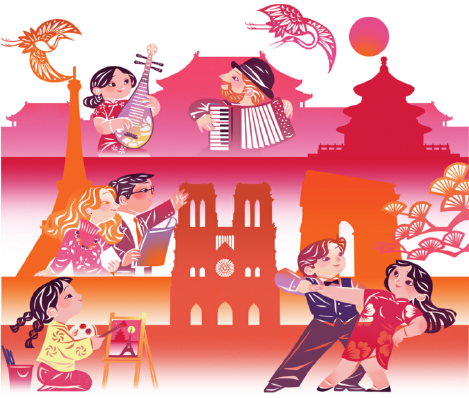
The outpouring of joy and empathy in China and around the world at the reopening of the Notre-Dame de Paris Cathedral is proof of the symbolic strength and value that we attach to monuments inscribed into our collective memory.
The celebrations indicate that exceptional places and monuments belong to not one nation or cultural group but to humankind as a whole: as was also evident from the outpouring of grief and solidarity that followed the devastation of Notre-Dame in 2019. Masterworks activate the viewers' and visitors' sense of beauty and their longing for the sublime.
Also, some heritage structures and historical places are loaded with stories that continue to enchant us. Victor Hugo's Notre-Dame de Paris (The Hunchback of Notre Dame) has fascinated generations of Chinese readers. Similarly, Western readers have been captivated not only by the narratives but also by the semi-real, semi-fictive palaces and gardens they encounter in A Dream of Red Mansions. They are reminded of what they have read while wandering through the streets of Beijing, Nanjing and Suzhou, their minds coloring these locations with words and feelings borrowed from the great writers of the past.
For a long time now, China has been aware of the significance attached to architectural testimonials from the past. Since the promulgation of the Cultural Relics Protection Law in 1982, China has constantly been amending and improving laws for the protection of cultural relics. Specific measures have been taken to address particularly important monuments, as can be seen from the Regulation on the Protection of the Great Wall (2006). The same year also saw the enactment of measures meant to protect UNESCO World Culture Heritage sites.
Both central and local governments are thus in possession of a range of regulations enabling them to keep in check shorter economic interests, which often discourage the effective protection and revitalization of a nation's architectural inheritance. More generally, China has proved to be an extremely active partner of UNESCO's long-term efforts to protect both tangible and intangible cultural heritage throughout the world.
Of course, there were and remain cultural differences when it comes to the way Western and East-Asian nations relate to historical sites. In the East, the wooden structure of temples is periodically rebuilt — often in a 60-year cycle. What counted most was the way the structure was built, the architectural techniques employed in construction, and respect for the original design.
In contrast, Western nations were and still are focusing on the preservation of the ancient material — one speaks sometimes of a kind of "veneration of the old stones", while progressively altering or expanding the original design of the edifice. Among professionals, a harmonization of conservation perspectives and techniques has taken place, a trend enshrined in the Venice Charter for the Conservation and Restoration of Monuments and Sites (1964), which provides an international framework for protecting and restoring historical buildings.
Still, differences in cultural sensitivities as well as the debates around a possible actualization of the said Charter alert us to a point of paramount importance: protecting tangible heritage is not akin to automatically applying a set of regulations and techniques.
Spirit has prevalence over the letter. There are several ways to protect and renovate a monument so as to ascertain and enhance its symbolic significance.
China's specific love for culture shows in the way it protects not only buildings but also its gardens and it considers all of these as living entities. How gardens are kept alive and allowed to blossom constitutes the best example of the way China relates to the past.
A traditional garden endlessly increases its size through its internal divisions — mounds that break the perspective, walls running along the walkways, partitions all around its pavilions. These partitions are pierced by openwork windows, round doors and numerous small openings through which one can appropriate space and sight. Windows and doors gradually reveal the garden, like a painter's hand unfolding the scroll on which he has drawn a roaring waterfall, the trail on the side of the mountain, the grove pines and the sea of clouds.
The garden indeed is a scroll, a miniature world enlarged by our walks and our whims. Pierced with orifices, the garden is irrigated by vessels through which circulate life, breath and seasons. Water transforms a garden into a living body.
Throughout history, Chinese gardens were sometimes destroyed and then redesigned. Like the Notre-Dame de Paris, their spiritual energy has enabled them to deploy again and again their beauty and significance, giving our own lives accrued meaning and richness.
The author is a professor and doctoral adviser at the School of Philosophy, Fudan University, Shanghai.
The views don't necessarily represent those of China Daily.
If you have a specific expertise, or would like to share your thought about our stories, then send us your writings at opinion@chinadaily.com.cn, and comment@chinadaily.com.cn.





