



Extreme weather poses threat to people's health







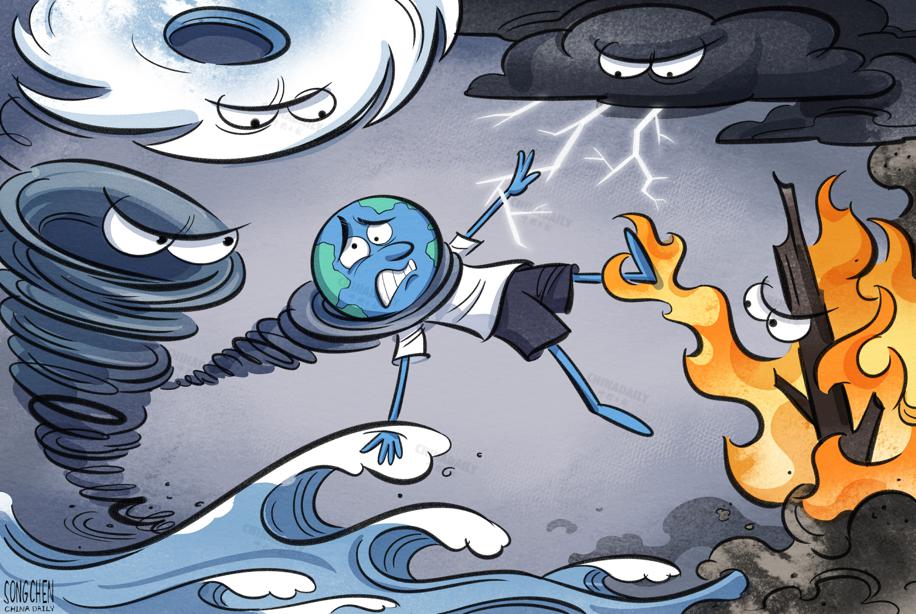
Climate change is emerging as one of the most severe threats to humanity, with intensifying global warming leading to more frequent and extreme weather events, causing water and food scarcities, disrupting the natural and social systems that underpin human health, exacerbating inequality, and hindering economic growth.
There is growing a concern that the extreme weather could result in a great number of climate refugees, potentially triggering political instability and even armed conflicts.
The impacts of climate change on human health are complex and diverse, which can be broadly categorized into direct and indirect effects on people's health and well-being, and healthcare systems.
The direct consequences of climate change include increasing heat waves and cold snaps, floods and wildfires that claim lives, destroy properties and disrupt economic activity. For instance, exceedingly high temperatures could cause heatstroke, and exacerbate cardiovascular, respiratory and urinary diseases, while extreme weather events could cause mental health issues such as post-traumatic stress disorder, depression and anxiety.
The indirect impacts of climate change are mainly outbreaks of infectious and non-communicable diseases, and mental health and climate-sensitive issues. These become more likely due to the change in the distribution of vectors, water and food shortages, and environmental pollution.
For example, global warming can alter the geographical distribution, reproduction and incubation pattern of vector-borne insects and pathogens, leading to a massive upsurge in bacterial and viral diseases like malaria, schistosomiasis and dengue fever.
Furthermore, the melting glaciers and ice caps can lead to water shortage, affect water supply for domestic and agricultural use, and impact food security and public health. Extreme weather can disrupt food production and supply, threatening food security and increasing incidences of child malnutrition, which could lead to stunted growth, anemia and obesity among children. And mounting air pollution can increase the incidence and death of respiratory and cardiovascular diseases, and cancer.
Scientific projections indicate that climate change will directly and indirectly result in about 250,000 additional deaths annually between 2030 and 2050, with developed countries facing higher mortality risks due to extreme heat, and some regions in the Global South facing increasing mortality risks from malaria, diarrhea and child malnutrition. The impact of climate change is likely to be more severe on the Global South, though, with children, pregnant women, the elderly, the infirm, outdoor workers and individuals with chronic respiratory and cardiovascular diseases being especially vulnerable.
Climate change can also affect the healthcare and public health systems by disrupting the functioning of medical equipment, pharmaceutical supply chains, energy and transportation systems, and endangering the health of medical workers.
The indirect impact of climate change can weaken the universal health coverage and primary healthcare systems of countries. As such, public health systems across the world are facing a greater challenge today.
At the 2023 United Nations Climate Change Conference, more than 140 countries, including China, signed the Declaration on Climate and Health. This is a milestone that health is mainstreamed in the global climate change agenda, signifying a step forward from scientific recognition to political action against climate change.
Also, the World Health Organization has issued an operational framework for building climate-resilient and low-carbon health systems, calling for actions to reduce carbon emissions. Hence, countries should strengthen cooperation, share their experiences, technologies and resources, and make joint efforts to combat climate change.
Comprehensive mitigation and adaptation measures, and cross-sectoral and interdisciplinary cooperation are necessary to address the impacts of climate change on human health. In September, China's National Administration of Disease Prevention and Control and 12 other governmental agencies issued the "National Climate Change Health Adaptation Action Plan (2024-30)" for enhancing the health sector's adaptability to climate change.
Only through collective action and practical measures can the international community mitigate the risks posed by climate change to human health and healthcare systems. In this context, China should engage in international cooperation and collaboration to combat climate change, implement national action plans and policies to address the health risks caused by climate change, and increase policy support for and investment in research and development.
By doing so, China can contribute to collaborative efforts to combat climate change, and advance the construction of a community with a shared future for mankind.
Ren Minghui is the director of the Institute for Global Health and the China Center for Health Development Studies at Peking University, and former assistant director-general of the WHO; and Li Na is a PhD candidate at the School of Public Health Peking University.
The views don't necessarily represent those of China Daily.
If you have a specific expertise, or would like to share your thought about our stories, then send us your writings at opinion@chinadaily.com.cn, and comment@chinadaily.com.cn.





