Tariffs on Chinese goods raise US inflation








The data released by the US Bureau of Labor Statistics recently show the consumer price index (CPI) rose by 2.4 percent year-on-year in September, slightly lower than the 2.5 percent in August. The core CPI, except for energy and food, however, rose by 3.3 percent year-on-year in September compared with 3.2 percent in the previous month.
On the whole, the United States has made significant progress in curbing inflation over the past two years and more, with the CPI falling from a record high 9.1 percent in June 2022 to 2.4 percent in September this year. With the CPI entering the 2 plus percent zone in July and staying there in August, the US Federal Reserve cut the federal interest rate by 50 basis points on Sept 18, suggesting serious inflation in the US is over.
However, the decline in inflation in the US has lagged behind that in the eurozone, where the CPI rose by only 1.7 percent in September compared with 2.2 percent in August. Considering the fact that Europe has been suffering seriously due to a drastic increase in natural gas prices following the halt in low-cost oil and gas supply from Russia and that the US didn't face such a problem, the tempo of the CPI's decline in the US has been very slow.
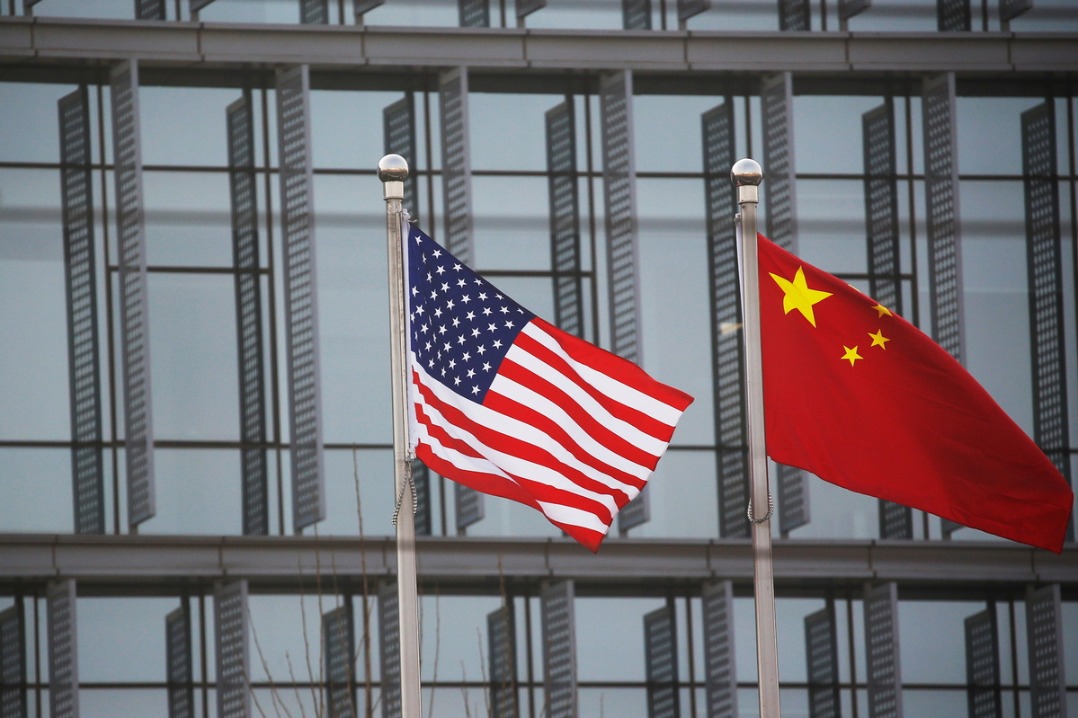
One of the reasons the US is lagging behind other major economies in curbing inflation is its high tariffs on more than $300 billion worth of Chinese goods. The total tariff volume add up to more than $80 billion per year, most of which, incidentally, had to be borne by US consumers and downstream industrial users.
According to a study by Oxford Economics, in the first two years (2018 and 2019), the punitive tariffs imposed on Chinese goods increased American families' spending by $88 billion. And from 2018 to 2022, the direct prices of apparel, textiles, travel goods and furniture increased by $166 billion.
Before the former Donald Trump administration imposed extra tariffs on Chinese goods, low-cost imports from China helped reduce inflation by 1.0-1.5 percentage points per year, as pointed out by a white paper issued by the Chinese government on Sept 18, 2018. The high tariffs on Chinese goods have reversed the effect and now contribute to inflation.
The Joe Biden administration once considered lifting most of the extra tariffs on Chinese goods to help bring down inflation. Treasury Secretary Janet Yellen even told Reuters in an interview that tariff cuts could cause a "deflation" effect. Had that been done, the CPI could have declined to below 3 percent much earlier. However, the Biden administration has announced additional tariffs on Chinese-made electric vehicles, batteries, steel and aluminum. And yet it has not been able to achieve its original goal of checking Chinese imports to the US.
According to Chinese customs data, Chinese exports to the US reached $478.42 billion in 2018, before the extra tariffs were imposed. Initially, the sweeping tariffs on Chinese goods during 2018-19 led to a decline in Chinese exports to the US by 12.5 percent to $418.67 billion in 2019. But Chinese exports started picking up from the second quarter of 2020, ending the year at $451.81 billion, a rebound of 7.9 percent. The trend continued into 2021 and 2022, reaching a new high in 2022 at $581.78 billion, up 21.6 percent from the pre-tariff year of 2018.
Chinese exports to the US started falling in third quarter of 2022, hitting $500.29 billion in 2023, down 13.1 percent year-on-year. The direct reason for that, however, was not new tariffs, but the US' restrictions on the imports of technology products from China. However, Chinese exports started rebounding again in the third quarter of 2023.
In the third quarter of this year, Chinese exports to the US reached $139.87 billion, up 5.2 percent year-on-year. Compared with the same period of 2022, or the previous high, the decline in the third quarter of 2024 was 9.9 percent, lower than the 13.1 percent in the same period last year. In September, Chinese exports to the US hit $47.02 billion. If multiplied by 12 to get the whole year's estimate, we get the figure of $564.18 billion, 97.0 percent of the total Chinese exports to the US in 2022.
The close and intertwined China-US supply chains make it difficult to decouple the two economies.
Trump, the Republican presidential candidate, has said he will impose a whopping 60 percent tariff on Chinese goods, and Tom Cotton, Republican House representative from Arkansas, has again proposed the "Trade with China Act", calling for revocation of permanent normal trade relations with China. What the Republican politicians are saying is not only a violation of World Trade Organization rules, but also a threat to the world economy.
But despite the US politicians' threats, high inflation is likely to hit the US again, neutralizing the Fed's hard efforts to bring down the CPI and cause more misery to American families. The only way the US administration can protect American families from high inflation is to lift all punitive tariffs on Chinese goods. That would also serve to normalize the US' relations with China and thus give a boost to the global economy.The author is a senior fellow at the Center for China and Globalization.
The views don't necessarily reflect those of China Daily.
If you have a specific expertise, or would like to share your thought about our stories, then send us your writings at opinion@chinadaily.com.cn, and comment@chinadaily.com.cn.