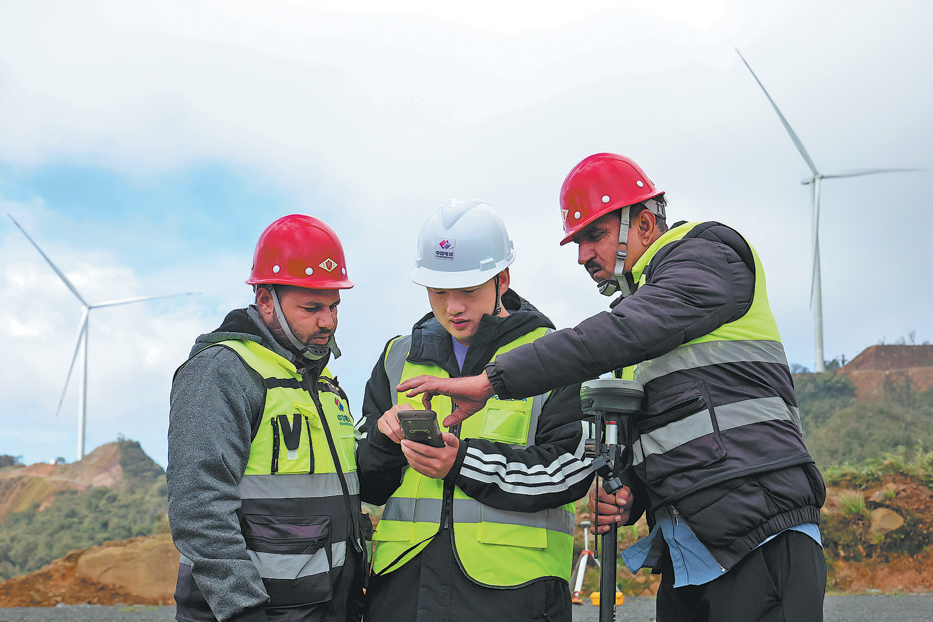
Knowledge-based cooperation strengthens mutual benefits







Empirically proven knowledge and information improve international relations by offering valuable data on trade, investment and economic trends, which in turn help policymakers make informed decisions. Such informative knowledge also helps stakeholders identify areas where cooperation can be enhanced by highlighting potential challenges that need to be addressed. It also encourages economic activities to be more transparent and builds trust between countries by fostering a more collaborative environment.
Information and knowledge on China's remarkable journey to the world's second-largest economy is one area that has to be harnessed well in South-South cooperation. This journey offers invaluable lessons for Africa, with China's development trajectory marked by rapid industrialization, infrastructure development and poverty alleviation, providing a resourceful blueprint that African nations can adapt to their unique contexts.
Informative knowledge has also many things to add to the Belt and Road Initiative. Over the past decade, the BRI has gained buy-ins from almost all African nations. As a cornerstone of China's foreign policy in leveraging its role in global development under the framework of South-South cooperation, the BRI aims to enhance connectivity, promote trade, and foster economic integration among participating countries for mutual benefit and common prosperity. When we see it on the ground, the BRI has undergone a decade-long constructive learning process. And in my view, it is now entering a new chapter of transition. Initially, the BRI followed an extensive approach, but I believe it is now time for the BRI to adopt an intensive approach, ensuring success in every project it implements. While the BRI has made significant strides, it faces challenges such as geopolitical tensions, financial sustainability concerns and environmental considerations. However, these challenges also present opportunities for reflection, adaptation and improvement. And knowledge-based cooperation among the Global South countries can make this into reality.
Mutual benefit and common prosperity are important slogans of China-Africa cooperation. And it takes the responsibility of each one of us to transform this good idea into reality. This common responsibility is translated into action through successful implementation of BRI projects. The first decade of the BRI has recorded many successes as well as many learning experiences. The learning experiences of the past decade are where the growth potential of BRI lies. I see a new season and chapter for the BRI in the future where it focuses on quality projects more than ever. In its new chapter, I see the quality of projects as the crucial element of success of the noble ideas embodied in the BRI in particular and in South-South cooperation in general.
By quality projects, I mean those that are fit for the purpose of the common prosperity slogan of South-South cooperation. A project that embodies the noble purpose of the BRI in the framework of South-South cooperation is what is called quality project here. Enhancing such quality in the future of the BRI calls for enhancing knowledge-based cooperation.
The following three points can be taken as key areas to promote knowledge-based cooperation for a better impact of the BRI in the future. These three areas are a deeper understanding of Africa, a broader responsibility of the private sector, and a stronger partnership with knowledge entities.
First, developing a deeper understanding of Africa. Many initiatives, projects and research efforts treat engagements between China and Africa as engagements between two nations. This is not a new challenge. It is a challenge Africa is facing in its engagements with many parts of the world. But I think it is easier to address this challenge in South-South cooperation. This challenge is about perceiving Africa as a single nation, while Africa is a continent with many independent nations with extremely diverse social, cultural and economic architecture and landscape. This reality affects the effectiveness of projects if not addressed in the detailed design and implementation process. To achieve better success in BRI projects in Africa, we must ensure a deeper understanding of the specific contexts of each host country separately through enhanced knowledge-based cooperation.
Second, a broader responsibility taken on by the private sector. Achieving all-round success in BRI projects requires all stakeholders to shoulder their share of responsibility. This includes financiers, host countries, the private sector, and other partners. While the private sector naturally seeks profit, which drives innovation and competitiveness, it must also ensure that it supports the proper implementation of real partnerships between China and Africa through various projects. The private sector's role in South-South cooperation should extend beyond profit, contributing to sustainable profit interests and growing business opportunities.
Third, fostering a stronger partnership with knowledge entities. The quality of planning and execution of partnerships depends on the level of information and knowledge it involves. Academic institutions like the Institute of South-South cooperation and Development provide empirically proven knowledge on China's remarkable growth trajectories with all its limitations.
Therefore, for better efficiency in the BRI in the future, a solid and deeper partnership of projects with knowledge entities such as universities, institutes, think tanks and other similar bodies is vital.
The above three areas cited — a deeper understanding of Africa, an enhanced and broader role of the private sector, and broader collaboration with academic and knowledge entities — highlight the importance of intensifying knowledge-based cooperation for the better future of the BRI in South-South cooperation.
The author is ex-state minister of planning and development of Ethiopia, ex-secretary-general of the Ethiopian Chamber of Commerce and Sectoral Associations and a PhD student at Peking University.