Washington's geopolitics worsen Ukraine crisis







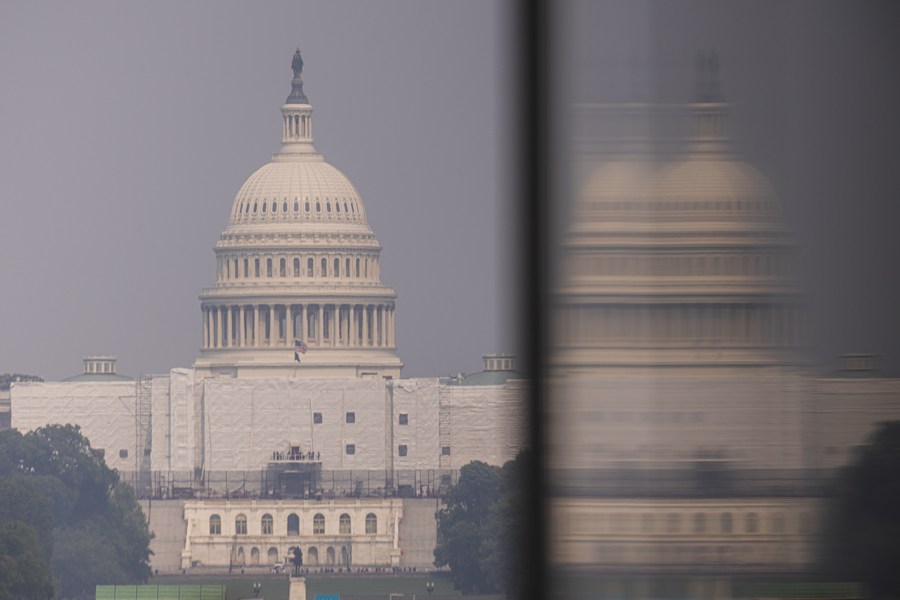
Ukraine launched a military operation in western Russia's Kursk region on Aug 6, prompting Russia to declare a state of emergency there, with Ukrainian President Volodymyr Zelensky saying on Monday that the Ukrainian army had taken control of 92 settlements in the region. Despite the worsening situation, the United States continues to add fuel to the fire by supplying arms and military equipment as well as financial aid to Ukraine. US President Joe Biden seemed to be patting himself on the back when he said on Aug 13 that Ukraine's military incursion into Russia has "created a real dilemma" for Russian President Vladimir Putin.
The Ukraine crisis has its roots in the Cold War. Even after the disintegration of the Soviet Union and the end of the Cold War, the US didn't change its hegemonic mindset. It launched a "mission" to Westernize former Soviet republics, which, to a large extent, laid the groundwork for the geopolitical confrontation between the US and Russia, leading to the Russia-Ukraine conflict.
The US' primary goal is to weaken Russia by promoting anti-Russia movements in the former Soviet republics and coercing them to strengthen cooperation with the European Union and the North Atlantic Treaty Organization. By trying to Westernize the former Soviet republics, the US wants to change the political systems and install pro-Western governments in the former Soviet republics. To achieve that, it has even triggered "color revolutions" in those countries.
On gaining formal independence in 1991 after the collapse of the Soviet Union, Ukraine had great development potential thanks to its abundant natural resources. Although Russia and Ukraine had disputes before and after the Soviet era, those disputes did not lead to any military confrontation. In fact, the two sides managed, even resolved, many of their disputes during former Ukrainian president Leonid Kuchma's administration.
However, the US continued to cultivate proxy leaders in Kyiv, and instigated the 2014"Maidan Revolution" in Ukraine because it considers the country a strategic fulcrum to deal with Russia. Ultimately, when Ukraine chose to join the Western camp, its disputes with Russia intensified, leading to the Crimea incident and the Donbas conflict. Following the two incidents, the US and NATO began fanning anti-Russia sentiments in Ukraine, which eventually led to the Russia-Ukraine conflict.
Since the outbreak of the Russia-Ukraine conflict, the US and its allies have increased their military aid to Ukraine, encouraging the Ukrainian army to attack new targets in Russia. At the same time, the US has been trying to control the pace of the conflict. It refuses to send troops to assist the Ukrainian army and, instead, has been egging Kyiv to continue the conflict and cross Russia's redline and claim later that is was "unaware" of Ukraine's actions.
The US' policy is not, as it claims, to promote the development of Ukraine, because the US has always put its own interests first. To fulfill its narrow political goals, it can trigger a conflict and even hold Europe hostage, without the latter knowing about it. Its evil design is evident in its attempt to create a rift between China and the EU and smear the China-Russia relationship.
Given the US' machinations, the chances of a political resolution to the Ukraine crisis appear slim. However, calls for negotiations between Russia and Ukraine to end the two-and-a-half-year conflict became stronger this year. In his interviews in June and July, Zelensky, too, expressed his willingness to open the door to direct talks with Moscow. As a matter of fact, he said in July that Russia should be represented at the proposed second peace summit in November — and Moscow didn't refuse to hold negotiations with Kyiv. The two sides' softening attitude toward negotiations had raised hopes that the crisis could be resolved.
But Ukraine's military operation in Kursk and the US' attitude toward the conflict brought the world back to reality, with Russian Foreign Ministry spokeswoman Maria Zakharova saying that Russia was not engaged in any "direct or indirect" talks with Ukraine.
Ukraine's Kursk offensive will further extend the front line. And the conflict could escalate after the supply of a new batch of weapons, including F-16 fighter jets, by the US and its Western allies to Ukraine. In the process, both Russia and Ukraine will suffer further losses.
Furthermore, Ukraine's combat capability largely depends on Western aid. Some US experts say Washington's speed of arms delivery to Ukraine is in accordance with its production speed. The US' military aid to Ukraine will last at least one year at the current speed. And the fact that NATO has agreed to provide €40 billion ($43 billion) worth of military aid for Ukraine next year means that, even if the next US administration reduces or cuts off aid to Ukraine, the country will still be able to prolong the conflict for some time with its own arms and military equipment and non-US Western aid, especially because the EU is likely to maintain or even increase its assistance to Ukraine.
The US has been instigating "controllable chaos" in other regions to serve its own geopolitical interests. For example, the US sees Israel as key to controlling the Middle East; that's why it continually provides military assistance for Tel Aviv. It is because of US support that Israel has continued its brutal assault on the Gaza Strip for the past more than 10 months, creating a humanitarian crisis. The US' hegemonic policy not only poses a threat to regional and global security but also violates the international order and undermines the global governance system.
The author is a researcher at the Institute of Russian, Eastern European and Central Asian Studies, Chinese Academy of Social Sciences.
The views don't necessarily reflect those of China Daily.
If you have a specific expertise, or would like to share your thought about our stories, then send us your writings at opinion@chinadaily.com.cn, and comment@chinadaily.com.cn.