Middle East wakes up to Chinese version of soft power







Egypt narrowly escaped colonization by France and Britain, the two great European powers of the 18th and 19th centuries. Instead, Egypt experienced French and British "cultural imperialism".
French engineering built the Suez Canal, the French Napoleonic Code became the basis of the Egyptian legal system, the children of Egypt's upper classes studied French language and literature, and Cairo's architecture reflected French styles. The spread of British culture came later, after the militarization of the Suez Canal, with administrative, commercial and financial influence. British tourists traveled the Nile and upper-class Egyptians began to play English sports.
After World War I, Egypt gradually came more under the cultural influence of the United States, the new great power. In 1956, when the US stopped the British-French-Israeli seizure of the Suez Canal, the prestige of the European powers collapsed. As the US seemed to care less about dominating Egypt than controlling the oil resources of the Gulf, Egyptians came to view it as benign, less self-interested than the Europeans.
The US quickly achieved a similar reputation across most of the Middle East. As Arab countries emerged from British or French colonial rule, they readily identified with Americans who had also escaped an empire. Moreover, in the final decades of the 20th century, the US' economic achievements and prowess in space suggested there was much to learn from it. The atheism of Soviet communism made it easier for Muslims to side with the Americans; Hollywood movies and American television familiarized Arab elites with American culture; and friendly American tourists were popular as they toured the region's historic sites.
The US, the sole superpower after the collapse of the Soviet Union, and the uncontested leader of the global economy, dominated the region. It was not only US naval strike groups or American influence over global economics that impressed the Arab elite. Many accepted the US' claimed "exceptionalism" and even its self-image as the "indispensable nation", the only power capable of managing international conflicts. Many were also attracted by the American political and social model, viewing it as the best template for the gradual modernization of their own societies and the advancement of their poor. They saw much to gain from learning from the US.
By the end of the 20th century, it was common to speak of the US' "soft power" — non-coercive means of co-opting support through the appeal of its values and the attraction of its example. The assertion of such cultural power, it was suggested, would minimize US dependence on its military.
In the new century, however, the US aggressively exercised its hard power, first in Afghanistan, then in Iraq and Libya. US prestige waned as each military venture failed to achieve its stated aims. In those years, also, the US was gradually losing its absolute preeminence in the global economy and the appeal of its institutions was being sullied by its increased political and social dysfunction. The American example no longer seemed so worthy of emulation.
Policy failures and strategic incoherence hastened a decline in American soft power. Washington pursued inconsistent policies toward the great rivals, Iran and Saudi Arabia. Russia, not the US, was the decisive player in the murderous Syrian civil war. President Obama punctured Egyptian belief in a friendly US by abandoning the Hosni Mubarak regime for the Muslim Brotherhood.
The Middle East awoke to China's version of soft power in the second decade of the 21st century. Governments and elites, astounded that tens of millions of Chinese were escaping poverty every year, saw much to admire, perhaps to emulate, in China's economy and its win-win approach to problem-solving. Chinese diplomacy amazed the region by brokering an accommodation between Iran and Saudi Arabia. Some began to think that the West was in terminal decline, and that the future would belong to the Global South in a multipolar world.
Unlike the US, but in the tradition of other great powers of history, China understands that the Middle East is the bridge between the Mediterranean world and Asia. Moreover, in contrast with US policies, which had dealt with the region on a country-by-country basis, China announced an ongoing relationship with the whole Arab world.
President Xi Jinping indicated that the Chinese-Arab relationship, building on historic Silk Road contacts, would involve enhanced exchanges and mutual understanding between two great civilizations. His recognition that Chinese and Arab civilizations are historic peers is in significant contrast to Western attitudes that privileged the achievements of the Pharaohs while neglecting those of the Arab past.
President Xi described China's relationship with the Arab world as "a strategic partnership of comprehensive cooperation and common development". The economic promise of the partnership is to link China's market of 1.4 billion people with the Arab world's 475 million.
The lodestar or guiding principle for "a closer China-Arab community with a shared future" is the Belt and Road Initiative. China puts Egypt and the Suez Canal at the center of its 21st Century Maritime Silk Road for Asian trade with Europe.
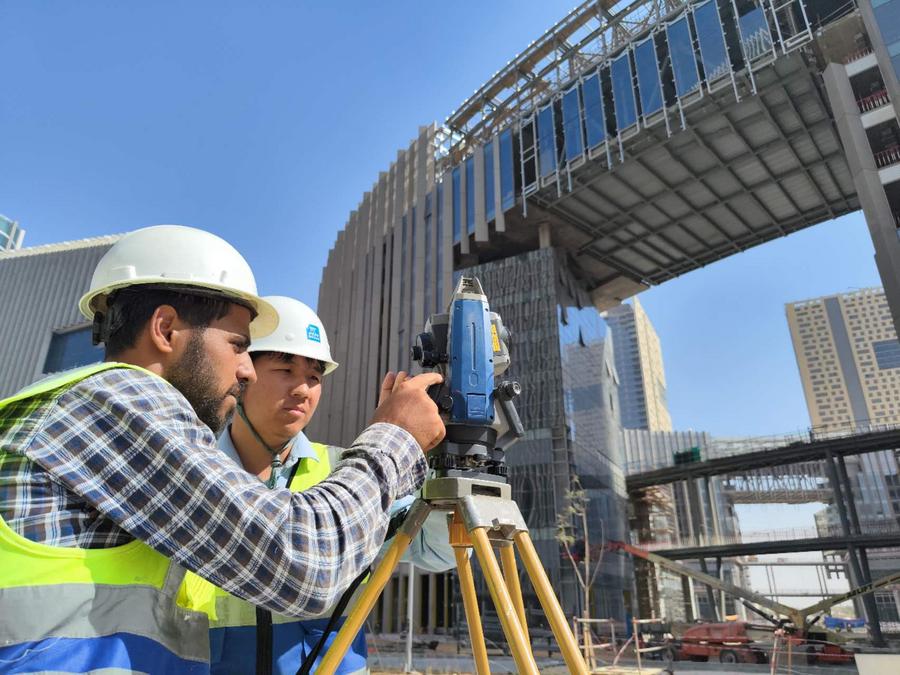
Egypt is home to huge BRI engineering projects, including major power plants and a new Canal Economic Zone for industry, trade and logistics. Egypt's New Administrative Capital, now being created in the desert east of Cairo, will house 6.5 million people in skyscrapers projected to be among the tallest buildings in Africa. These projects support Egypt's national development plan targeted for completion in 2030.
Breaking with America's laissez-faire doctrine of modernization through private investment and market forces, China has integrated its BRI projects with the national development plans of other Middle Eastern governments, including Saudi Arabia's Vision 2030, Oman's Vision 2040 and Morocco's Emergence plans. China has also supported several Arab governments in developing port infrastructure and coastal economic zones, and improving logistics and supply chains.
The West never built anything on the scale of the BRI projects. Indeed, in physical terms, only the architectural monuments of the ancient empires in Egypt — the Ptolemies, Romans, Arab dynasties and Ottomans — are comparable. And those ancient monuments were built over centuries, not in a decade or two.
But soft power achieves its persuasive influence over hearts and minds — not physically, but gradually through countless human interactions. After two centuries, the cultural impression of the West remains strong in the Middle East. China's soft power faces formidable cultural competition from the English language, Western ideas about economics and politics, and long habits of interaction between Western and Arab elites.
People-to-people connectivity, identified by President Xi as a primary BRI goal, will add to China's soft power by producing mutually profitable deals between Chinese and Arab businesses. He also emphasized the importance of cultural mutual respect and mutual learning.
Today, however, both Chinese and Arab commercial elites are largely ignorant of the other society, either its historic achievements or its contemporary culture. Chinese-Arab business — indeed the whole Chinese-Arab relationship — will never achieve its potential until that deep cultural divide is bridged.
The future of China's soft power in the region depends on Chinese and Arabs getting to know one another better, and more fully understanding each others' lives, hopes and struggles. It will be decided by individual Chinese and Arabs discovering mutual goals as they talk, work and play together.
The author is a former senior Egyptian diplomat, most notably as consul general to London and Hong Kong and ambassador to Slovakia.