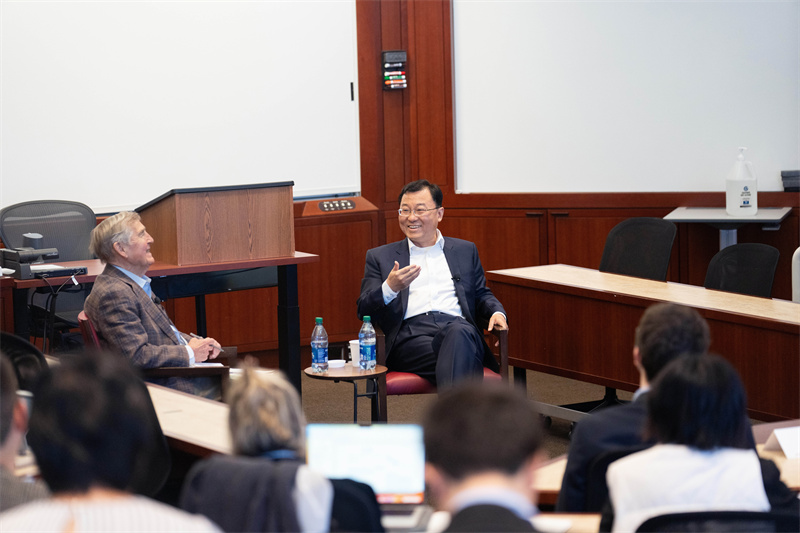
Ambassador Xie Feng had a fireside chat with Founding Dean of Harvard Kennedy School Prof. Graham Allison







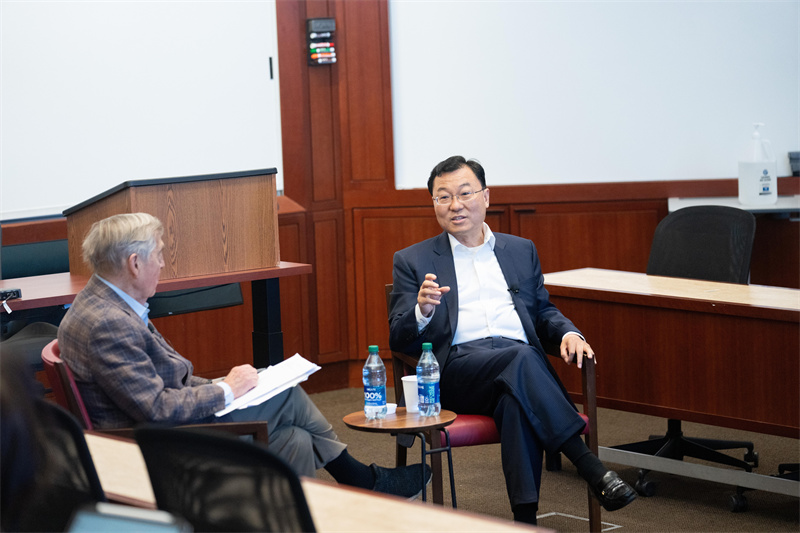
On April 19, 2024, Chinese Ambassador to the United States Xie Feng visited Harvard University and had a fireside chat with Founding Dean of Harvard Kennedy School Prof. Graham Allison. Ambassador Xie elaborated on China's policies and position on how China and the United States can leap over the "Thucydides Trap", cooperation and competition between the two countries, Belt and Road cooperation and other issues.
Ambassador Xie pointed out that as the world's most important bilateral relationship, the China-US relationship is facing unprecedented challenges. Whether the younger generation can continue to enjoy the eight-decade-long peace and development as their parents did depend largely on whether China and the United States can find the right way to get along in the new era. In this globalized world, countries are not riding separately in some 190 small boats, but are sailing in one giant ship, sharing the same future. Only by pulling together can we find a way out, while pulling apart will only get us all drowned.
China's choice is clear and firm: We will advance national rejuvenation through a Chinese path to modernization at home, and promote world peace and development through building a community with a shared future for mankind internationally. Now that we have all realized the extreme danger of the "Thucydides trap", why should we still jump headlong into it? From the very start, China does not see the "Thucydides trap" as inevitable. We are willing to work with the US side based on the principles outlined by President Xi Jinping, namely, mutual respect, peaceful coexistence and win-win cooperation, to promote the sound, steady and sustainable development of China-US relations, and jointly navigate around the trap. Is the US side also ready to do so?
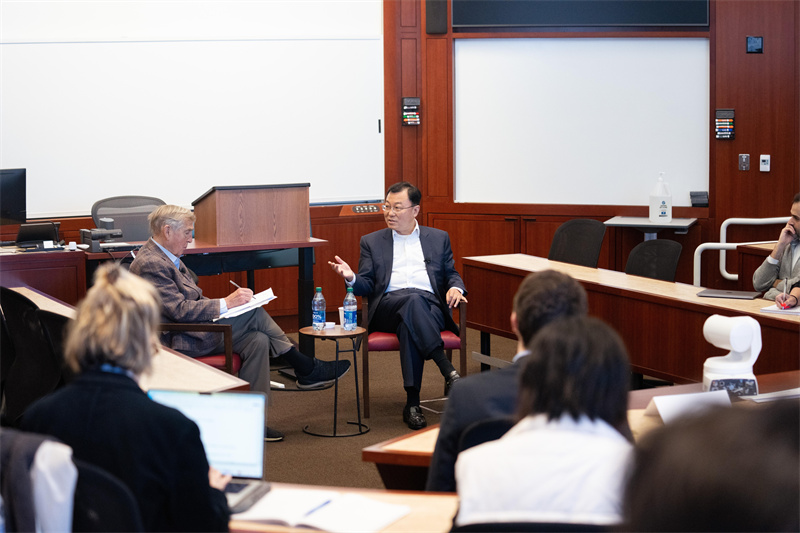
Ambassador Xie said that the historic summit between President Xi Jinping and President Joe Biden in San Francisco last November has not only injected stability into the bilateral relationship, but also formed a future-oriented "San Francisco vision". Since the meeting, the two sides have maintained interactions at various levels, and conducted dialogue and cooperation in areas including foreign policy, economy and trade, law enforcement, agriculture, and mil-to-mil relations. On the fentanyl issue and other issues of concern to the US side, China has fully shown its sincerity for cooperation. But dialogue and cooperation should be reciprocal and based on mutual respect, and one cannot focus on their own interests in the process. It is hoped that the US side will take earnest actions to implement the two Presidents' important consensus on issues of concern to the Chinese side. For instance, the two Presidents agreed that the two sides should hold consultations on national security boundaries. The two sides did start such consultations, but little progress has been made over the past six months. Although the US side agreed on holding such consultations in principle, it is reluctant to go into detailed discussions. And when pressed, it would just claim "national security is not negotiable". This is not a responsible attitude.
From traditional fields such as economy, trade and agriculture, to new areas such as climate change and artificial intelligence, China and the United States have extensive common interests and room for mutually beneficial cooperation. The two sides should advance cooperation in a reciprocal spirit, and prudently manage differences, so as to turn the "San Francisco vision" into reality, and promote the sound, stable and sustainable development of China-US relations.
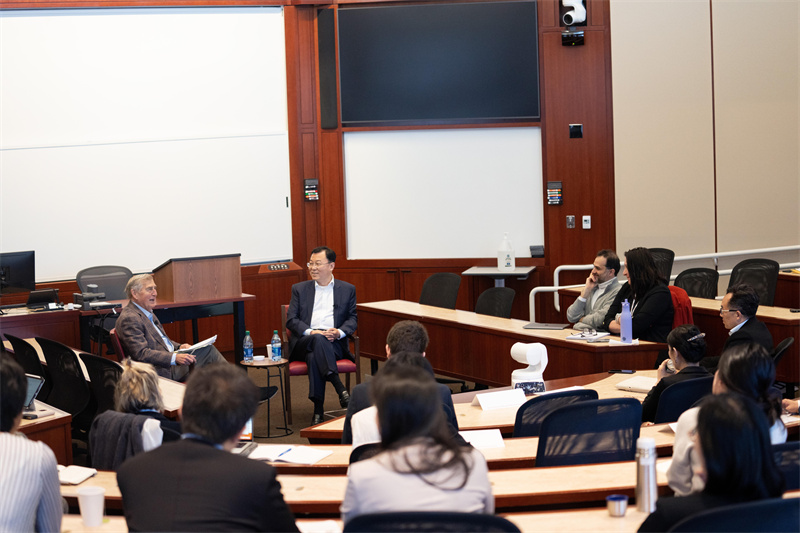
Ambassador Xie noted that there is indeed competition between China and the United States. The Chinese people do not shy away from competition, but any competition must be fair. It should be like competing for excellence in a racing field, not beating one another in a wrestling ring. What the US side is having in mind, though, is not competition, but bullying. By slapping sanctions on Chinese companies according to its own domestic law, the US side is basically keeping Chinese players out of the game even before it starts. The US side has also forced other countries to ban exports of certain devices and technologies to China, for instance, lithography machines. This is just like asking others to run barefooted or on straw slippers while one wears high-tech track shoes in a race. But even when barefooted, some top Chinese players, such as producers of electric vehicles, lithium-ion batteries and photovoltaic products, have managed to take the lead. The US side, however, then accuses them of being "overcompetent", causing "overcapacity" and posing a threat to other contestants, demanding they quit the game. This is not fair.
Competition is not the entirety of the China-US relationship, as the two countries have cooperation in many areas. The relationship should not be simply defined by competition. If we allow competition to dominate China-US relations, it would only give rise to strategic risks. No one would come out as a winner.
It would be self-deluding to suppress and encircle China in the name of competition on one hand, and try to manage competition and avoid direct conflict on the other. If we only aim at the minimum goal of avoiding conflict in China-US relations, then we would not be far away from going into one. This is like racing cars on a cliff's edge, where conceited drivers are most likely to end up falling into the abyss below. No amount of guardrails would be enough to put a floor under the relationship then.
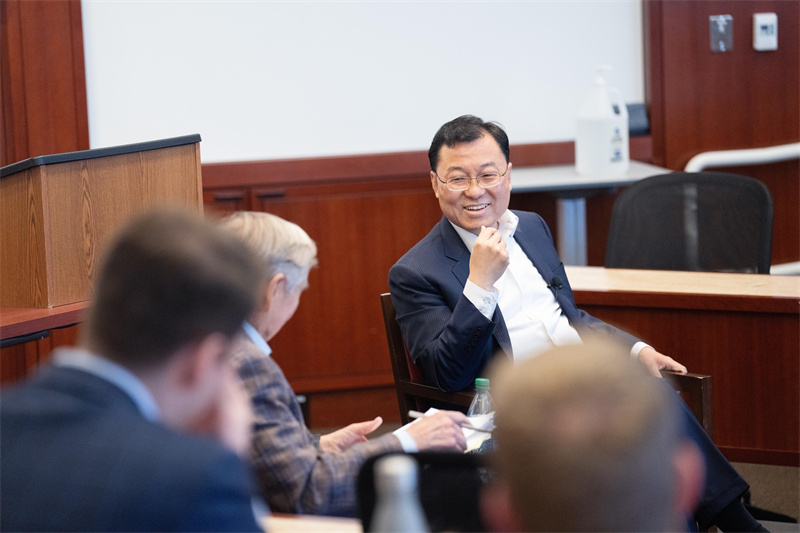
When responding to a question on the Belt and Road initiative (BRI), Ambassador Xie said that China has always adhered to the principle of extensive consultation, joint contribution and shared benefits in advancing Belt and Road cooperation, so as to facilitate the revitalization of all countries and inject momentum into common development. The BRI is not a geopolitical tool, but a widely popular global public good. Instead of being intended for bloc confrontation, it is an open and inclusive platform for international cooperation. Citing the success of the Jakarta-Bandung high-speed railway, Ambassador Xie stressed that the fruitful outcomes of Belt and Road cooperation have proven again that high-quality industrial capacity is not excessive globally, and can generate more effective demands and boost economic growth. The facts have debunked those narratives smearing and spreading doom and gloom about the initiative. Ambassador Xie said that the obsession with hegemony is not in China's DNA. China is neither Athens nor Sparta. Assuming China would surely tread the old path taken by traditional Western powers is a serious miscalculation, and those believing "strength determines the intention" are basically imposing their mindset on others. China will always be a member of the developing world, and is ready to share development dividends with other countries.?
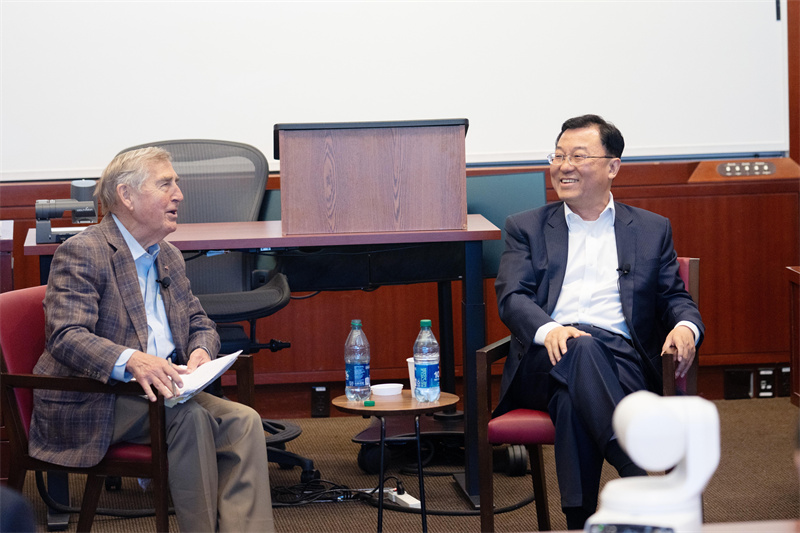
Ambassador Xie also stated China's position on the anti-espionage law, China's nuclear policy and China-US economic ties. He stressed that legislating on national security is a common practice internationally. In enacting relevant legislation, China also drew on the experience of other countries. Foreign nationals have no reason to worry about their security as long as they abide by the law in China. On China's nuclear policy, he pointed out that China is firmly committed to a self-defensive nuclear strategy. China has pledged not to use nuclear weapons first, and follows a policy of not using or threatening to use nuclear weapons against non-nuclear-weapon States and nuclear-weapon-free zones unconditionally. It stands for the complete prohibition and thorough destruction of nuclear weapons worldwide. On China-US economic and trade relations, Ambassador Xie stressed that such ties are essentially mutually beneficial. A trade war serves no one's interests. Ultimately, American consumers will pay the cost, American businesses will suffer losses, the international economic and trade order and global industrial and supply chains will be rattled, and the global recovery will be dragged down.