



Manila violates DOC on Ren'ai Reef







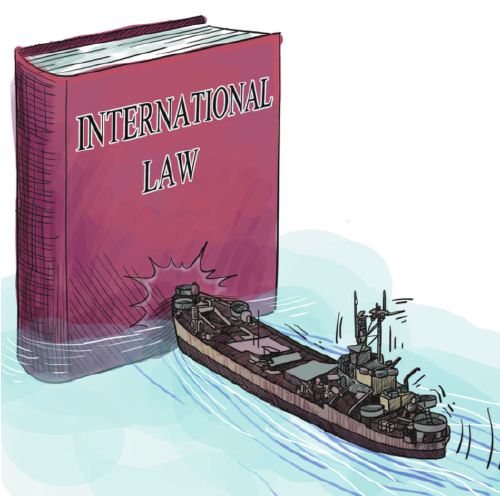
The Philippines has been creating trouble on Ren'ai Jiao in the South China Sea. On Feb 2, the China Coast Guard monitored and tracked the Philippine civilian vessel that delivered supplies to a military vessel illegally "grounded" at China's Ren'ai Jiao, or Ren'ai Reef. And on Monday the CCG legally drove away a Philippine Coast Guard vessel which intruded into the waters.
On Dec 29, the spokesperson for the Armed Forces of the Philippines, Medel Aguilar, said the Philippine government is considering building a permanent civilian structure — a lighthouse or a marine science research center — on Ren'ai Jiao in the South China Sea, heightening tensions in the South China Sea. Chinese Foreign Ministry spokesperson Mao Ning responded on the same day, asserting that Ren'ai Jiao "is part of China's Nansha Qundao", and China has "indisputable sovereignty over Nansha Qundao (Nansha Islands), including Ren'ai Jiao, and their adjacent waters".
Also, China has consistently held that the 2016 Arbitral Tribunal award is null and void, and never accepted the claim that Ren'ai Jiao is part of the Philippines' exclusive economic zone or continental shelf.
We have to trace the origin of the dispute over Ren'ai Jiao to determine whether the real dispute is about territorial sovereignty. In 1999, when the Philippines intentionally grounded BRP Sierra Madre on Ren'ai Jiao, every state took this as "a unilateral action to assert sovereignty over the Spratlys". This was confirmed on Aug 7, 2023, by then Philippine Foreign Affairs spokesperson Teresita Daza. She said the Philippines "decided to deploy a permanent station on Ayungin Shoal (the Philippines' name for Ren'ai Jiao) in 1999", and maintain it as "a permanent station".
Besides, according to media reports, Philippine Coast Guard spokesman Jay Tarriela said Sierra Madre is "the symbol of Philippine sovereignty in the area".
It is thus clear that the Philippines intended to occupy Ren'ai Jiao and claim it as part of its territory in 1999, for which it intentionally grounded Sierra Madre on the reef. It used the illegal "grounding" to establish its permanent presence on the reef, and back its claim by building either a permanent military station or civilian infrastructure there.
When China demanded that the grounded ship be removed, then Philippine "president (Joseph) Estrada promised to tow it away as soon as it could be safely floated off the reef". When China and members of the Association of Southeast Asian Nations negotiated on the Declaration on the Conduct of Parties in the South China Sea (DOC) from 1997 and eventually signed it in 2002, Ren'ai Jiao was not inhabited because Sierra Madre was a grounded ship (no matter intentionally or unintentionally) and Manila had promised to tow it away.
Importantly, Paragraph 5 of the DOC uses the term "inhabit"/"uninhabited" instead of "occupy"/"unoccupied". The wording reveals the understanding (and acceptance) of the 11 parties that Ren'ai Jiao was not an inhabited feature in the South China Sea, to maintain the uninhabited status of the feature and prohibit any activities that would turn the reef into a permanent maritime base.
Para 5 represents the fundamental commitment of the 11 parties to the DOC that vowed to observe and respect the stance. Over the past more than 20 years, China and the ASEAN members have together, and in good faith, implemented Para 5, which has played a key role in maintaining peace and stability in the region. In fact, Para 5 is the cornerstone of the regional rules for maintaining peace and stability.
But in August last year, the Philippines announced a change of plan and declared that it intends to build a permanent military base or civilian infrastructure on Ren'ai Jiao. Manila's decision is an attempt to turn Ren'ai Jiao into an inhabited feature, which is a clear breach of the commitments it has made in the DOC. This will complicate issues and escalate tensions.
For some time now, China and ASEAN members have been holding talks on the Code of Conduct for the South China Sea on the basis of effective and full implementation of the DOC. And by violating the DOC, the Philippines will pollute the good environment of the COC consultation and thus undermine the joint efforts of ASEAN and China to maintain peace and stability in the region.
Manila's decision to build civilian infrastructure is an attempt to turn Ren'ai Jiao into an inhabited reef. This will complicate issues and escalate disputes. Over the past more than 20 years, the ASEAN members and China have managed disputes through self-constraint, consultations and cooperation.
At the regional level, China and the ASEAN members have agreed on the DOC. And at the bilateral level, China and the Philippines have adhered to good practices in the past. For example, the Bilateral Consultative Mechanism, the joint working group on many cooperation issues including oil and gas exploration and exploitation, and fishing. China and the Philippines have also had a "gentlemen's agreement" on managing disputes at sea. These joint efforts between the two sides stopped after Manila's provocative activities in 2023.
Therefore, the only possible way out of this problem is to not play tricks and, instead, resolve the sovereignty and maritime disputes in good faith, and maintain peace and stability in the region. This "dual-track approach" is also what China and the ASEAN members agreed on.
As Chinese Foreign Minister Wang Yi has said, China remains committed to resolving differences through dialogue and consultation so as to maintain maritime stability, noting that this is an effective way for the neighbors to get along with each other and improve Beijing-Manila relations.
The author is a professor of law at Wuhan University.
The views don't necessarily reflect those of China Daily.
If you have a specific expertise, or would like to share your thought about our stories, then send us your writings at opinion@chinadaily.com.cn, and comment@chinadaily.com.cn.





