


Home, home on the vast Chinese range







Editor's note: China Daily presents the series Friends Afar to tell the stories of people-to-people exchanges between China and other countries. Through the vivid narration of the people in the stories, readers can get a better understanding of a country that is boosting openness.
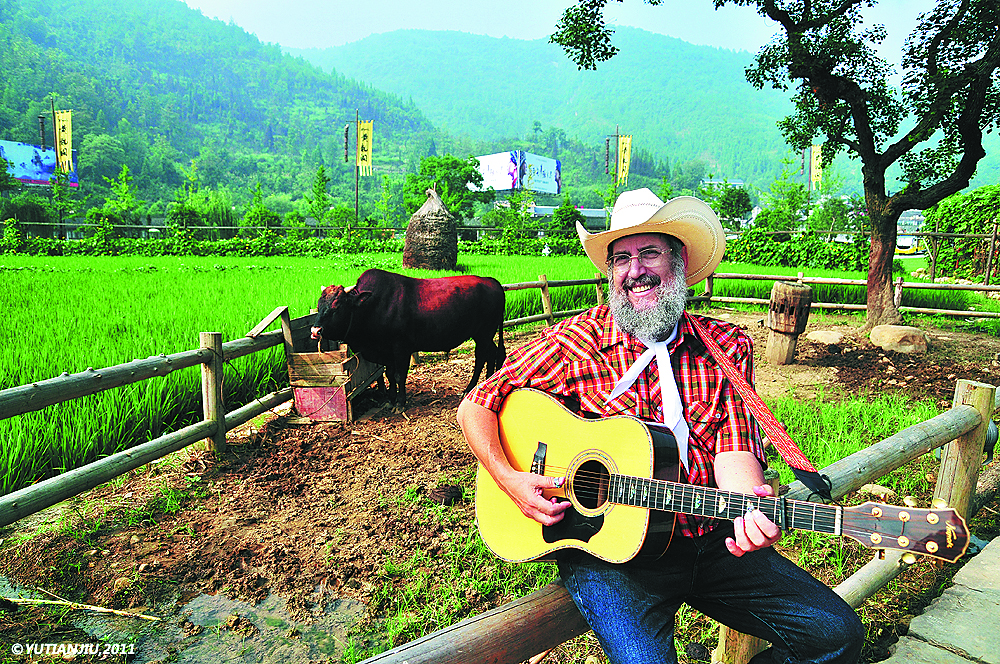
"Dare to ask where the road is". That is the English title of one of 75-year-old Mark Levine's favorite Chinese songs, Gan Wen Lu Zai He Fang, which was also the theme song for the 1986 Chinese TV series Journey to the West.
The strange thing is that if Levine had ever dared to ask himself about where life's road might take him, the answer would have put him on a trajectory in exactly the opposite direction — to the east.
Moreover, when he decided to take up a one-year work contract in China in 2005, he would not have imagined that he would spend the next quarter of his life there.
Levine's favorite song recounts the story of the gritty determination of monk Xuanzang. He headed to ancient India on a mission during the Tang Dynasty (618-907) to obtain the Buddhist sutras.
"If I'm invited to sing only one song, it's always that song," said Levine, a singer, composer and teacher from the United States. "If I can sing more than one song, that's almost always the first one."
Levine's journey to the east that turned into an odyssey and ultimately a stay of almost 20 years began in Huai'an, Jiangsu province. As his one-year contract as a college English teacher neared its end, Levine, like Xuanzang, seemed to find a missionary zeal, and he decided he was not going home.
"One of the reasons was that I found many people, especially young students, had little understanding of the US. They thought everybody in the US was very rich," Levine said.
He said he was interested in why this misunderstanding existed and how to correct it.
Just as plenty of Chinese people barely understand the US, Levine himself had a lot to learn about China. As he did so over the next 19 years, he decided to put that learning into music.
"When I started writing my songs, I took the music style I was most comfortable with — the American country music — and attached it to a subject that I was just learning about and experiencing," said Levine, who grew up in Los Angeles and learned to play the guitar when he was 9.
Soon, an innovative, quirky blend of Chinese folk music and Western country music compositions and arrangements made their debut.
"One of my songs describes a 24-hour train journey. It was after Spring Festival and people were grumpy because they had to go back to work," Levine said.
"I've also written songs about my friend Fu Han's hometown in Hubei province. I saw the fireworks there and farmers were busy preparing meals for Spring Festival.
"All these are real. My songs are based on my experiences rather than on make-believe."
Fu, a musician and director, is not only Levine's friend, but also his agent and partner of the music duo In Side Out.
In 2007, Levine began teaching at the Minzu University of China in Beijing, where he met Fu, who plays the two-stringed instrument erhu and introduced him to Chinese folk music.
"One day, it occurred to me that I could play erhu with him, combining two different music styles," Fu said. "Erhu has a beautiful sound similar to that of the violin, and it goes well with the rhythm of the guitar."
In Side Out's first performance was a folk song, Masangshu'er Da Dengtai of the Tujia ethnic group, during the Zhangjiajie International Country Music Week in Hunan province in 2013.
"We sang the song in Tujia dialect while playing the guitar and erhu. Many musicians from other countries were fascinated and asked me what the song meant," Fu said.
Masang and dengtai are two kinds of trees that always grow with one another, and they symbolize love for the people of the Tujia ethnic group.
The song is about a young man who is about to go into battle and he persuades his girlfriend to marry another man. However, the young woman decides to wait for his return from battle.
"The audience was unfamiliar with the lyrics, but this story of eternal love really touched them," Fu said.
The success encouraged the duo. Their performances are usually a combination of Chinese songs and Levine's country creations. Levine said one thing that US country music and Chinese folk music have in common is that both tell stories.
What it really is like
Levine has also written books that illustrate his life in China. In Stories from My Chinese Journey published in 2014, and Singing My China Stories to the World published in 2021, he wrote so as to tell those unfamiliar with the country about what it really is like.
Levine's friends back home like his stories. They feel that what they know about China is incomplete and are eager to get a different perspective from his books, he said.
One of the misconceptions relates to the Uygur people, he said. He was able to gauge for himself how things really are when he visited Kashgar, Xinjiang Uygur autonomous region, in August and September.
"I visited a kindergarten and listened to various classes. There were two teachers in each classroom, one speaking Mandarin and the other Uygur. You could see there were Han children in the class learning Uygur. China is not destroying minority languages and culture," Levine said.
Regarding misunderstandings between China and the US, Levine said that while Chinese and US people are different in many ways, they have the same values and concerns deep down.
"We all want to have a good life for ourselves and families, a good life in a peaceful world where we have work to do, a decent place to live, sufficient food and access to medical care and education," he said.
Levine said he will spend the rest of his life in China, continuing to teach, write and sing.
wangxiangyan@chinadaily.com.cn





