



Chinese philosophy distinct from the West







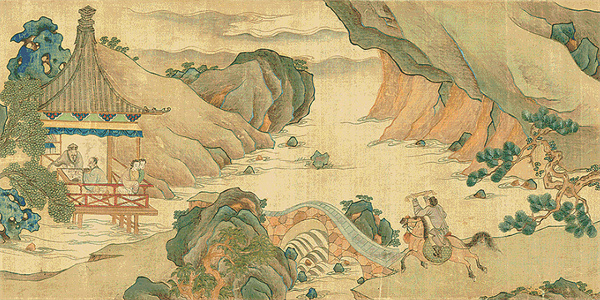
Chinese culture has a rich history of 5,000 years. It is closely linked to the Chinese language, and facilitated the emergence of Chinese literature, and documentation in the form of written records and printed books. Books are closely linked to the rise and fall of a culture. Even in the downfall of a society, the historical facts are recorded in writing in order to provide posterity with the evidence of the achievements, failures and the reasons for the downfall of that society.
Chinese culture is unthinkable without these written testimonies, which are not only cultural expressions of self-assurance and representation but also artifacts of self-reflection. Literature and culture therefore have a relationship of reference.
Chinese culture owes its raison d'être primarily to three main philosophies, Confucianism, Taoism and Buddhism, all of which could be considered to have gone through five phases.
The earliest phase can be traced to before the unification of China and was primarily concerned with social issues. In the second phase, the worldview was primarily to make projections for consideration, while the third phase had an ontological approach that dealt with the being, the I. The fourth phase was concerned with idealism, which is the diametrically opposite of materialism, realism and empiricism. In the European context, Plato and Descartes are worth mentioning, because they accord fullness to the being to ideas.
The fifth and last phase is characterized by gnoseology, which deals with questions about the prerequisites for knowledge, and how knowledge is acquired. In addition, the truthfulness of certainty and justification are questioned and doubts raised about certain desirable beliefs. This still continues, although Confucianism is placed alongside it because it is constitutive of China's identity and culture today.
The duality of learning according to Confucius' concept is still valid today, because it means "learning for others" and "learning for yourself", meaning one cannot do without the other. Only through learning can ren, which means something like "thoughtfulness" and the difference between humans and animals, be determined.
No wonder many countries have agreed to set up Confucius Institutes whose main task is to promote the concept of learning from each other and create space for fruitful cultural exchanges, which, first of all, requires overcoming foreignness by transferring what is foreign into what is familiar so that one can enrich oneself by what is foreign.
Unfortunately, there still exists a tendency in many to trivialize the foreignness of other cultures, including Chinese ones, so that the foreign is subsumed under an universalistic model of humans in general, making it quite difficult to deny a Euro-American-centric perspective.
The philosophy of alterity is of crucial importance in this context, as one must assume that the fundamental "givenness" of human existence and the response to the other is a prerequisite for the constitution of one's own, the I.
Palestinian academic and literary critic Edward Said made an important contribution to the understanding of post-colonial culture with his book Orientalism: Western Conceptions of the Orient. The orient here includes China. Said sparked an important discussion by criticizing the perspective of culture and images of the other in the European-American cultural space. He was against the binary opposition: positive/negative, which Georg Wilhelm Friedrich Hegel also advocated in the case of China. In his eyes, this is an unacceptable, distorted perception of others and their cultures that needs to be changed.
An equal dialogue among all cultures, especially the extremely demanding Chinese culture, is not only important but also necessary, because we have to realize that European-American culture, together with the cultures of other industrialized countries, still dominate the global discourse.
The history of humanity shows that the flowering of one culture sometimes went hand in hand with the rejection of other cultures, especially as a separation of one from the others, as was the case with the Greeks and Romans. This culture was often forced upon others through open colonization to prove the superiority of one set of people and culture over other peoples and cultures, leading to economic and military oppression of peoples of what today can be called the Global South.
Cultural exchanges can help promote harmony and peace between peoples, because regardless of the ethnicity, language, culture, history, customs and social conditions, the mere existence of a person is constitutive of self. As Aristotle said: "A unity must derive from a multitude."
The author is a professor at Hainan College of Foreign Studies. The views don't necessarily reflect those of China Daily.
If you have a specific expertise, or would like to share your thought about our stories, then send us your writings at opinion@chinadaily.com.cn, and comment@chinadaily.com.cn.





